
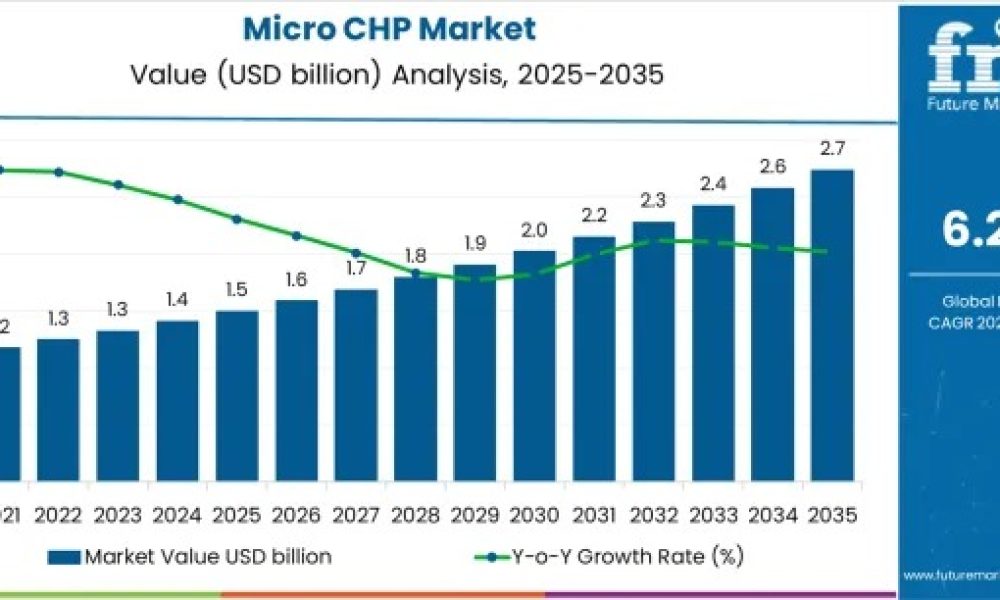
Global Micro CHP Market Set for Strong Growth
The global Micro CHP Market is expected to expand from USD 1.5 billion in 2025 to USD 2.7 billion by 2035, achieving an 80% increase in value over the forecast period. Growth is driven by decarbonization policies, increasing energy efficiency mandates, and the adoption of hydrogen-ready systems that enhance building resilience, reduce energy costs, and enable reliable distributed generation in residential, commercial, institutional, and light industrial applications.
Request For Sample Report | Customize Report | Purchase Full Report–
Market Growth Phases
From 2025 to 2030, the micro CHP market will grow from USD 1.5B to USD 2.0B, accounting for nearly 42% of the ten-year forecast growth. This period is expected to be shaped by rising adoption of fuel cell micro CHP systems, increased hydrogen-ready solutions, and expanding residential and commercial deployment to meet decarbonization goals and energy security requirements.
Key Drivers (2025–2030):
- Rising building decarbonization initiatives
- Growth in fuel cell micro CHP adoption
- Expansion of hydrogen-ready system deployment
Between 2030 and 2035, the market will grow an additional USD 0.7B, driven by smart grid integration, hydrogen blending capabilities, renewable gas infrastructure, and advanced monitoring technologies enabling predictive maintenance and energy optimization across distributed generation systems.
Key Drivers (2030–2035):
- Hydrogen blending and pure hydrogen operation
- Smart grid connectivity and vehicle-to-home integration
- Adoption of digital monitoring and predictive maintenance
Leading Market Segments
The 2-10 kW capacity segment leads the micro CHP market, providing optimal sizing for residential and small commercial buildings while delivering both heat and power efficiently. Natural gas and LPG dominate the fuel mix due to widespread availability and established infrastructure. Residential applications maintain the highest share, but small commercial and institutional buildings are rapidly adopting micro CHP systems to meet sustainability and energy cost reduction objectives.
Segment Highlights:
- Capacity: 2–10 kW holds 45% share
- Fuel: Natural gas & LPG represent 68% of demand
- End-Use: Residential (56%), Small Commercial (28%), Public/Institutional (9%), Light Industrial (7%)
Regional Insights
The micro CHP market is growing globally, with the United States leading at a 6.5% CAGR, supported by natural gas infrastructure and residential energy resilience programs. South Korea, Japan, and the United Kingdom follow closely, driven by hydrogen economy roadmaps, smart city projects, and boiler replacement initiatives. Germany and Italy emphasize municipal and SME cogeneration, tax incentives, and HORECA sector adoption, while the Netherlands focuses on district-level hydrogen blending pilots.
Key Regional Growth:
- United States: 6.5% CAGR – residential resilience and gas infrastructure
- South Korea: 6.4% CAGR – hydrogen economy and smart cities
- Japan: 6.2% CAGR – ENE-FARM continuity and hydrogen blending
- United Kingdom: 6.1% CAGR – boiler replacement and retrofits
- Germany: 5.8% CAGR – municipal & SME programs
- Italy: 5.6% CAGR – retail & HORECA adoption
- Netherlands: 5.5% CAGR – gas transition and hydrogen pilots
Competitive Landscape
Micro CHP manufacturers are focusing on hydrogen-ready systems, fuel cell efficiency, and smart integration platforms. Viessmann Group leads with a 19% market share in Europe, offering hydrogen-ready micro CHP systems. Other key players include BDR Thermea, Yanmar Holdings, AISIN, Panasonic, Vaillant, Bosch Thermotechnology, Ceres Power, SolidPower, and Qnergy, all driving innovation in distributed generation technologies to support residential, commercial, and institutional energy needs.
Key Players:
- Viessmann Group – hydrogen-ready solutions
- BDR Thermea Group – UK & Netherlands trials
- Yanmar Holdings – 5–10 kW gas micro CHP
- AISIN & Panasonic – residential fuel cells in Japan
- Vaillant & Bosch – distributed energy systems
- Ceres Power, SolidPower, Qnergy – fuel cell & Stirling systems
Market Drivers and Trends
The market is fueled by increasing energy efficiency mandates, decarbonization policies, and demand for distributed energy solutions. Hydrogen-ready technologies and renewable gas integration are creating long-term growth opportunities. Smart grid connectivity, predictive maintenance, and vehicle-to-home integration further support residential and commercial adoption while improving operational efficiency and reducing carbon footprints.
Trends and Innovations:
- Hydrogen-ready and fuel-flexible micro CHP systems
- Smart grid and demand response integration
- High-efficiency fuel cell development and cost reduction
- Predictive maintenance and remote monitoring
Get data that aligns with your strategic priorities — ask for report customization today:
Have a specific Requirements and Need Assistant on Report Pricing or Limited Budget please contact us – [email protected]
About Future Market Insights (FMI)
Future Market Insights, Inc. (FMI) is an ESOMAR-certified, ISO 9001:2015 market research and consulting organization, trusted by Fortune 500 clients and global enterprises. With operations in the U.S., UK, India, and Dubai, FMI provides data-backed insights and strategic intelligence across 30+ industries and 1200 markets worldwide.
Contact Us:
Future Market Insights Inc.
Christiana Corporate, 200 Continental Drive,
Suite 401, Newark, Delaware – 19713, USA
T: +1-347-918-3531



