
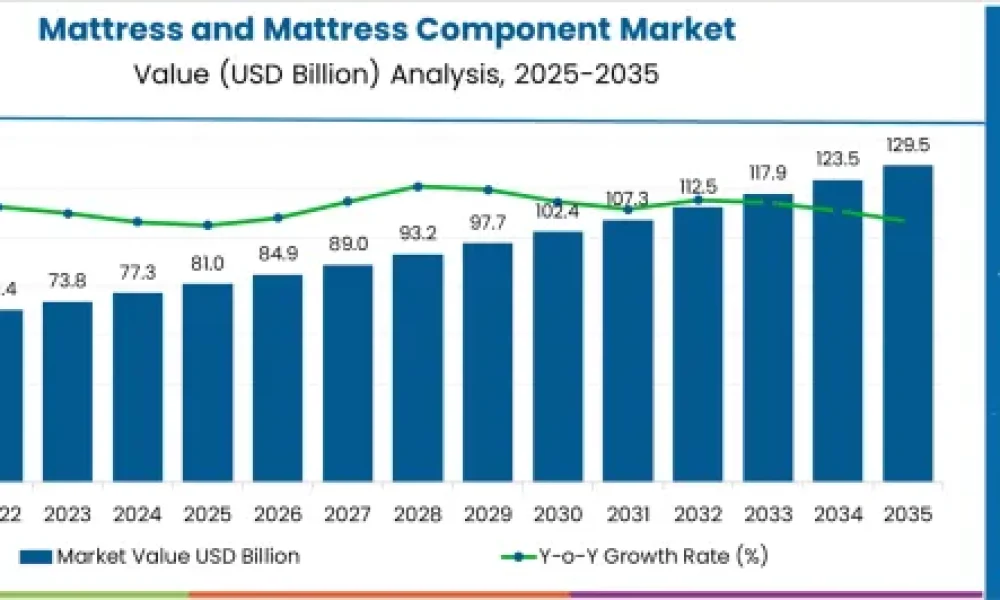
The global Mattress and Mattress Component Market is projected to grow from USD 81.0 billion in 2025 to USD 129.5 billion by 2035, registering a compound annual growth rate (CAGR) of 4.8% over the forecast period. The outlook reflects a mature yet resilient industry, characterized by predictable replacement cycles, rising awareness of sleep health, and sustained demand for premium and hybrid mattress formats across residential and commercial segments.
Year-over-year growth is expected to remain consistently between 4.6% and 4.9%, underscoring long-term stability rather than cyclical volatility. Annual market additions are forecast to rise from approximately USD 4.1 billion in the early years of the forecast to nearly USD 6.0 billion by the later years, highlighting dependable demand momentum across developed and emerging economies.
Access detailed data tables and actionable market insights — Request Your Sample Report Now
Market Context: A Stable, Replacement-Driven Industry with Premium Upside
The mattress and mattress component industry serves as a foundational segment within the global home furnishings and wellness ecosystem. Demand is primarily supported by routine replacement behavior, expanding urban housing stock, and increasing consumer willingness to invest in comfort-driven and health-oriented sleep products.
Heightened focus on ergonomic support, pressure relief, and sleep quality has shifted consumer preference toward advanced mattress technologies, particularly foam-based and hybrid designs. At the same time, strong retail networks and accelerating e-commerce penetration, including direct-to-consumer models, have expanded accessibility and price transparency, supporting consistent volume growth.
Key Market Highlights and Segmentation Trends
- In 2025, foam mattresses are expected to account for 2% of total market revenue, making them the leading product category. Their ability to conform to body contours, reduce motion transfer, and support spinal alignment continues to resonate with consumers across age groups. Advancements such as memory foam and gel-infused variants have further strengthened this segment’s appeal by improving temperature regulation and durability.
- From a materials perspective, foam components are projected to hold 8% of mattress component revenue in 2025. Manufacturers increasingly favor foam for its lightweight properties, design flexibility, and adaptability across firmness levels. Growing adoption of eco-certified and low-emission foams is also shaping procurement and product development strategies.
- By size, king-size mattresses are forecast to represent 5% of global revenue in 2025, reflecting consumer preference for spacious sleep environments. Larger bedroom layouts, premium bedroom furniture trends, and lifestyle-driven purchasing decisions among couples and families continue to support this segment’s dominance.
Growth Drivers Shaping the Market Outlook
Several structural factors are driving sustained expansion of the mattress and mattress component market:
- Premium comfort and wellness orientation: Rising awareness of posture-related issues and sleep disorders has increased demand for orthopedic, ergonomic, and hybrid mattresses, particularly in urban and higher-income households.
- Digital retail expansion: Online channels, including bed-in-a-box models, have reshaped purchasing behavior by offering convenience, competitive pricing, and extensive product comparison, intensifying competition while broadening consumer reach.
- Material and design innovation: Continuous advancements in foam formulations, cooling layers, latex blends, and modular components are enhancing product differentiation and extending replacement cycles.
- Health-driven purchasing decisions: Mattresses are increasingly viewed as wellness investments rather than discretionary furniture items, supporting premiumization across multiple demographics.
Regional and Country-Level Growth Dynamics
Regionally, North America, Asia-Pacific, and Europe remain the primary growth engines. Asia-Pacific leads in growth rate, driven by housing development, rising disposable incomes, and expanding domestic manufacturing bases.
- China is projected to record a 6.5% CAGR from 2025 to 2035, supported by luxury and hybrid mattress adoption, competitive domestic production, and growing integration of smart bedding features.
- India is expected to grow at a 6.0% CAGR, fueled by middle-class expansion, deeper penetration of branded retail, and rising demand for orthopedic and memory foam solutions.
- France is forecast to achieve 5.0% CAGR, reflecting strong preference for luxury and eco-certified bedding products, alongside hospitality sector investments.
- The United Kingdom is projected to grow at 4.6% CAGR, driven by e-commerce dominance and demand for compact, ergonomic designs.
- The United States, a mature market, is expected to post 4.1% CAGR, supported by digital-first retail strategies, premium foam expansion, and steady replacement demand.
Competitive Landscape and Industry Positioning
The competitive environment includes a mix of global manufacturers, component suppliers, and digitally native brands. Tempur Sealy International and Serta Simmons Bedding maintain strong positions through diversified portfolios and global distribution. Ashley Furniture Industries leverages extensive retail reach, while Leggett & Platt plays a critical role as a leading component supplier.
Direct-to-consumer brands such as DreamCloud, Helix Sleep, and Saatva continue to gain traction through online-first strategies, while Sleep Number Corporation differentiates through adjustable and smart bed technologies. Luxury-focused players, including Hästens and Stearns & Foster, address high-end demand driven by craftsmanship and premium materials.
Outlook Through 2035
Overall, the mattress and mattress component market is expected to maintain steady, long-term growth through 2035. Predictable replacement cycles, continued innovation in materials and design, and the integration of wellness-driven features position the industry for sustained relevance. As consumer perception of sleep quality evolves, mattresses are likely to remain a resilient, demand-stable category within the global furnishings and health-oriented consumer goods landscape.
Have a specific Requirements and Need Assistant on Report Pricing or Limited Budget please contact us – [email protected]
About Future Market Insights (FMI)
Future Market Insights, Inc. (FMI) is an ESOMAR-certified, ISO 9001:2015 market research and consulting organization, trusted by Fortune 500 clients and global enterprises. With operations in the U.S., UK, India, and Dubai, FMI provides data-backed insights and strategic intelligence across 30+ industries and 1200 markets worldwide
Why Choose FMI: https://www.futuremarketinsights.com/why-fmi



