
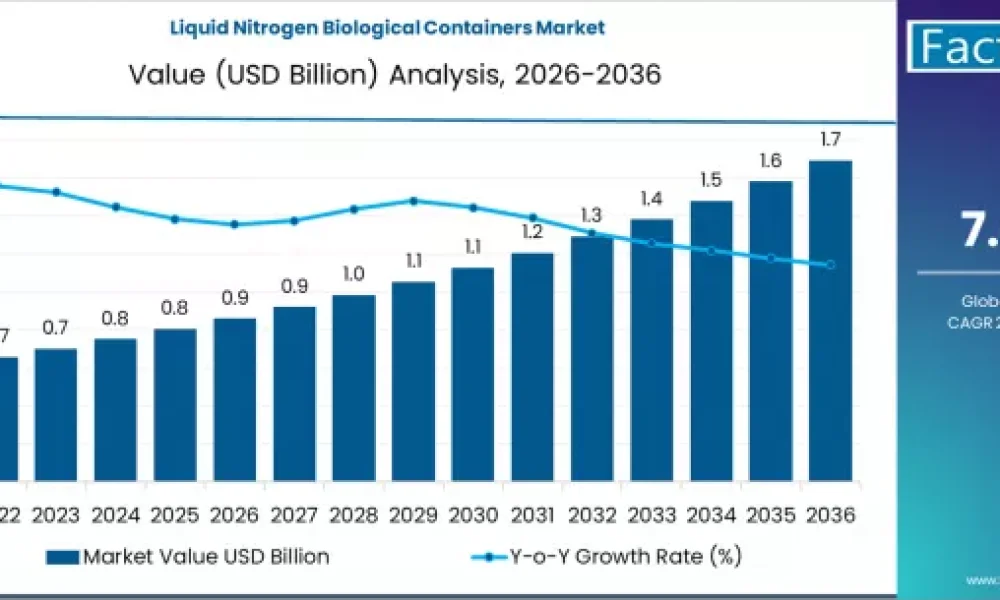
The global liquid nitrogen biological containers market is entering a decade of sustained, innovation-led expansion as life sciences, biobanking, regenerative medicine, and advanced therapeutics accelerate worldwide. The market is projected to grow from approximately USD 0.9 billion in 2026 to USD 1.7 billion by 2036, representing a compound annual growth rate (CAGR) of around 7.0% over the forecast period. This growth reflects the increasing strategic importance of ultra-low temperature storage solutions in preserving biological integrity across research, clinical, and commercial applications.
Market Fundamentals and Growth Outlook (2026–2036)
Liquid nitrogen biological containers are critical assets for the long-term storage of cells, tissues, reproductive materials, vaccines, and genetic samples at temperatures near –196°C. As biopharma pipelines become more complex and personalized, the need for reliable cryogenic containment has shifted from a supporting function to a mission-critical infrastructure component.
To access the complete data tables and in-depth insights, request a Discount On The Report here: https://www.factmr.com/connectus/sample?flag=S&rep_id=13392
By 2036, market expansion will be underpinned by three macro forces:
- Rapid growth in biobanking and cell repositories, driven by genomics, precision medicine, and population-scale research initiatives.
- Commercialization of cell and gene therapies, which require validated, regulatory-compliant cryogenic storage across manufacturing, transport, and clinical use.
- Rising global healthcare and R&D spending, particularly in emerging economies seeking to build domestic life-science capabilities.
Fact-based analysis indicates that cryogenic storage tanks will dominate the product landscape, accounting for more than 53% of total market share, while biobanking applications alone represent nearly 49% of overall demand—a clear signal that institutional and long-term storage use cases are the primary volume drivers.
Regional Dynamics: Where Growth Will Be Concentrated
From a geographic standpoint, North America and Europe will continue to account for a substantial share of revenues due to their mature biopharmaceutical sectors, established biobanks, and strict regulatory standards. However, the Asia-Pacific region is expected to deliver the fastest growth rate through 2036, supported by expanding clinical research activity, government-backed biotech investments, and the localization of biologics manufacturing.
This regional shift mirrors broader trends in the global nitrogen and cryogenic ecosystem. The global liquid nitrogen market, which supplies the foundational input for these containers, is forecast to grow significantly over the next decade, ensuring stable upstream availability and continued technological refinement in storage systems.
Technology Trends Shaping the Competitive Landscape
Between 2026 and 2036, differentiation in the liquid nitrogen biological containers market will be driven less by basic insulation performance and more by smart design, automation, and compliance-ready features. Manufacturers are increasingly integrating:
- Advanced vacuum insulation and lightweight composite materials to reduce nitrogen loss and operating costs.
- Digital monitoring systems, including IoT-enabled temperature tracking, alarms, and data logging, to support regulatory audits and remote management.
- Modular and scalable container designs, allowing facilities to expand capacity without major infrastructure changes.
These innovations align with the broader cryogenic storage equipment sector, reflecting rising quality and traceability requirements across the value chain.
Market Entry Insights for New and Expanding Players
For companies considering market entry or regional expansion between 2026 and 2036, the data highlights several strategic imperatives:
- Focus on regulated end-users first. Biobanks, cell therapy manufacturers, and fertility clinics prioritize compliance, reliability, and lifecycle support over upfront cost, creating higher-margin opportunities.
- Build partnerships with life-science infrastructure providers. Collaborations with biobank operators, CROs, and cold-chain logistics firms can accelerate adoption and embed products into long-term workflows.
- Localize manufacturing and service networks. Especially in Asia-Pacific and Latin America, local presence reduces lead times, improves service responsiveness, and aligns with government procurement preferences.
Given that the market is projected to nearly double in value over the next decade, early positioning in high-growth regions can yield disproportionate returns.
Emerging Opportunities Through 2036
Beyond traditional storage use cases, several emerging opportunities are expected to reshape demand patterns:
- Cell and gene therapy scale-up: The global cell cryopreservation market is expanding rapidly, creating downstream demand for high-capacity, high-reliability liquid nitrogen containers to support clinical and commercial volumes.
- Personalized medicine and population genomics: National biobanking initiatives require standardized, long-term cryogenic storage at unprecedented scale.
- Decentralized healthcare models: Smaller, modular containers are gaining traction in satellite labs, regional hospitals, and mobile research units.
As these trends converge, liquid nitrogen biological containers will evolve from static storage vessels into integrated platforms supporting data, compliance, and operational efficiency.
Strategic Outlook
Looking ahead to 2036, the liquid nitrogen biological containers market will remain a steady-growth, high-reliability segment within the broader life-sciences infrastructure ecosystem. With projected revenues approaching USD 1.7 billion, consistent 7% annual growth, and expanding application breadth, the sector offers compelling opportunities for manufacturers, investors, and strategic partners willing to align with long-term healthcare and biotechnology trends.
In an era where biological samples underpin everything from vaccine development to personalized cancer therapies, liquid nitrogen biological containers are no longer peripheral equipment—they are foundational assets shaping the future of global health and science.
Related Report



