
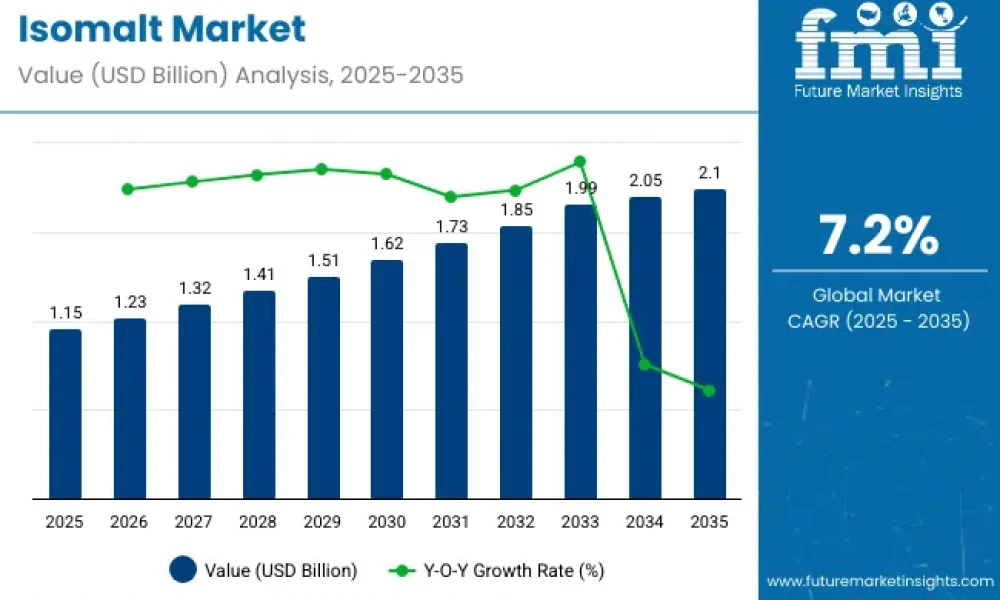
The global market for Isomalt, a sugar-substitute polyol widely used in confectionery, pharmaceuticals and functional foods, is set to grow from USD 1.15 billion in 2025 to USD 2.10 billion by 2035, representing a compound annual growth rate (CAGR) of 7.2 %.
This robust growth reflects increasing consumer demand for low-calorie, sugar-free ingredients, heightened regulatory support and widespread reformulation efforts across regions.
Get Exclusive Access To Data Tables, Market Sizing Dashboards, And Analyst Insights. Request Sample Report: https://www.futuremarketinsights.com/reports/sample/rep-gb-2396
Key market dynamics
• A shift in consumer behaviour toward healthier sweeteners amid rising rates of obesity and diabetes is fueling demand for isomalt.
• Regulatory endorsements by European Food Safety Authority (EFSA) and the U.S. Food and Drug Administration (FDA) bolster confidence in isomalt for use in food and pharmaceutical applications.
• Innovation in clean-label, organic and non-GMO ingredients is driving premium segment adoption—organic isomalt is projected to grow at an 8.5 % CAGR from USD 360 million in 2025 to USD 810 million by 2035.
• The powder form remains the dominant format due to ease of handling and compatibility with dry-mix applications. It is projected to reach about USD 1.52 billion by 2035.
Regional outlook
Asia-Pacific (APAC): India leads the growth frontier with a CAGR of 8.6 % from USD 65 million in 2025 to USD 150 million by 2035, supported by surging urban health awareness and expansion of nutraceuticals. China and Japan are also key contributors, each posting strong growth above the global average (China ~7.4 %, Japan ~7.5 %).
Europe: Germany, the UK and France have mature markets driven by sugar-reduction policies, sugar taxation and strong clean-label trends. Germany’s market grows from USD 138 million to USD 270 million (CAGR ~6.9 %) by 2035.
USA (North America): The U.S. market will expand from USD 175 million in 2025 to USD 340 million by 2035 at a CAGR of 6.8 %, propelled by reformulated confectionery, functional foods and OTC pharmaceuticals.
Saudi Arabia (Middle East & Africa): While specific Saudi Arabia figures are not highlighted, the MEA region is noted as an emerging frontier for isomalt given rising awareness of sugar-free options and functional food uptake.
Market segmentation & competitive landscape
By nature, conventional isomalt holds a majority share, growing at ~6.0 % CAGR to USD 1.29 billion by 2035, while the organic segment grows faster at ~8.5 % CAGR to USD 810 million.
By form, the powder segment dominates, expected to reach USD 1.52 billion by 2035, while the syrup form grows more modestly to USD 580 million.
By end-use, confectionery remains the largest application, growing from USD 460 million in 2025 to USD 820 million by 2035 (CAGR ~6.0 %). Pharmaceuticals (lozenges, chewables) show stronger growth, targeted to reach USD 510 million by 2035 (CAGR ~6.7 %).
Leading global manufacturers account for significant shares: BENEO GmbH commands approx. 35 % of the market, followed by Cargill, Inc. with ~20 % and Merck KGaA at ~10 %.
Recent developments & strategic imperatives
Manufacturers are ramping up production capacity and targeting clean-label launches to capture rising demand. For instance, Cargill has announced investments aimed at polyol capacity expansion to support the shift to healthier sweeteners.
As regulatory frameworks tighten around sugar reduction and front-of-pack labelling, formulators are increasingly replacing sucrose with isomalt in candies, bakery goods, and functional snack bars without compromising taste or texture.
For Customized Insights And Licensing Options, Get The Full Report. Purchase Full Report: https://www.futuremarketinsights.com/checkout/2396
Stakeholder benefits & strategic take-aways
For ingredient suppliers, isomalt presents a high-growth opportunity anchored in health-driven consumer trends and regulatory tailwinds.
Food and pharmaceutical formulators gain a functional sweetener that aligns with sugar-reduction mandates, offers improved mouthfeel and supports clean-label positioning.
Investors and strategists can leverage forecast data to identify profitable avenues—particularly in premium segments (organic, powder form) and high-growth geographies (India, China, Middle East).
Looking ahead, businesses should prioritise:
- innovation in premium/organic isomalt applications;
- expansion in high-growth geographies such as APAC and MEA;
- strengthening supply chain traceability and non-GMO status to align with consumer demands.
About Future Market Insights (FMI)
Future Market Insights, Inc. (FMI) is an ESOMAR-certified, ISO 9001:2015 market research and consulting organization, trusted by Fortune 500 clients and global enterprises. With operations in the U.S., UK, India, and Dubai, FMI provides data-backed insights and strategic intelligence across 30+ industries and 1200 markets worldwide.



