

Hospital Surface Cleaning Products Market Analysis 2023-2032
Market Overview
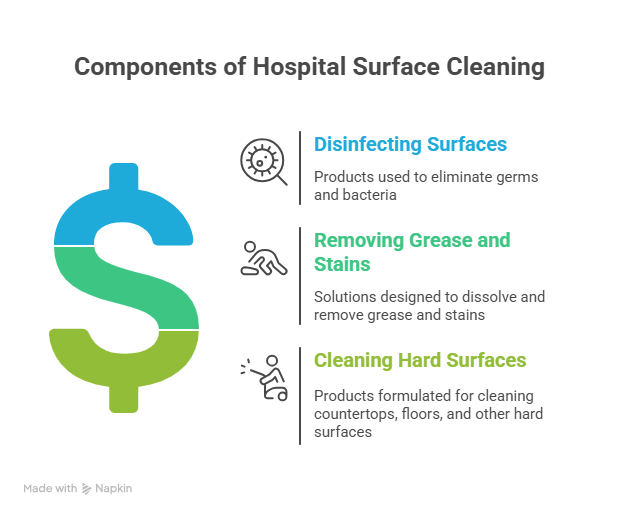
The global hospital surface cleaning products market, valued at USD 1.9 billion in 2020, is projected to reach USD 3.3 billion by 2032, growing at a compound annual growth rate (CAGR) of 3.9% from 2023 to 2032. These products are essential for disinfecting and cleaning various surfaces in healthcare facilities, removing contaminants such as grease, stains, grime, oil, dust, and germs from countertops, floors, beds, door handles, and other hard surfaces. Designed to maintain hygiene and prevent infections, hospital surface cleaning products play a critical role in ensuring safe and sanitary healthcare environments.
The market’s growth is driven by increasing healthcare infrastructure, rising awareness of hygiene, and the need to combat hospital-acquired infections (HAIs). The demand for effective, environmentally friendly, and safe cleaning solutions continues to shape the market, with innovations in product formulations enhancing their efficacy and usability.
Download PDF Sample Copy@ https://www.alliedmarketresearch.com/request-sample/A177828
Market Dynamics
Drivers
Several factors are fueling the growth of the hospital surface cleaning products market:
- Surge in Healthcare Infrastructure: The global healthcare industry has expanded rapidly, driven by population growth, particularly among the geriatric population, and the increasing prevalence of bacterial, viral, and zoonotic diseases. For instance, in February 2022, the Indian government launched a USD 6.8 billion credit incentive program to enhance healthcare infrastructure, enabling businesses to expand hospital capacity and purchase medical supplies, particularly for COVID-19-related facilities in rural areas. In 2021, healthcare spending accounted for approximately 1.8% of global GDP, reflecting significant investments that drive demand for surface cleaning products.
- Increased Focus on Infection Prevention: The rise in hospital-acquired infections (HAIs), caused by unhygienic environments, has heightened the need for regular surface cleaning in healthcare settings. Surface cleaning products are used to disinfect medical devices, high-touch surfaces, and non-critical areas like floors and furniture, reducing the risk of HAIs. The growing prevalence of HAIs is expected to create substantial growth opportunities for the market.
- Impact of the COVID-19 Pandemic: The COVID-19 pandemic significantly increased the demand for surface cleaning products due to the urgent need to prevent viral transmission in hospitals, clinics, and surgical facilities. This heightened awareness of hygiene and disinfection continues to drive market growth, as healthcare facilities prioritize robust cleaning protocols.
- Government Regulations and Initiatives: Stringent government regulations regarding workplace safety and public health have compelled healthcare organizations to adopt effective cleaning solutions. Additionally, government initiatives, such as funding for healthcare infrastructure, support the adoption of advanced cleaning products to maintain sanitary conditions.
- Advantages of Wipes: Disinfectant wipes, valued for their ease of use and zero water consumption, are gaining popularity in healthcare settings. Their convenience and effectiveness in disinfecting high-touch surfaces contribute to market growth.
Restraints
The market faces certain challenges:
- Adverse Effects of Chemical Disinfectants: Many chemical disinfectants, such as those containing quaternary ammonium compounds (QUATS) or chlorine compounds, have toxic properties that can affect the human respiratory system, cause corrosion, or harm the environment. These adverse effects necessitate careful handling and restrict market growth, as healthcare facilities seek safer alternatives.
- Environmental Concerns: The environmental impact of chemical-based cleaning products is a growing concern. Regulatory pressures and consumer demand for eco-friendly solutions are pushing manufacturers to develop non-toxic, sustainable formulations, which may increase production costs and limit market expansion in the short term.
Opportunities
The market offers several growth opportunities:
- Advancements in Eco-Friendly Products: The demand for environmentally friendly and non-toxic cleaning products presents opportunities for innovation. Manufacturers are developing plant-based or low-toxicity disinfectants, such as Clorox EcoClean™ Disinfecting Cleaner, to meet regulatory and consumer demands.
- Expansion in Emerging Markets: Rapid urbanization and healthcare infrastructure development in regions like Asia-Pacific and LAMEA create significant market potential. Rising awareness of infection prevention and increasing healthcare investments in these regions drive demand for surface cleaning products.
- Technological Advancements: Innovations in cleaning technology, such as faster-acting disinfectants and versatile formulations, enhance product performance and open new market segments. For example, products with rapid kill times for pathogens like SARS-CoV-2 are highly sought after in healthcare settings.
Segmental Overview
The hospital surface cleaning products market is segmented by product type, components, end-user, and region.
By Product Type
The market is categorized into liquid, powder, and wipes:
- Liquid: In 2020, the liquid segment dominated the market due to its high efficacy against a broad spectrum of pathogens, including bacteria, viruses, and fungi. Liquids are versatile, easily applied using sprayers, mops, or cloths, and effective on various surfaces like floors, walls, countertops, and medical equipment. Active ingredients like QUATS, hydrogen peroxide, and sodium hypochlorite enhance their disinfecting power.
- Wipes: Expected to grow at the highest CAGR, wipes offer convenience, zero water consumption, and effective disinfection of high-touch surfaces, making them increasingly popular in healthcare settings.
- Powder: Powder-based cleaners are used for specific applications but hold a smaller market share compared to liquids and wipes.
By Components
The market is divided into QUATS, alcohol, hydrogen peroxide, chlorine compounds, and others:
- Alcohol: This segment held the largest share in 2020 due to its strong disinfecting properties, effective against a wide range of microorganisms. Isopropyl alcohol (70%–99%) and ethanol are commonly used in surface cleaners for countertops, desks, doorknobs, and medical equipment.
- Hydrogen Peroxide: Expected to grow rapidly, hydrogen peroxide-based cleaners are valued for their efficacy and lower environmental impact compared to traditional chemical disinfectants.
- QUATS, Chlorine Compounds, and Others: These components are widely used but face challenges due to toxicity concerns, prompting research into safer alternatives.
By End-User
The market is segmented into hospitals, clinics, laboratories, and others:
- Hospitals: The largest segment in 2020, hospitals rely on surface cleaning products for high-level disinfection of critical and non-critical surfaces, such as floors, furniture, and high-touch areas like doorknobs and handrails. The rise in HAIs drives demand for effective cleaning solutions.
- Clinics: Expected to grow at the highest CAGR, clinics are increasingly adopting surface cleaning products to maintain hygiene in smaller healthcare settings.
- Laboratories and Others: These segments require specialized cleaning products to ensure sterile environments for research and diagnostic activities.
By Region
The market is analyzed across North America, Europe, Asia-Pacific, and LAMEA:
- North America: This region held the largest market share in 2020, driven by advanced healthcare infrastructure, stringent regulations, and high awareness of infection prevention.
- Asia-Pacific: Expected to register the highest CAGR, Asia-Pacific benefits from rapid healthcare expansion, urbanization, and rising incidences of HAIs in emerging economies like China and India. Government and non-government investments in infection control further boost the market.
- Europe and LAMEA: These regions show steady growth, supported by healthcare reforms and increasing demand for eco-friendly cleaning solutions.
Competitive Landscape
Key players in the hospital surface cleaning products market include 3M Company, CarrollCLEAN, Diversey Inc., Ecolab Inc., Medline Industries Inc., Metrex Research LLC, STERIS plc, The Clorox Company, The Procter & Gamble Company, and Whiteley Corporation Limited. These companies focus on product launches and acquisitions to strengthen their portfolios. Notable examples include:
- Ecolab (October 2020): Launched a sink and surface cleaner sanitizer listed on the EPA’s List N for use against SARS-CoV-2, offering rapid pathogen kill times and versatility for hospital and food-contact surfaces.
- The Clorox Company (September 2022): Introduced Clorox EcoClean™ Disinfecting Cleaner, a plant-based, non-toxic disinfectant effective against multiple pathogens, including SARS-CoV-2 and MRSA.
- Medline (November 2022): Launched Micro-Kill Bleach Germicidal Bleach Wipes, targeting persistent fungi like C. auris on hospital surfaces.
Key Benefits for Stakeholders
- Trend Analysis: The report provides comprehensive insights into current and emerging market trends from 2020 to 2032.
- Segment Estimations: In-depth analysis of key market segments helps identify growth opportunities.
- Competitive Insights: Monitoring of top competitors and their strategies offers a clear understanding of market dynamics.
- Regional Opportunities: Analysis of all regions highlights high-growth markets, particularly in Asia-Pacific.
- Forecast Accuracy: Revenue and volume forecasts from 2023 to 2032 support strategic planning.
- Competitive Outlook: Profiles of key players and their strategies provide insights into the industry’s competitive landscape.
The global hospital surface cleaning products market is set to grow steadily, driven by expanding healthcare infrastructure, rising HAIs, and increased awareness of hygiene. Despite challenges like the toxicity of chemical disinfectants, opportunities in eco-friendly innovations and emerging markets like Asia-Pacific will propel the market to USD 3.3 billion by 2032. Stakeholders can leverage these trends by investing in sustainable products and targeting high-growth regions to meet the evolving demands of the healthcare industry.
About Us:
Allied Market Research (AMR) is a full-service market research and business-consulting wing of Allied Analytics LLP based in Portland, Oregon. Allied Market Research provides global enterprises as well as medium and small businesses with unmatched quality of “Market Research Reports” and “Business Intelligence Solutions.” AMR has a targeted view to provide business insights and consulting to assist its clients to make strategic business decisions and achieve sustainable growth in their respective market domain.
We are in professional corporate relations with various companies and this helps us in digging out market data that helps us generate accurate research data tables and confirms utmost accuracy in our market forecasting. Allied Market Research CEO Pawan Kumar is instrumental in inspiring and encouraging everyone associated with the company to maintain high quality of data and help clients in every way possible to achieve success. Each and every data presented in the reports published by us is extracted through primary interviews with top officials from leading companies of domain concerned. Our secondary data procurement methodology includes deep online and offline research and discussion with knowledgeable professionals and analysts in the industry.
Contact us:
United States
1209 Orange Street,
Corporation Trust Center,
Wilmington, New Castle,
Delaware 19801 USA.
Int’l: +1-503-894-6022
Toll Free: +1-800-792-5285
Fax: +1-800-792-5285
[email protected]
Construction blog https://vijayconma.medium.com/
Construction News: https://sites.google.com/view/conmavijay/home




