
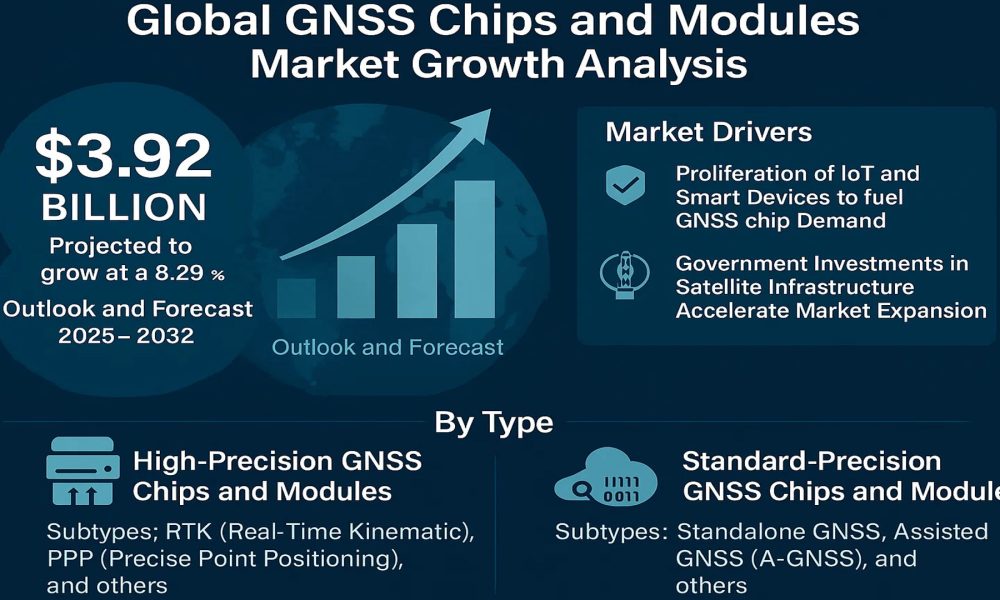
Global GNSS Chips and Modules Market : Global outlook, Key Trends, and Global Forecast to 2032
The global GNSS Chips and Modules Market size was valued at US$ 3.92 billion in 2024 and is projected to reach US$ 7.43 billion by 2032, at a CAGR of 8.29% during the forecast period 2025-2032.
GNSS chips and modules are critical components that enable devices to receive and process signals from global navigation satellite systems like GPS, GLONASS, Galileo, and BeiDou. These semiconductor solutions provide precise positioning, navigation, and timing (PNT) capabilities across various applications, from smartphones to automotive systems. The technology ranges from standard precision modules offering meter-level accuracy to high-precision chips capable of centimeter-level positioning.
The market growth is primarily driven by increasing demand for location-based services, expanding IoT applications, and rising adoption in automotive and transportation sectors. Furthermore, government initiatives to modernize GNSS infrastructure and technological advancements in multi-band, multi-constellation chips are accelerating market expansion. Recent developments include Qualcomm’s 2024 launch of the Snapdragon Satellite modem-RF system, which integrates GNSS with satellite communications for enhanced global connectivity.
Get Full Report with trend analysis, growth forecasts, and Future strategies : https://semiconductorinsight.com/report/global-gnss-chips-and-modules-market/
Segment Analysis:
By Type
High-Precision GNSS Chips and Modules Lead the Market Due to Growing Demand for Accurate Positioning
The market is segmented based on type into:
- High-Precision GNSS Chips and Modules
- Subtypes: RTK (Real-Time Kinematic), PPP (Precise Point Positioning), and others
- Standard-Precision GNSS Chips and Modules
- Subtypes: Standalone GNSS, Assisted GNSS (A-GNSS), and others
By Application
Smartphones Remain the Dominant Segment Owing to Widespread GNSS Integration in Mobile Devices
The market is segmented based on application into:
- Smartphones
- In-Vehicle Systems
- Wearable Devices
- Asset Tracking
- Others
By Technology
Multi-Constellation Support Gains Traction Due to Improved Accuracy and Reliability
The market is segmented based on technology into:
- GPS
- GLONASS
- Galileo
- BeiDou
- Hybrid (Multi-Constellation)
MARKET DYNAMICS
MARKET DRIVERS
Proliferation of IoT and Smart Devices to Fuel GNSS Chip Demand
The exponential growth of IoT-connected devices is creating robust demand for GNSS chips and modules across multiple industries. With over 30 billion active IoT devices expected by 2025, positioning technology has become fundamental for asset tracking, smart logistics, and connected ecosystems. The automotive sector represents one of the strongest growth areas, where GNSS enables advanced driver assistance systems (ADAS), autonomous vehicle navigation, and telematics solutions. Consumer electronics manufacturers are integrating GNSS capabilities into wearables, tablets, and even digital cameras to enhance location-based functionalities and user experiences.
Government Investments in Satellite Infrastructure Accelerate Market Expansion
Global investments in satellite navigation infrastructure continue to drive technological advancements in GNSS chip capabilities. The deployment of third-generation BeiDou satellites has significantly improved positioning accuracy in Asia-Pacific markets, while Europe’s Galileo system now provides unprecedented centimeter-level precision. These enhanced constellations enable chip manufacturers to develop more sophisticated modules supporting multi-band and multi-constellation functionality. Military modernization programs worldwide are also incorporating next-generation GNSS technologies into defense systems, creating specialized demand for ruggedized, encrypted positioning modules.
Furthermore, the increasing integration of 5G networks with GNSS technologies is creating new opportunities for hybrid positioning solutions that combine satellite signals with terrestrial networks.
➤ For instance, leading smartphone manufacturers now utilize both GNSS and 5G cellular positioning to deliver uninterrupted location services in urban canyons and indoor environments.
MARKET OPPORTUNITIES
Emerging RTK Technology Creates New High-Accuracy Market Segments
The commercialization of real-time kinematic (RTK) and precise point positioning (PPP) technologies is unlocking centimeter-level accuracy for mass-market applications. Agricultural equipment manufacturers are adopting these solutions for autonomous tractor guidance, while construction firms utilize them for machine control and site surveying. The global RTK GNSS market is projected to grow at nearly 15% annually as correction network infrastructure expands worldwide.
Automotive OEMs are developing dead reckoning systems that combine GNSS with vehicle sensors to maintain positioning during tunnel transits and parking garage navigation. These hybrid solutions are becoming standard features in premium vehicles and will likely trickle down to mainstream models as costs decrease. The integration of quantum inertial sensors with GNSS modules represents the next frontier, potentially eliminating dependence on satellite signals altogether for short-duration navigation.
Additionally, the modernization of global augmentation systems (SBAS) like WAAS and EGNOS is improving aviation safety while stimulating demand for dual-frequency aviation-grade receivers. These developments create lucrative opportunities for chipmakers who can deliver certified solutions meeting stringent aviation reliability standards.
GLOBAL GNSS CHIPS AND MODULES MARKET TRENDS
Integration of Multi-Constellation Support Driving Market Adoption
The GNSS chips and modules market is experiencing significant transformation due to the increasing adoption of multi-constellation GNSS support. Modern chipsets now simultaneously process signals from multiple satellite systems including GPS, GLONASS, Galileo, and BeiDou, improving positional accuracy to centimeter-level precision in high-end applications. This technological leap is particularly evident in automotive navigation systems, where real-time kinematic (RTK) positioning achieves 2-4 cm accuracy, a substantial improvement over traditional 5-10 meter ranges. The global market for high-precision GNSS modules is projected to grow at a compound annual rate exceeding 11% through 2030, fueled by demand from autonomous vehicles, precision agriculture, and surveying applications where millimeter-level accuracy is becoming standard.
Other Trends
Miniaturization and Power Efficiency Breakthroughs
Manufacturers are achieving breakthroughs in power efficiency and form factor reduction, enabling GNSS technology integration into wearables and IoT devices. Current generation chipsets consume less than 15mA during active tracking – a 60% reduction from previous models – while maintaining continuous positioning capabilities. This evolution supports the proliferation of asset tracking solutions, with modules now small enough for livestock collars and package monitoring tags. Concurrently, advancements in hybrid positioning combine GNSS with Wi-Fi, Bluetooth, and inertial sensors, creating robust location solutions for indoor-outdoor transitional environments where satellite signals weaken.
Automotive Sector Adoption Accelerating Market Growth
The automotive industry’s transition toward autonomous driving systems is creating unprecedented demand for high-reliability GNSS modules. Modern vehicles now integrate redundant GNSS receivers with inertial measurement units (IMUs) achieving positioning continuity during signal outages. This technological pairing is critical for advanced driver assistance systems (ADAS) and emerging autonomous vehicle platforms requiring lane-level accuracy. The automotive segment currently accounts for over 35% of total GNSS module shipments, with projections indicating 8 million units annually will be dedicated to autonomous vehicle development by 2025. Furthermore, regulatory mandates for emergency call (eCall) systems in several regions are creating a baseline demand for embedded GNSS capabilities across all vehicle classes.
Recent Developments – Global GNSS Chips and Modules Market(2024–2032)
1. Expansion Driven by Automotive and Autonomous Applications
- Significant growth in demand for GNSS modules in autonomous vehicles, driver-assistance systems (ADAS), and fleet tracking.
- Automotive OEMs are integrating multi-frequency and multi-constellation GNSS for lane-level accuracy and real-time tracking.
2. Integration with IoT and Consumer Devices
- Increasing use of low-power GNSS chips in wearables, smartphones, asset trackers, and smart agriculture equipment.
- Companies are developing miniaturized GNSS modules optimized for integration into space-constrained IoT devices.
3. Emergence of Multi-Constellation and Dual/Triple-Frequency GNSS
- Shift toward multi-constellation GNSS support (GPS, GLONASS, Galileo, BeiDou, QZSS) for improved reliability and accuracy.
- Dual-frequency (L1+L5, L1+E5) and triple-frequency chips are becoming more common in surveying, mapping, and high-precision GNSS applications.
4. Technological Innovation in Chip Design
- Leading companies are focusing on low-power, high-sensitivity GNSS chips for battery-powered applications.
- Integration of GNSS with inertial measurement units (IMUs), UWB, and sensor fusion for continuous positioning in urban canyons and indoors.
5. Growth of GNSS in Agriculture and Drones
- Precision farming, drone-based mapping, and machine guidance systems are driving demand for centimeter-level positioning solutions.
- GNSS RTK (Real-Time Kinematic) and PPP (Precise Point Positioning) modules are increasingly adopted in smart farming equipment.
6. Regional GNSS System Enhancements
- Continued development and expansion of regional satellite systems like India’s NavIC, China’s BeiDou, and Japan’s QZSS, pushing vendors to release compatible modules.
- Regulatory support in countries like India is encouraging the domestic adoption of NavIC-based GNSS chipsets in smartphones and navigation systems.
Download A Sample Report : https://semiconductorinsight.com/download-sample-report/?product_id=95909
COMPETITIVE LANDSCAPE
Key Industry Players
Market Leaders Focus on Multi-GNSS Solutions to Gain Competitive Edge
The global GNSS chips and modules market features a mix of semiconductor giants and specialized positioning technology providers. Qualcomm Technologies dominates the smartphone segment due to its system-on-chip (SoC) integrations, capturing over 40% of the consumer GNSS chip market. Their Snapdragon processors with built-in GNSS capabilities have become industry benchmarks for mobile devices.
U-blox and Broadcom maintain strong positions in industrial and automotive applications through their high-precision modules. U-blox’s recent acquisition of Sapcorda Services strengthened its centimeter-level positioning capabilities, while Broadcom’s dual-frequency GNSS solutions are gaining traction in autonomous vehicle prototypes.
The market sees increasing competition from Asian manufacturers like Mediatek, which has aggressively priced its standalone GNSS chips for IoT applications. Meanwhile, European firms like STMicroelectronics are differentiating through low-power designs for wearable devices, where energy efficiency is critical.
Recent industry developments highlight the strategic importance of multi-constellation support. All leading players now offer chips compatible with at least four global navigation systems (GPS, GLONASS, Galileo, and BeiDou), with some premium solutions adding regional systems like QZSS and IRNSS for enhanced urban coverage.
List of Key GNSS Chip and Module Manufacturers
- Qualcomm Technologies (U.S.)
- Broadcom Inc. (U.S.)
- MediaTek Inc. (Taiwan)
- u-blox Holding AG (Switzerland)
- STMicroelectronics (Switzerland)
- Intel Corporation (U.S.)
- Furuno Electric Co., Ltd. (Japan)
- Hexagon AB (Sweden)
- NovAtel Inc. (Canada)
- Septentrio NV (Belgium)
The competitive intensity continues to rise as companies expand into emerging applications like drone navigation, robotics, and augmented reality. Smaller innovators are challenging incumbents in niche segments, particularly for centimeter-level accuracy solutions requiring real-time kinematics (RTK) technology.
Browse Related Reports : Global Carbon Brush Holder Market Research Report 2025
CONTACT US:
City vista, 203A, Fountain Road, Ashoka Nagar, Kharadi, Pune, Maharashtra 411014
+91 8087992013
[email protected]




