
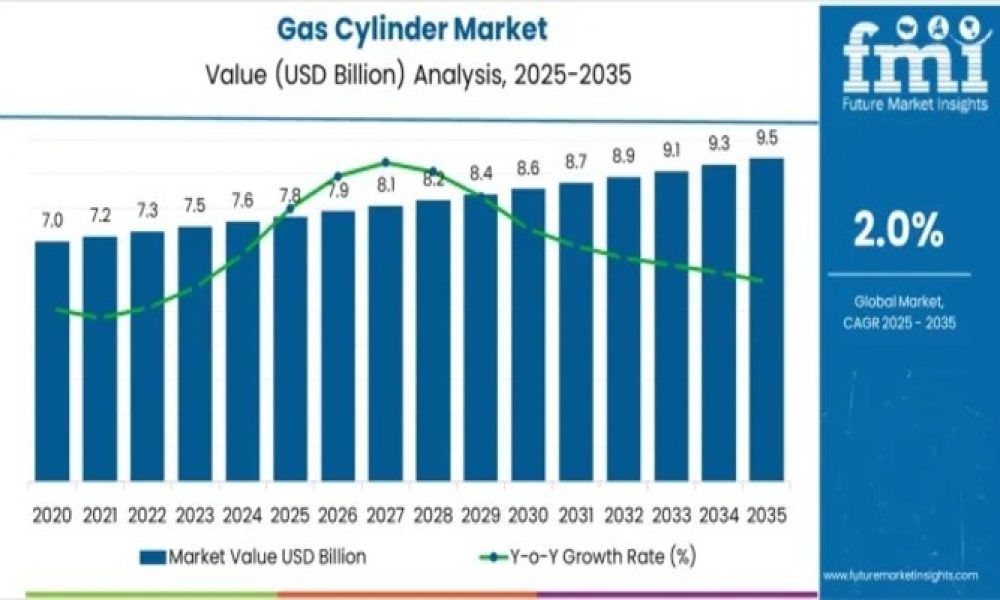
The global gas cylinder market is entering a phase of stable, long-term growth, underpinned by rising industrial gas consumption, expanding healthcare infrastructure, and accelerating investments in clean energy systems. According to the latest industry assessment, the market is valued at USD 7.8 billion in 2025 and is projected to reach USD 9.5 billion by 2035, registering a compound annual growth rate (CAGR) of 2.0% over the forecast period.
Gas cylinders remain a critical component of modern industrial, medical, residential, and energy ecosystems. Their role in the safe storage and transportation of compressed and liquefied gases positions them at the intersection of manufacturing, healthcare delivery, energy transition, and infrastructure development worldwide.
Discover Growth Opportunities in the Market – Get Your Sample Report Now
Market Snapshot: Key Numbers at a Glance
- Market Value (2025): USD 7.8 billion
- Forecast Value (2035): USD 9.5 billion
- Forecast CAGR (2025–2035): 2.0%
- Leading Cylinder Type (2025): Type I – 36.8% share
- Leading Wrap Type: Carbon Fiber – 33.4% share
- Dominant Size Segment: 14 KGS – 29.7% share
- High-Demand Gas Type: Flammable Gases – 29.2% share
- Key Growth Regions: North America, Asia-Pacific, Europe
Industry Dynamics Shaping the Market
The current gas cylinder market landscape reflects a balance between maturity and innovation. While traditional steel and aluminum cylinders continue to dominate volume demand, manufacturers are increasingly investing in lightweight composite materials, advanced valve technologies, and automation-driven manufacturing processes to enhance safety, efficiency, and cost competitiveness.
Key growth drivers include:
- Rising demand for industrial gases across manufacturing, electronics, automotive, and aerospace sectors
- Expanding healthcare applications, particularly for oxygen and specialty medical gases
- Growing adoption of LPG and CNG in residential, commercial, and transportation uses
- Increased focus on hydrogen and alternative fuels as part of global decarbonization strategies
Together, these forces are reinforcing the market’s structural stability while creating opportunities for both global leaders and regional manufacturers.
Segment Insights: Where Demand Is Concentrated
Type I Cylinders Lead by Reliability and Cost Efficiency: Type I cylinders account for 36.8% of the market in 2025, maintaining leadership due to their robustness, affordability, and proven performance in high-pressure applications. Their dominance is reinforced by:
- Established global manufacturing infrastructure
- Low production complexity and widespread steel availability
- Strong replacement demand in domestic and commercial LPG systems
Growth in this segment is expected to remain steady as industrial gas usage rises and refurbishment cycles accelerate globally.
Carbon Fiber Wraps Drive Lightweight Innovation: With a 33.4% share, carbon fiber–wrapped cylinders lead the wrap type category. Their superior strength-to-weight ratio makes them ideal for automotive, aerospace, portable gas, CNG, and hydrogen storage applications. Continuous improvements in filament winding and resin systems are enabling higher output and longer service life, supporting sustained adoption.
14 KGS Cylinders Dominate Size Demand: The 14 KGS segment, holding 29.7% share, continues to lead due to its balance of portability and capacity. It remains the preferred choice for household LPG distribution and small commercial use, supported by standardized refilling infrastructure and government-backed clean cooking initiatives in developing economies.
Regional Outlook: Growth Patterns Across Key Markets
- United States (CAGR 0.7%)
Growth is supported by a diversified industrial base and sustained demand from healthcare and energy sectors. - United Kingdom (CAGR 0.8%)
Healthcare and food & beverage applications are major demand drivers, with gas cylinders playing a vital role in medical gas delivery and food processing. - Germany (CAGR 0.5%)
Construction activity and the transition toward renewable energy and hydrogen infrastructure underpin steady demand. - France (CAGR 1.2%)
Technological innovation and rising demand for specialty gases in research and advanced manufacturing are accelerating adoption. - India (CAGR 5.4%)
India stands out as the fastest-growing market, driven by LPG penetration, clean energy policies, and large-scale investments in gas distribution infrastructure.
Historical Performance vs. Future Outlook
- 2020–2025 CAGR: 1.2%
- 2025–2035 Forecast CAGR: ~2.1%
Historically, growth was shaped by industrial expansion and stricter safety regulations. Looking ahead, green technologies, hydrogen fuel systems, and expanding healthcare access are expected to create new demand channels, while e-commerce platforms simplify procurement for small and mid-sized buyers.
Competitive Landscape and Strategic Focus
The gas cylinder market features a diverse mix of global and regional players competing on safety compliance, material innovation, and application-specific customization. Key companies include Luxfer Gas Cylinders, Hexagon Composites ASA, Worthington Cylinders, Drägerwerk AG & Co. KGaA, Time Technoplast, Faber Industries, Beijing Tianhai Industry, Linde plc, and others.
Leading manufacturers are prioritizing:
- Advanced composite cylinder development
- Automation and cost optimization
- Compliance with evolving global safety standards
- Expansion into emerging and high-growth markets
Outlook: Stability with Selective Upside
While the gas cylinder market is not characterized by rapid disruption, its predictable growth trajectory, essential role across industries, and alignment with clean energy and healthcare trends position it as a resilient, long-term investment space. Ongoing innovation in materials, safety, and distribution models is expected to sustain adoption and revenue growth through 2035, particularly in emerging economies and alternative energy applications.
Why FMI: https://www.futuremarketinsights.com/why-fmi
About Future Market Insights (FMI)
Future Market Insights, Inc. (FMI) is an ESOMAR-certified, ISO 9001:2015 market research and consulting organization, trusted by Fortune 500 clients and global enterprises. With operations in the U.S., UK, India, and Dubai, FMI provides data-backed insights and strategic intelligence across 30+ industries and 1200 markets worldwide.



