
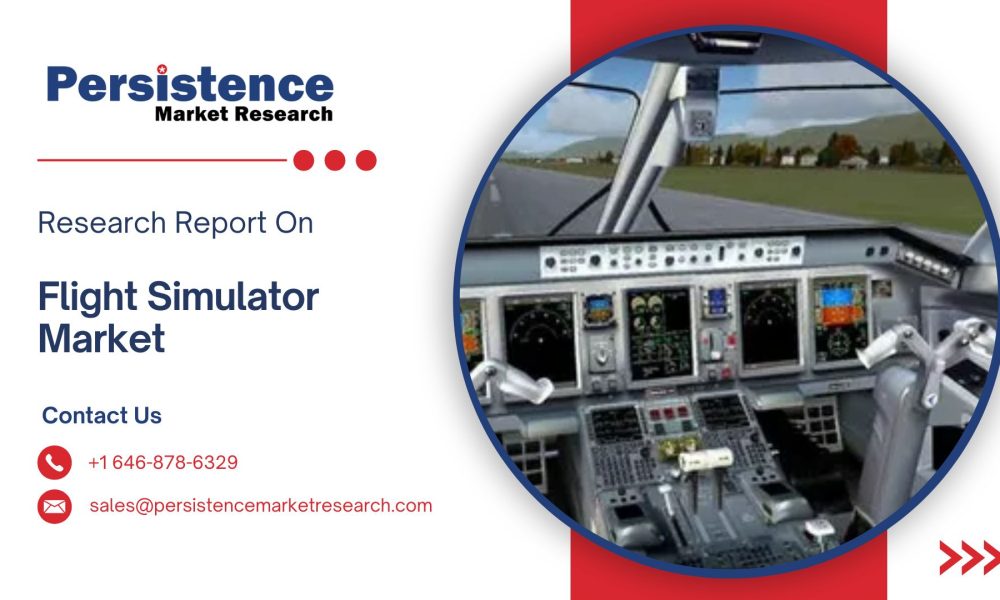
The global flight simulator market is witnessing significant growth, fueled by technological advancements and increasing demand for pilot training solutions. According to Persistence Market Research, the market is projected to grow from US$ 7,168.6 Mn in 2025 to US$ 10,882.8 Mn by 2032, registering a CAGR of 6.2% during the forecast period. Flight simulators are integral to aviation training, enabling pilots to practice complex maneuvers and emergency procedures in a safe environment. Over the past decade, the increasing adoption of advanced simulators with immersive graphics, realistic controls, and AI-based features has driven the market forward.
The flight simulator market is primarily driven by the expansion of commercial aviation, rising air traffic, and stringent regulatory requirements for pilot training worldwide. Among product types, full-flight simulators dominate due to their high-fidelity features and compliance with aviation standards. Geographically, North America leads the market, attributed to the presence of major aerospace manufacturers, advanced aviation infrastructure, and significant investments in pilot training programs. The Asia-Pacific region, however, is emerging as a high-growth market due to the rapid expansion of commercial airlines and government initiatives to enhance aviation safety.
Get | Download Sample Copy with TOC, Graphs & List of Figures @ https://www.persistencemarketresearch.com/samples/35191
Key Highlights from the Report
- Flight simulator market projected to reach US$ 10,882.8 Mn by 2032, growing at a CAGR of 6.2% from 2025.
- Full-flight simulators dominate the product segment, due to superior realism and regulatory compliance.
- North America leads geographically, driven by established aviation infrastructure and advanced training programs.
- Asia-Pacific emerging as a key growth market, supported by increasing air travel demand and government aviation initiatives.
- Technological advancements in virtual reality and AI integration are enhancing simulator capabilities and adoption rates.
- Commercial aviation training remains the primary end-user segment, contributing to consistent demand growth globally.
Market Segmentation
The flight simulator market can be segmented based on product type, end-user, and technology. Product-wise, it primarily includes full-flight simulators, fixed-base simulators, and part-task trainers. Full-flight simulators hold the largest share due to their high-fidelity replication of real aircraft systems, making them critical for commercial airline pilot training. Fixed-base simulators and part-task trainers are gaining traction in pilot schools and military applications due to their cost-effectiveness and specific functionality.
End-user segmentation divides the market into commercial aviation, military & defense, and pilot training institutes. Commercial aviation accounts for the largest market share, as airlines are increasingly investing in flight simulators to train pilots efficiently while minimizing operational risks. Military & defense applications are also witnessing steady growth due to the increasing need for simulation-based combat and tactical training. Pilot training institutes are expanding their simulator capacities to meet the growing demand for certified pilots worldwide.
Regional Insights
North America continues to dominate the flight simulator market due to the presence of leading simulator manufacturers, robust aviation infrastructure, and stringent safety regulations. The United States, in particular, contributes significantly to market revenue, driven by heavy investments from airlines and defense organizations. Furthermore, technological innovations, including VR-based simulators, reinforce North America’s leadership in this market.
The Asia-Pacific region is emerging as a high-potential market with rapid growth in commercial aviation and increasing government initiatives to improve aviation safety. Countries such as China and India are witnessing an unprecedented rise in air traffic, fueling the demand for advanced pilot training solutions. Additionally, collaborations between regional airlines and international simulator providers are boosting market penetration in this region.
For customization options before purchasing: https://www.persistencemarketresearch.com/request-customization/35191
Market Drivers
The growth of the flight simulator market is primarily propelled by increasing demand for pilot training solutions amid a rising number of commercial aircraft globally. Airlines are investing in simulators to optimize pilot training costs while adhering to strict safety regulations. Moreover, technological advancements in simulators, including high-definition visuals, AI-driven scenarios, and realistic cockpit replication, are enhancing training efficiency and adoption.
Another major driver is the increasing global emphasis on aviation safety. Regulatory authorities like the FAA and EASA mandate extensive simulator-based training for pilots, particularly for handling emergency situations and complex flight scenarios. This compliance requirement drives airlines, military organizations, and training institutes to adopt advanced flight simulators, further fueling market growth.
Market Restraints
Despite promising growth, the flight simulator market faces certain restraints. The high initial cost of acquiring full-flight simulators remains a significant barrier for small airlines and pilot training institutions. Maintenance costs and software updates also add to the total expenditure, which can deter smaller market players from adopting high-fidelity simulators.
Additionally, rapid technological advancements can render existing simulators obsolete, requiring frequent upgrades. The dependence on advanced hardware, such as motion platforms and VR systems, necessitates skilled personnel for operation and maintenance, which can be a challenge in developing regions. These factors limit the market’s growth potential in certain segments.
Market Opportunities
The flight simulator market presents significant growth opportunities, particularly through the integration of AI, machine learning, and virtual reality technologies. These innovations enable more immersive and adaptive training solutions, attracting airlines and military organizations seeking cost-effective and efficient pilot training options.
Expanding commercial aviation in emerging markets, such as Asia-Pacific and the Middle East, offers another major growth opportunity. Governments and airlines are increasingly investing in simulator infrastructure to train the growing pool of pilots, thereby creating long-term demand for advanced simulators. Partnerships and collaborations between simulator manufacturers and regional airlines also provide avenues for market expansion.
Frequently Asked Questions
➤ What are the main factors influencing the Flight Simulator Market 2025-2032?
➤ Which companies are the major sources in the Flight Simulator Market?
➤ What are the market’s opportunities, risks, and general structure?
➤ Which of the top Flight Simulator Market companies compare in terms of sales, revenue, and prices?
➤ How are market types and applications explored in the Flight Simulator Market in terms of revenue and value?
Company Insights
Key players operating in the flight simulator market include:
- CAE Inc.
- Lockheed Martin Corporation
- L3Harris Technologies, Inc.
- Thales Group
- FlightSafety International Inc.
- Airbus S.A.S.
- Boeing Company
- TRU Simulation + Training
Buy Now: https://www.persistencemarketresearch.com/checkout/35191
Recent Developments:
- CAE Inc. announced the launch of a next-generation full-flight simulator with advanced VR and AI-based scenario training in 2024.
- L3Harris Technologies expanded its pilot training services in the Asia-Pacific region through strategic partnerships with leading airlines.
Future Opportunities and Growth Prospects
The flight simulator market is poised for significant expansion, driven by continuous technological advancements, increased air travel, and stringent aviation regulations. Emerging technologies like augmented reality (AR), virtual reality (VR), and AI-based adaptive learning will play a crucial role in enhancing simulator efficiency and training quality.
Furthermore, expanding aviation sectors in developing regions, such as Asia-Pacific and the Middle East, will provide sustained demand for flight simulators. Strategic collaborations, mergers, and acquisitions among key players are expected to create a competitive landscape that fosters innovation and market penetration.
With increasing emphasis on pilot safety, cost-effective training, and operational efficiency, the global flight simulator market is expected to witness steady growth through 2032, offering lucrative opportunities for manufacturers, airlines, and training institutes.




