
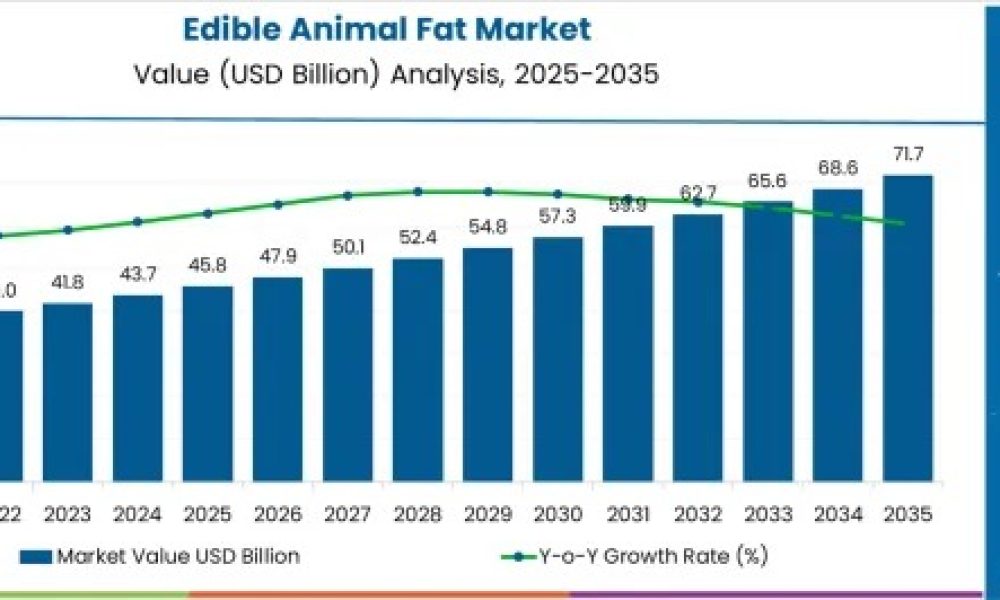
The global edible animal fat market is valued at USD 45.8 billion in 2025 and is projected to reach USD 71.7 billion by 2035, expanding at a CAGR of 4.6% over the forecast period. Growth is supported by sustained demand from bakery, confectionery, processed foods, and culinary applications, where animal fats deliver flavor intensity, texture, and thermal stability.
At the same time, regulatory frameworks governing food safety, labeling, traceability, and animal welfare are increasingly shaping production economics and competitive positioning. Authorities such as the U.S. Food and Drug Administration (FDA), European Food Safety Authority (EFSA), and Asia-Pacific food safety bodies continue to enforce stringent compliance standards across rendering, refining, packaging, and distribution.
Explore trends before investing – request a sample report today!
Regulations directly influence operational costs by mandating approved additives, hygiene protocols, permissible fat composition, and storage practices. Mandatory origin documentation and humane sourcing requirements add complexity to supply chains, particularly affecting smaller processors and regional producers. While these measures enhance consumer confidence and long-term market credibility, they also raise entry barriers and impact pricing structures across regions.
Market Positioning Within the Global Food Ingredients Ecosystem
The edible animal fat market represents a specialized but essential segment of the global food ingredients industry:
- ~4.1% of the global fats and oils sector
- ~3.8% of the meat and dairy derivatives industry
- ~3.5% of food processing and ingredient solutions
- ~3.2% of processed and convenience foods
Its relevance is reinforced by consistent demand for functional performance, shelf-life extension, and authentic taste profiles in both industrial and traditional food applications.
Why the Edible Animal Fat Market Continues to Expand
Growth is supported by:
- Rising consumption of processed and convenience foods
- Strong demand from bakery and confectionery manufacturers
- Continued use in traditional and regional cuisines
- Renewed interest driven by ketogenic and low-carb dietary trends
Despite competition from plant-based alternatives, animal fats remain preferred in applications where texture, flavor release, and frying performance are critical.
Key Segment Insights
Butter dominates the type segment, accounting for 34.7% of market share in 2025, driven by clean-label preferences, premium bakery demand, and artisanal food trends.
Cattle-derived fats lead by source with 42% share, benefiting from high smoke points, integrated meat processing supply chains, and growing interest in sustainable by-product utilization.
Bakery and confectionery remain the largest application, holding 39% share, as manufacturers prioritize natural fats over synthetic emulsifiers to achieve premium sensory outcomes.
Regional Growth Snapshot
Asia-Pacific and Europe remain high-growth regions, while North America sustains steady demand through industrial food processing.
Country-level CAGR highlights (2025–2035):
- China: 6.2%
- India: 5.8%
- Germany: 5.3%
- UK: 4.4%
- USA: 3.9%
China and India benefit from large-scale food manufacturing and traditional culinary usage, while European growth is anchored in regulatory-driven quality assurance and premium food production.
Dive deeper—click here for the comprehensive report!
Competitive Landscape
The market features a mix of global agribusiness leaders and specialized regional players. Companies such as Cargill, SARIA SE & Co. KG, and Ten Kate Holding B.V leverage integrated supply chains and diversified portfolios to meet regulatory and application-specific requirements. Regional specialists including Bank Brothers, Coast Packing, Sanimax, Sonac, and York Foods compete through local sourcing, tailored formulations, and strong customer relationships. Competitive advantage increasingly depends on traceability, sustainability initiatives, and compliance with international food safety certifications.
Looking ahead, regulatory interventions will continue to guide technological adoption, quality benchmarks, and competitive positioning. While compliance requirements may create entry barriers, they also reinforce consumer trust and long-term stability, shaping a resilient growth trajectory for the global edible animal fat market through 2035.
Key companies include:
Bank Brothers, Cargill, Coast Packing, Leo Group Ltd, Sanimax, Sonac, Ten Kate Holding B.V, York Foods, SARIA SE & Co. KG.
Strategic priorities include process automation, compliance investments, sustainable sourcing, and long-term partnerships with food manufacturers.
Why FMI: https://www.futuremarketinsights.com/why-fmi
About Future Market Insights (FMI)
Future Market Insights, Inc. (FMI) is an ESOMAR-certified and ISO 9001:2015-accredited market research and consulting organization. Trusted by Fortune 500 companies and global enterprises, FMI delivers data-driven insights across 30+ industries and 1,200+ markets, with operations in the U.S., UK, India, and Dubai.



