
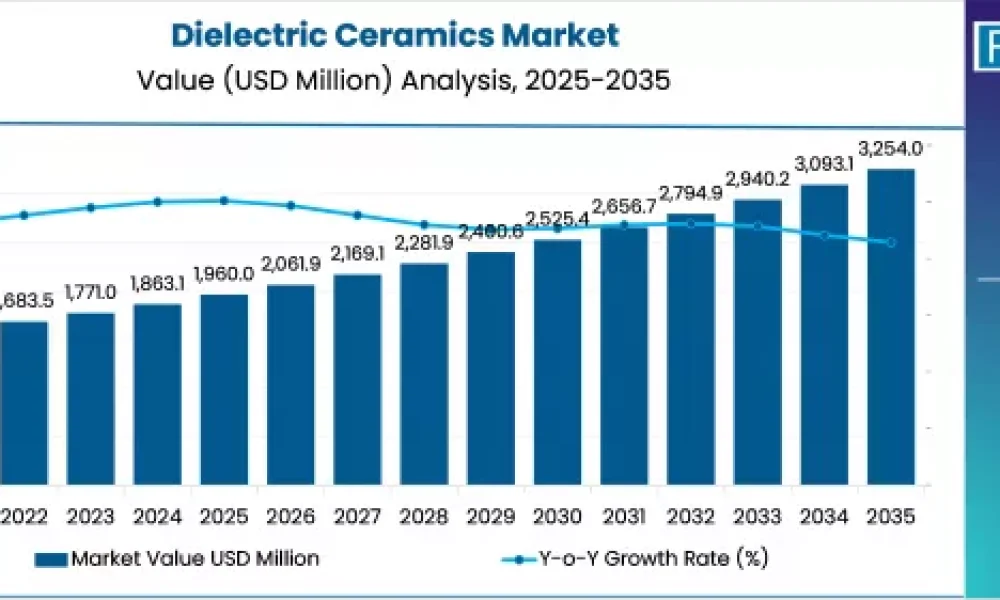
The global dielectric ceramics market is projected to grow from USD 1,960 million in 2025 to USD 3,254 million by 2035, reflecting a CAGR of 5.2%, according to a new report by Fact.MR. Rising demand for miniaturized electronic components, capacitors, and communication systems, along with increasing adoption across electrical and electronics industries, is driving robust market growth globally.
Dielectric ceramics are electrical insulators with customized dielectric properties, including dielectric constant, resistivity, and operating frequency, making them critical for capacitors, microelectronics, insulators, and high-voltage applications. Materials such as lead zirconate titanate (PZT), barium titanate (BT), magnesium titanate (MT), and strontium titanate (ST) form the backbone of this high-performance ceramics segment.
Market Value Analysis
| Metric | Value |
|---|---|
| Market Size (2025 E) | USD 1,960 million |
| Market Size (2035 F) | USD 3,254 million |
| Forecast CAGR (2025–2035) | 5.2% |
To access the complete data tables and in-depth insights, request a Discount On The Report here: https://www.factmr.com/connectus/sample?flag=S&rep_id=4107
Key Growth Drivers
Wireless communication expansion: Dielectric ceramics are essential in cell phones, satellites, radar systems, and intelligent transport systems, driving demand across the telecom industry.
Electronics miniaturization: The push for smaller, lightweight, and cost-efficient components in automotive, consumer electronics, and aerospace enhances demand.
Substitute for metals in high-frequency applications: Dielectric ceramics reduce weight, cost, and signal loss compared to conventional metal-based substrates.
Market Constraints:
High cost of raw materials for manufacturing dielectric ceramics
Capital-intensive and technologically complex production processes
Regional Outlook
East Asia dominates global demand due to a robust electronics manufacturing base, supportive government policies, and a growing consumer electronics market. China, Japan, and South Korea remain the primary production hubs for dielectric ceramics.
North America shows steady growth, led by demand for miniaturized electronics and the presence of advanced manufacturing technologies.
Europe is expected to see moderate growth, limited by slower economic expansion, whereas South Asia & Oceania are emerging markets driven by rising middle-class consumption and government initiatives.
Middle East & Africa (MEA) and Latin America are forecasted to witness single-digit growth, largely reliant on imports for advanced ceramic components.
| Country | CAGR |
|---|---|
| Canada | 3.9% |
| Spain | 3.5% |
| Malaysia | 4.3% |
| Indonesia | 4.7% |
Purchase Full Report for Detailed Insights
For access to full forecasts, regional breakouts, company share analysis, and emerging trend assessments, you can purchase the complete report here:
https://www.factmr.com/checkout/4107
Market Segmentation
By Product Type:
Recognize Acid Calcium Porcelain
Calcium Qin Silicon Porcelain
Qin Acid Magnesium Porcelain
Qin Magnesium Porcelain
By Application:
Electrical & Electronics (dominant segment)
Capacitors (largest sub-segment)
Microelectronics circuits
Insulators
Semiconductors
Others
Communication Systems
Others
By Region:
North America
Latin America
Europe
East Asia
South Asia & Oceania
Middle East & Africa
Competitive Landscape
The dielectric ceramics market is moderately consolidated, with leading players holding majority market share:
Kyocera Corporation
Monocrystal
Rubicon Technology
San Jose Delta Associates
Advanced Technical Ceramics
National Magnetics Group
Morgan Advanced Materials
Strategic Initiatives: Manufacturers are investing in R&D, digital integration, and ESG-aligned production, focusing on high-performance dielectric ceramics to serve miniaturized electronic and high-frequency applications.
Outlook: Next Decade of Growth
The dielectric ceramics market is set to benefit from increasing urbanization, expansion of electronics and communication sectors, and rising adoption of miniaturized components. Fact.MR predicts continued double-digit growth in East Asia and South Asia, while North America and Europe maintain steady demand through innovation and technological enhancements.
“Dielectric ceramics are no longer just components—they are enablers of next-generation electronics, communication systems, and industrial applications,” said a senior analyst at Fact.MR. “Market participants investing in technology, efficiency, and global supply chain optimization will lead the sector over the next decade.”
To View Related Report :
Dielectric Fluids Market
About Fact.MR
Fact.MR is a leading global market research firm providing actionable insights across 1,500+ markets worldwide. Headquartered in Dublin, Ireland, with offices in the U.S. and India, Fact.MR supports strategic decisions in chemicals, electronics, materials, and industrial sectors.



