
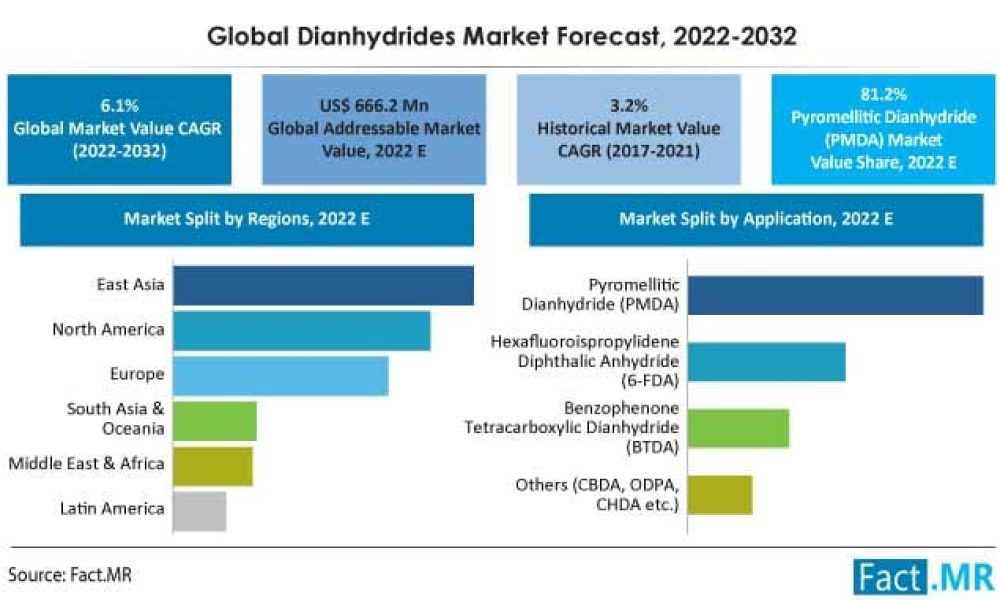
The current global valuation of the dianhydride market stands at US$ 666.2 million, with a projected compound annual growth rate (CAGR) of 6.1% from 2022 to 2032, reaching a substantial US$ 1.1 billion. Anticipated growth in pyromethyl dihydride (PMDA) compounds consumption is set at a 4.8% CAGR, expected to reach 65.7 KT by 2032. Presently, the leading 5 dianhydride producers command approximately 22% of the market share.
This sector presents numerous opportunities, including manufacturing goods, licensing, selling, and exhibiting services. Fact.MR analysts have conducted thorough mandatory research and an extensive optional investigation to formulate diverse assessments and forecasts for global and local dianhydride demand.
Playing a pivotal role in the production of advanced materials and chemicals, the dianhydride market serves as a crucial component in the synthesis of polymers, particularly high-temperature-resistant polyimides. These polymers find widespread application in industries such as aerospace, automotive, and electronics, owing to their remarkable thermal stability, mechanical strength, and resistance to various environmental factors.
A key driver propelling the dianhydride market is the increasing demand for advanced materials exhibiting superior performance characteristics. As industries strive to develop products capable of withstanding extreme conditions, there is a growing need for innovative polymers and composites. Dianhydrides play a vital role in the creation of high-performance materials, thereby contributing significantly to advancements in technology and engineering.
Key Market Trends
Polyimide Demand: A noteworthy trend in the dianhydride market is the escalating adoption of high-temperature-resistant polyimides, derived from dianhydrides. These polymers are highly valued for their ability to maintain exceptional mechanical properties and dimensional stability at elevated temperatures, playing a vital role in aerospace and electronics applications.
Electronics and Microelectronics: The continual miniaturization of electronic devices has spurred the demand for materials based on dianhydrides. These materials are integral in the production of flexible circuit boards and high-performance insulating films for semiconductors, contributing significantly to the rapid growth of the microelectronics sector.
Green and Sustainable Chemistry: A burgeoning trend in the dianhydride market is the increasing focus on sustainable chemistry and environmentally friendly production processes. This shift is driven by regulatory requirements and the growing consumer demand for eco-friendly products, emphasizing the industry’s commitment to environmentally responsible practices.
Collaborations and Research Initiatives: Collaborative research and development initiatives involving chemical companies, academic institutions, and government organizations have become more prevalent. These partnerships aim to foster innovation in dianhydride synthesis and applications, reflecting a concerted effort towards advancing the industry through collective expertise and resources.
𝐌𝐚𝐫𝐤𝐞𝐭 𝐏𝐥𝐚𝐲𝐞𝐫𝐬: –
• Boshan Hengtai Chemical Factory
• CABB Chemicals
• Daicel Corporation
• Daikin Chemicals
• Evonik
• Fanxian Guofeng Fine Chemical Co., Ltd.
• Fanxian Senyuan Chemical Industry Co., Ltd.
• Fengchen Group Co., Ltd
• Haihang Industry
• Hualun
• Huangshan Deping Chemical Co., Ltd.
• Liyang Qingfeng Fine Chemical Co., Ltd.
• Lonza Group AG
• Mitsubishi Gas Chemical Company
• Nexam Chemical
• Puyang Longde Young New Material Co., Ltd.
• Puyang Shenghuade Chemical Co., Ltd.
• Rugao Leheng Chemical Co., Ltd.
• Shandong Helishi Petrochemical Technology Development Co., Ltd.
• Shijiazhuang Hope Chemical Co., Ltd.
• UIV Chem
Competition Landscape
In the pursuit of price reduction, industry consensus recognizes the imperative need for substantial research and development efforts aimed at enhancing performance and cutting costs. Dianhydride has emerged as a promising option for various burgeoning applications within the semiconductor, paint & coating, and adhesive manufacturing industries.
Leading dianhydride manufacturers and prominent chemical companies have maintained a robust presence in terms of substantial investments in the dianhydrides market. Their proactive engagement underscores a strategic commitment to unlocking future revenue-generating opportunities in targeted markets. This dynamic landscape reflects a collective industry drive towards innovation and sustained growth through strategic investments and research initiatives.
Key Segments Covered in Dianhydrides Industry Research
- Dianhydrides Market by Compound :
- Pyromellitic Dianhydride (PMDA)
- Benzophenone Tetracarboxylic Dianhydride (BTDA)
- Hexafluoroispropylidene Diphthalic Anhydride (6-FDA)
- Others (CBDA, ODPA, CHDA, etc.)
- Dianhydrides Market by Purity :
- Below 98% Dianhydride
- Above 98% Dianhydride
- Dianhydrides Market by Function :
- Additives
- Precursors
- Curing Agents
- Chain Extenders
- Dianhydrides Market by Application :
- Resin Production
- Epoxy
- Polyester
- Polyether
- Polyimide (Kapton)
- Others
- Adhesive Production
- Coating Production
- Mouldings Powder Production
- Lubricant Production
- Others
- Resin Production
- Dianhydrides Market by Region :
- North America
- Latin America
- Europe
- East Asia
- South Asia & Oceania
- Middle East & Africa
Rising Demand for High-Performance Adhesives & Coatings Drives Dianhydride Usage
Dianhydride has become integral in the production of high-performance adhesives and coatings. Among these compounds, pyromellitic dianhydride (PMDA) stands out as a white solid substance utilized in the formulation of polycarbonates, polyether, plasticizers, polyesters, epoxy resins, and various thermoplastics.
The escalating demand for thermoplastics across diverse industries, including automobiles, adhesive manufacturing, paints & coatings, and lubricants, is propelling the market to a high-value growth rate of 6.1% during the forecast period.
Simultaneously, the utilization of BTDA compound has witnessed a surge as a viable alternative to PMDA, addressing concerns related to brittleness and high glass transition temperature associated with PMDA. In response to this trend, manufacturers are actively investing in the research and development of alternative anhydrides. These alternatives not only overcome the limitations of PMDA but also enhance the overall versatility and applicability of dianhydrides in various industrial use-cases.
𝐂𝐮𝐬𝐭𝐨𝐦𝐢𝐳𝐞 𝐭𝐡𝐢𝐬 𝐫𝐞𝐩𝐨𝐫𝐭 𝐟𝐨𝐫 𝐲𝐨𝐮𝐫 𝐬𝐩𝐞𝐜𝐢𝐟𝐢𝐜 𝐫𝐞𝐬𝐞𝐚𝐫𝐜𝐡 𝐬𝐨𝐥𝐮𝐭𝐢𝐨𝐧:https://www.factmr.com/connectus/sample?flag=RC&rep_id=7370?PJ
Contact:
US Sales Office:
11140 Rockville Pike
Suite 400
Rockville, MD 20852
United States
Tel: +1 (628) 251-1583
E Mail : [email protected]




