
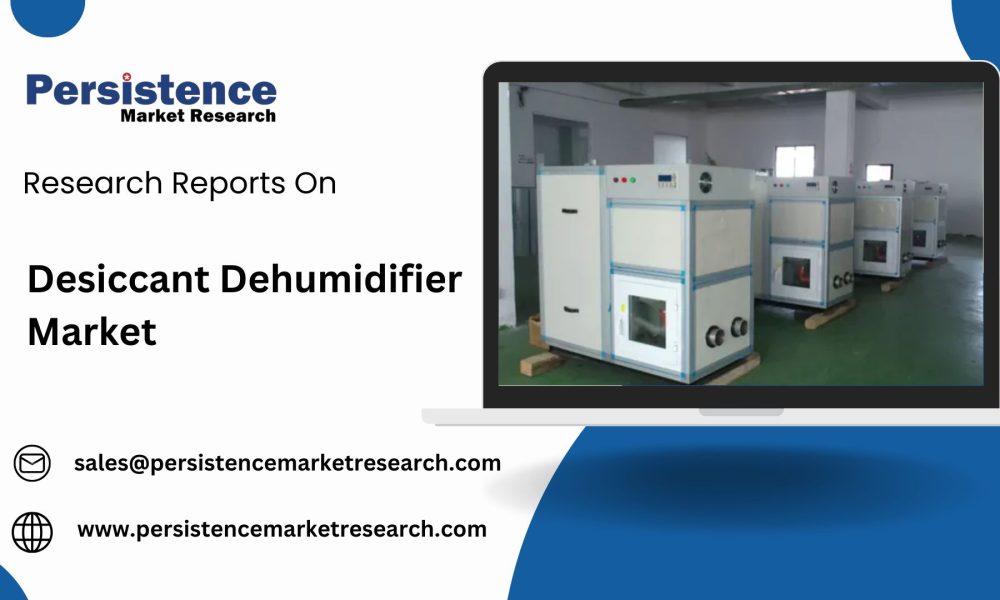
The global desiccant dehumidifier market is witnessing steady growth, driven by its unique ability to precisely manage humidity in challenging environments. According to recent market analysis, the industry is estimated to reach US$ 588.1 Mn in 2024, and it is predicted to surge at a CAGR of 6.5% during 2024–2031, attaining a value of US$ 913.9 Mn by 2031. The increasing adoption of these devices across food processing, electronics manufacturing, pharmaceuticals, and construction is expected to significantly fuel growth.
Market Overview
Desiccant dehumidifiers are engineered to remove excess moisture from air using moisture-absorbing materials, most commonly silica gel or zeolite. Unlike refrigerant-based dehumidifiers, these machines remain effective in low-temperature and high-humidity conditions, making them highly suitable for industries where precision humidity control is critical.
With industries seeking more sustainable and energy-efficient solutions, desiccant dehumidifiers have gained prominence due to their eco-friendly design, portability, and operational flexibility. In 2024, global demand for dehumidifiers is set to accelerate, with desiccant-based systems leading the market transformation.
Key Market Drivers
- Rising Demand in Food Processing and Storage
Moisture control plays a vital role in preserving food quality and extending shelf life. Desiccant dehumidifiers are extensively used in dry storage areas, cold rooms, and packaging lines to prevent mold, bacteria growth, and product spoilage. With the global food industry growing rapidly, the demand for advanced humidity control systems is increasing.
- Growth in Pharmaceutical and Healthcare Applications
In the pharmaceutical industry, humidity can compromise the stability of medicines, vaccines, and biological products. Desiccant dehumidifiers are employed in cleanrooms, laboratories, and production facilities to maintain precise humidity levels, ensuring compliance with stringent regulatory standards.
- Electronics Manufacturing Requirements
High humidity poses risks such as corrosion, condensation, and electrostatic discharge in electronics manufacturing. Desiccant dehumidifiers help maintain controlled environments for semiconductors, circuit boards, and sensitive components, which is driving demand across Asia-Pacific, particularly in countries like China, South Korea, and Japan.
- Construction and Disaster Recovery Applications
Temporary and portable moisture control solutions are increasingly in demand. For example, in June 2024, a large-scale construction project in California utilized desiccant dehumidifiers to prevent material degradation by maintaining specific humidity thresholds. Similarly, in disaster recovery situations such as flooding or hurricanes, portable dehumidifiers help restore damaged buildings and reduce mold risks.
- Sustainability and Energy Efficiency
Eco-friendly desiccant materials, particularly silica gel-based dehumidifiers, align with industries’ push toward sustainable operations. Their low energy consumption compared to refrigerant-based models makes them a preferred choice for companies looking to reduce carbon footprints.
Market Challenges
Despite robust growth, the desiccant dehumidifier market faces certain challenges:
- High Initial Costs: Advanced models require significant upfront investment, which can be a barrier for small enterprises.
- Maintenance Requirements: Desiccant wheels and filters need regular replacement or regeneration, adding to operational costs.
- Competition from Refrigerant Dehumidifiers: In moderate climates, refrigerant-based systems remain cheaper and effective, creating competitive pressure.
However, technological innovations are expected to reduce costs and improve efficiency, mitigating these challenges over time.
Elevate your business strategy with comprehensive market data. Request a sample report now: https://www.persistencemarketresearch.com/samples/35020
Regional Insights
North America
North America holds a significant share of the market due to widespread use in construction, pharmaceuticals, and food processing. The United States leads adoption, particularly in sectors requiring precision climate control.
Europe
Europe demonstrates strong demand owing to stringent food safety standards, cleanroom requirements, and increasing investments in sustainable infrastructure. Germany, the United Kingdom, and France are key contributors.
Asia-Pacific
The fastest-growing region, driven by booming electronics manufacturing, pharmaceutical production, and rapid industrialization. Countries like China, Japan, and India are witnessing accelerated adoption of desiccant dehumidifiers.
Middle East & Africa
Rising investments in infrastructure, food storage facilities, and healthcare systems are fueling gradual market growth. Harsh climatic conditions in the Gulf region make humidity control a necessity.
Latin America
Emerging adoption in construction, agriculture, and food processing sectors is expanding the market footprint in Brazil, Mexico, and Argentina.
Segmentation Analysis
The market can be segmented by:
- Type: Fixed vs. Portable Dehumidifiers.
- Application: Food, Pharmaceuticals, Electronics, Construction, Energy, and Others.
- End-User Industry: Industrial, Commercial, and Residential.
Among these, industrial applications dominate due to stringent humidity requirements in critical sectors. However, the portable segment is gaining traction, especially in construction and emergency restoration services.
Technological Advancements
The desiccant dehumidifier industry is undergoing significant technological improvements, such as:
- Hybrid Systems: Combining refrigerant and desiccant technologies for greater efficiency.
- Smart Controls: IoT-enabled dehumidifiers that allow remote monitoring and automatic adjustments.
- Eco-Friendly Desiccants: Innovations in sustainable, recyclable moisture-absorbing materials.
- Energy Recovery Systems: Utilizing waste heat to regenerate desiccants, reducing energy consumption.
Recent Industry Developments
- June 2024: A leading California construction project deployed large-scale desiccant dehumidifiers for precision moisture control.
- April 2024: A major electronics manufacturer in South Korea integrated AI-powered desiccant dehumidifiers to optimize cleanroom conditions.
- February 2024: A pharmaceutical company in Europe installed eco-friendly silica gel-based dehumidifiers to enhance production efficiency and meet regulatory standards.
These developments highlight the growing versatility and demand for desiccant dehumidifiers across industries.
Future Outlook
The desiccant dehumidifier market is poised for sustained growth through 2031. Increasing emphasis on sustainability, regulatory compliance, and product quality will keep demand strong across critical industries. Furthermore, rising global investments in infrastructure, food security, and healthcare will provide long-term opportunities for manufacturers.
By 2031, desiccant dehumidifiers are expected to become an integral part of industrial operations worldwide, with adoption further accelerated by technological advancements and cost optimization strategies.
Conclusion
The global desiccant dehumidifier market is entering a phase of robust growth, with industries recognizing its role in ensuring safety, quality, and sustainability. With the market projected to reach US$ 913.9 Mn by 2031, manufacturers are focusing on innovation, cost efficiency, and eco-friendly designs to meet rising global demand.
As businesses prioritize moisture management in complex environments, desiccant dehumidifiers will continue to establish themselves as indispensable tools in critical industrial processes.




