
Definition
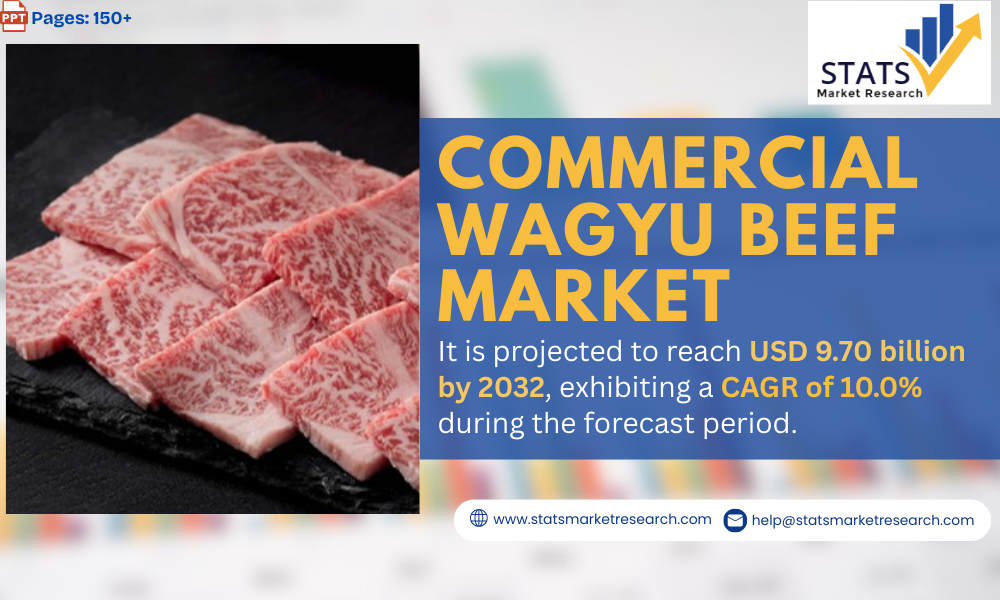
Global Commercial Wagyu Beef refers to a premium segment of beef derived from Wagyu cattle, a term that literally means “Japanese cattle.” These cattle are genetically predisposed to produce finely marbled meat with a higher proportion of monounsaturated fats, particularly oleic acid, compared to conventional beef. This unique fat distribution ensures unparalleled tenderness, a buttery texture, and rich umami flavor, distinguishing Wagyu beef from other meat types.
Wagyu beef can be classified into various types based on genetic purity and breeding practices. Fullblood Wagyu refers to cattle that are 100% of Japanese lineage, typically originating from breeds like Japanese Black (Tajima), Japanese Brown, and others. Purebred Wagyu indicates at least 50% genetic purity, whereas crossbred Wagyu combines Wagyu genetics with other cattle breeds.
The market encompasses high-end restaurant offerings, retail sales, and specialty distribution channels, including online platforms. Its appeal is not just sensory; the meat’s nutritional profile, including higher conjugated linoleic acid (CLA) levels and lower cholesterol content compared to conventional beef, positions Wagyu as a healthier protein option for affluent, health-conscious consumers.
Globally, this market is shaped by both domestic production in Japan and international cultivation in countries like Australia, the U.S., and parts of Europe. Growth is driven by rising consumer demand for premium meats, expanding culinary culture, and increased accessibility via e-commerce and retail networks.
Recent Developments in the Commercial Wagyu Beef Market
The commercial Wagyu beef market is undergoing significant expansion, driven by a rising global appetite for high-quality, gourmet meat. A major recent development is the increasing investment in genetic research and breeding technologies to improve the quality and consistency of Wagyu beef worldwide. Producers are also adopting innovative farming practices, such as precision feeding and AI-driven monitoring systems, to ensure optimal cattle health and meat quality. Another notable trend is the push for greater transparency and authenticity, with producers using DNA traceability and QR codes to provide consumers with detailed information about the cattle’s origin, genetics, and feeding methods. This focus on premium quality, sustainability, and traceability is strengthening consumer trust and allowing for price premiums, further propelling the market’s growth.
Major Distribution Channels
The distribution of commercial Wagyu beef is primarily segmented into the foodservice and retail sectors. The foodservice channel, which includes high-end restaurants, luxury hotels, and steakhouses, remains the largest and most critical market for premium cuts, especially in regions like Asia-Pacific and North America. However, the retail segment is rapidly growing, with a strong emphasis on specialty butcher shops and gourmet food retailers that cater to discerning customers. A major recent shift is the explosive growth of e-commerce as a key distribution channel. Online platforms and direct-to-consumer (D2C) services are providing a convenient and discreet way for consumers to purchase exclusive cuts, broadening the market’s reach beyond traditional brick-and-mortar stores and making Wagyu more accessible to a global audience.
Market Size
Global Commercial Wagyu Beef market was valued at USD 5.06 billion in 2024 and is projected to reach USD 9.70 billion by 2032, growing at a CAGR of 10.0% during the forecast period.
Download FREE Sample of this Report @ https://www.statsmarketresearch.com/download-free-sample/8058529/global-commercial-wagyu-beef-forecast-market
Historically, the market has seen consistent expansion, largely driven by the premiumization of food consumption and the rising popularity of gourmet dining. In Asia-Pacific, particularly Japan, Wagyu accounts for the largest market share, capturing 81% of total global demand. North America represents around 11%, driven by luxury restaurants and growing retail availability.
By product category, Fullblood Wagyu dominates with 65% market share due to its genetic purity and superior marbling characteristics. Retail channels have emerged as the primary sales conduit, accounting for 52% of global sales, reflecting the increasing consumer accessibility to high-quality Wagyu through specialty grocers and online platforms.
Market projections indicate robust growth in emerging regions, particularly in China, Southeast Asia, and the Middle East, as rising affluence, luxury hotel expansions, and increasing awareness of premium protein sources drive demand. The market’s upward trajectory is further reinforced by innovative product offerings and value-added formats like Wagyu burgers, cured meats, and snack products.
Market Dynamics (Drivers, Restraints, Opportunities, and Challenges)
Drivers
Growing Premiumization Trend in Global Food Industry
Rising consumer willingness to pay for premium, ethically sourced proteins drives market expansion. Wagyu beef, priced 3–5 times higher than conventional beef, has become a status symbol in affluent markets. Globally, 72% of high-end steakhouse menus now feature Wagyu, compared to 38% five years ago, reflecting its growing premium appeal.
Health-Conscious Consumers Choosing High-Oleic Meat Proteins
Wagyu’s nutritional profile—high in oleic acid and CLA, low in cholesterol—aligns with health trends. Specialty retailers report 28% year-over-year growth in health-focused segments. Clinical studies show that consuming Wagyu can improve HDL cholesterol and reduce LDL oxidation, offering heart-health benefits comparable to olive oil.
Expansion of Premium Retail Channels and E-Commerce Availability
Retail growth has surged, with a 41% increase in retailers carrying certified Wagyu products since 2020. Direct-to-consumer e-commerce platforms report 300% revenue growth since 2021, supported by advanced cold-chain logistics. This omnichannel presence enables wider consumer access, previously restricted to high-end dining establishments.
Restraints
Extensive Production Timeline and Limited Supply
Fullblood Wagyu cattle take 28–32 months to reach market weight, nearly double conventional cattle. Limited genetic stock (around 3,000 fullblood breeding animals outside Japan) constrains supply, creating high prices and limiting market penetration. Global Wagyu production meets less than 0.3% of total beef demand.
Counterfeit Products and Labeling Fraud
Up to 38% of meat labeled “Wagyu” internationally lacks Japanese lineage, including terms like “American Kobe.” The absence of consistent global certification standards complicates market expansion and risks eroding premium consumer confidence.
Climate Change Impacts
Rising temperatures and extreme weather reduce optimal grazing days by 15% annually in Japan. Droughts in Australia and other key regions increase water requirements by 40% over conventional beef. Climate-controlled barns and alternative feed strategies elevate production costs.
Opportunities
Emerging Markets in Asia
Southeast Asia presents untapped potential, with China experiencing 22% CAGR in Wagyu imports since 2020. Vietnam, Indonesia, and other emerging markets are projected to represent over 30% of global sales by 2030, fueled by luxury hotels and restaurants.
Value-Added Product Innovation
Product innovation extends Wagyu beyond steak. Wagyu-blend burgers and cured meat lines have achieved 140% higher check values and 90% YOY growth, respectively, expanding consumption occasions to casual dining and snacking.
Blockchain Technology Enhances Traceability
Blockchain adoption ensures full lifecycle tracking, providing proof of origin, feeding regimen, and genetics. Early adopters report 28% higher customer retention, while enabling micro-segmentation for tiered pricing across market segments.
Challenges
Maintaining Genetic Integrity Globally
Crossbreeding and gene pool dilution can reduce marbling scores over generations. Maintaining breed purity requires expensive artificial insemination programs and rigorous performance testing.
Animal Welfare Scrutiny
Traditional finishing methods face scrutiny for intensive feeding practices. Pasture-based programs meet welfare standards but may compromise marbling quality. Balancing ethics with quality necessitates substantial R&D investments.
Trade Policy Volatility
Export restrictions from Japan and tariff disputes cause price fluctuations of 30–50% in key import markets. Inconsistent global classification standards exacerbate trade challenges.
Regional Analysis
Asia-Pacific dominates the global Wagyu beef market, primarily due to Japan’s historical cultivation and consumption culture, with 81% of total market share. China’s growing affluence and luxury food sector drive import demand.
North America, representing 11% market share, benefits from expanding retail and restaurant penetration, alongside rising consumer awareness of health and premium nutrition. Europe is a niche but growing market, emphasizing ethical production and pasture-based Wagyu.
Australia has emerged as a key international producer, leveraging favorable grazing conditions and vertical integration. Other regions, including the Middle East and Russia, are adopting Wagyu beef in luxury hospitality and gourmet segments.
Competitor Analysis
Key players leverage genetics, premium branding, and distribution control to maintain market leadership.
- Itoham Foods Inc. (Japan) – Market leader with 21% revenue share, strong distribution networks.
- Starzen Co., Ltd. (Japan) – 18% share, focused on premium restaurant partnerships.
- Australian Agricultural Company (AACo, Australia) – 9% share, vertically integrated.
- Rangers Valley (Australia) – Strong international export presence.
- Snake River Farms (U.S.) – Combines Wagyu genetics with local breeding.
Other notable players include Stone Axe Pastoral, Pardoo Beef, Mizusako Farm Group, Stockyard Beef, Mayura Station, Miratorg, Blackmore Wagyu, and Irongate Wagyu.
Competition focuses on genetic stock quality, distribution expansion, brand building, and innovative product formats.
Get the Complete Report & TOC @ https://www.statsmarketresearch.com/global-commercial-wagyu-beef-forecast-market-8058529
Global Commercial Wagyu Beef: Market Segmentation Analysis
This report provides a deep insight into the global Commercial Wagyu Beef, covering all its essential aspects. This ranges from a macro overview of the market to micro details of the market size, competitive landscape, development trend, niche market, key market drivers and challenges, SWOT analysis, value chain analysis, etc. The analysis helps the reader to shape the competition within the industries and strategies for the competitive environment to enhance the potential profit. Furthermore, it provides a simple framework for evaluating and assessing the position of the business organization. The report structure also focuses on the competitive landscape of the Global Commercial Wagyu Beef. This report introduces in detail the market share, market performance, product situation, operation situation, etc., of the main players, which helps the readers in the industry to identify the main competitors and deeply understand the competition pattern of the market. In a word, this report is a must-read for industry players, investors, researchers, consultants, business strategists, and all those who have any kind of stake or are planning to foray into the Commercial Wagyu Beef in any manner.
Market Segmentation (by Application)
- Foodservice (Restaurants, Hotels)
- Retail Consumers
- Processing Industry
- Others
Market Segmentation (by Type)
- Fullblood Wagyu
- Japanese Black (Tajima)
- Japanese Brown
- Others
- Purebred Wagyu
- Crossbred Wagyu
- Others
Key Company
- Itoham Foods Inc. (Japan)
- Starzen Co., Ltd. (Japan)
- Australian Agricultural Company (AACo) (Australia)
- Rangers Valley (Australia)
- Snake River Farms (U.S.)
- Stone Axe Pastoral Company (Australia)
- Pardoo Beef Corporation (Australia)
- Mizusako Farm Group (Japan)
- Stockyard Beef (Australia)
- Mayura Station (Australia)
- Miratorg (Russia)
- Blackmore Wagyu (U.S.)
- Irongate Wagyu (Australia)
Geographic Segmentation
- Asia-Pacific
- North America
- Europe
- Middle East & Africa
- South America
FAQ
Q1: What is the current market size of the Global Commercial Wagyu Beef?
A1: The market was valued at USD 5.06 billion in 2024 and is projected to reach USD 9.70 billion by 2032, growing at a CAGR of 10.0%.
Q2: Which are the key companies operating in the Global Commercial Wagyu Beef market?
A2: Key players include Itoham Foods Inc., Starzen Co., AACo, Rangers Valley, Snake River Farms, Stone Axe Pastoral, Pardoo Beef Corporation, Mizusako Farm Group, Stockyard Beef, Mayura Station, Miratorg, Blackmore Wagyu, and Irongate Wagyu.
Q3: What are the key growth drivers in the Global Commercial Wagyu Beef market?
A3: Growth drivers include premiumization trends, health-conscious consumer demand, expansion of retail and e-commerce channels, and rising adoption in emerging Asian markets.
Q4: Which regions dominate the Global Commercial Wagyu Beef market?
A4: Asia-Pacific dominates with 81% market share, led by Japan, followed by growing adoption in North America and emerging demand in Southeast Asia and the Middle East.
Q5: What are the emerging trends in the Global Commercial Wagyu Beef market?
A5: Emerging trends include value-added product innovation, blockchain-based traceability, expansion into emerging markets, and adoption of ethical and pasture-based production methods.
About Us
☎️ International: +1 (332) 2424 294
📄 Website: www.statsmarketresearch.com
Join us on LinkedIn:- https://www.linkedin.com/company/statsmarketresearch




