
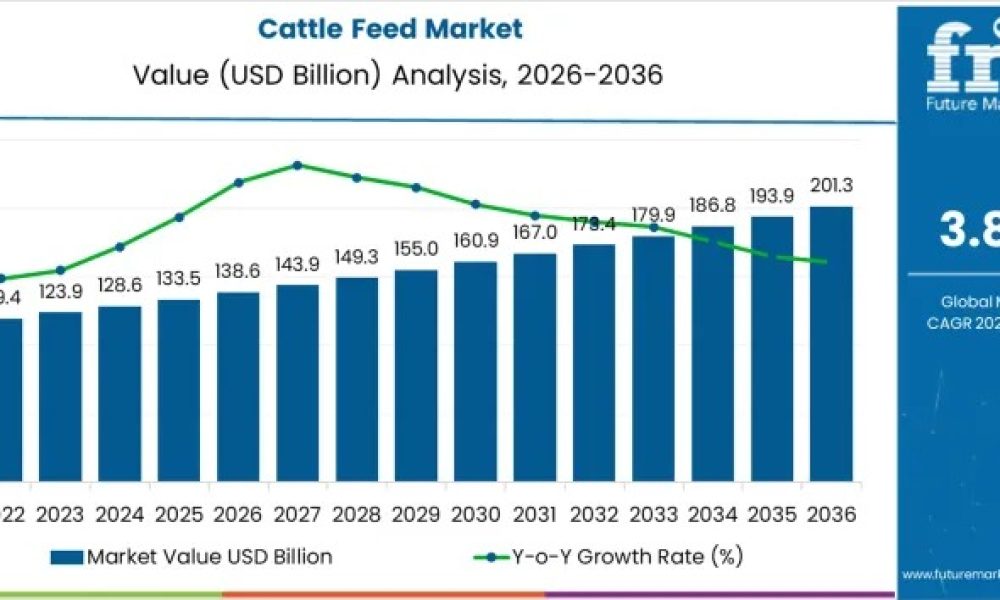
The global cattle feed market is entering a phase of sustained expansion, underpinned by rising consumption of meat and dairy products and the growing need to improve livestock productivity through balanced nutrition. According to industry analysis, the market is projected to grow from USD 138.6 billion in 2026 to USD 201.3 billion by 2036, registering a steady CAGR of 3.8% over the forecast period. This growth trajectory reflects structural shifts in global diets, particularly in emerging economies where protein-rich food consumption is increasing alongside urbanization and income growth.
Cattle feed plays a critical role in determining animal health, feed efficiency, and output quality across both dairy and beef production systems. As demand rises for consistent milk yields and leaner meat, producers are increasingly turning to scientifically formulated feeds that deliver optimal nutrition while controlling costs. This shift is reinforcing the importance of high-quality compound feed solutions in modern livestock farming.
Explore trends before investing – request a sample report today!
Market Snapshot Highlights
- Market Value (2026): USD 138.6 Billion
- Forecast Value (2036): USD 201.3 Billion
- Forecast CAGR (2026–2036): 3.8%
- Leading Product Type: Concentrate Foods
- Key Growth Regions: Asia Pacific, North America
- Top Players: Cargill Inc., Archer Daniels Midland (ADM), ForFarmers Inc., De Heus, Land O’Lakes Inc.
Demand Drivers Reshaping the Market
Growth in the cattle feed market is closely linked to the global rise in demand for animal-derived proteins. Developing regions across Asia Pacific, Latin America, and parts of Africa are witnessing dietary transitions toward higher meat and dairy intake. This has heightened the need for nutritionally balanced feed solutions that improve weight gain, milk yield, and herd health.
At the same time, livestock producers are under pressure to increase output sustainably. Feed efficiency, animal welfare, and environmental impact are now central to purchasing decisions. As a result, manufacturers are investing in advanced feed additives, improved formulations, and precision nutrition approaches that align feed intake with specific production goals.
Technology and Sustainability at the Core
Technological advancements are significantly influencing cattle feed production. Precision feeding systems, enzyme-based additives, probiotics, and amino acid optimization are enhancing nutrient absorption while reducing feed waste. These innovations help producers achieve higher productivity with lower input costs, supporting profitability amid volatile raw material prices.
Sustainability is also becoming a defining theme. Demand for eco-friendly feed options—such as plant-based ingredients, organic formulations, and antibiotic-free solutions—is growing rapidly. Consumers increasingly expect transparency across the food supply chain, pushing feed producers to focus on ingredient traceability, responsible sourcing, and reduced environmental footprints.
Segment-Wise Market Insights
By product type, concentrate feeds dominate with approximately 44% market share. Their nutrient-dense composition makes them indispensable for dairy and beef cattle, delivering essential proteins, energy, vitamins, and minerals required for optimal performance. Concentrates complement roughages such as hay and silage, enabling balanced diets that maximize productivity.
In terms of form, pelletized feeds account for around 34% of the market. Pellets are favored for their ease of handling, consistent nutrient delivery, and reduced wastage. Their uniform structure improves digestibility and ensures cattle receive balanced nutrition with every intake, supporting herd health and efficiency.
Regional Growth Outlook
Asia Pacific continues to emerge as a high-growth region, led by India, which is projected to expand at a CAGR of 8.2%. Growth is supported by the country’s vast livestock population, increasing dairy consumption, and rising awareness of scientific feeding practices among farmers. Government initiatives promoting modern animal husbandry further strengthen market momentum.
Developed markets such as Japan (4.3% CAGR) and the UK (3.5% CAGR) are driven by demand for premium meat and dairy products, strict animal welfare regulations, and strong emphasis on sustainability. Meanwhile, South Korea (3.4%) and Brazil (3.0%) continue to invest in efficient feeding systems to support modernized livestock operations and export-oriented production.
To Access The Full Market Analysis, Strategic Recommendations, And Analyst Support, Purchase The Complete Report Here.
Competitive Landscape and Strategic Focus
Competition in the cattle feed market centers on nutritional expertise, formulation science, and distribution reach. Leading players emphasize research-backed feed solutions that improve feed conversion ratios, support immune health, and enhance productivity across different cattle categories. Customization, advisory services, and integrated supply chains are increasingly used to differentiate offerings and build long-term farmer relationships.
As global livestock systems evolve to meet rising food demand sustainably, the cattle feed market is expected to remain a cornerstone of agricultural value chains. Continued innovation in nutrition, technology-driven feeding practices, and sustainability-focused formulations will shape the industry’s growth trajectory through 2036.
Key Players in Cattle Feed Market
- Cargill Inc.
- Archer Daniels Midland (ADM)
- ForFarmers Inc.
- De Heus
- Land O’Lakes Inc.
About Future Market Insights (FMI)
Future Market Insights, Inc. (FMI) is an ESOMAR-certified, ISO 9001:2015 market research and consulting organization, trusted by Fortune 500 clients and global enterprises. With operations in the U.S., UK, India, and Dubai, FMI provides data-backed insights and strategic intelligence across 30+ industries and 1,200 markets worldwide.



