
Barrier Systems Market Overview
Introduction
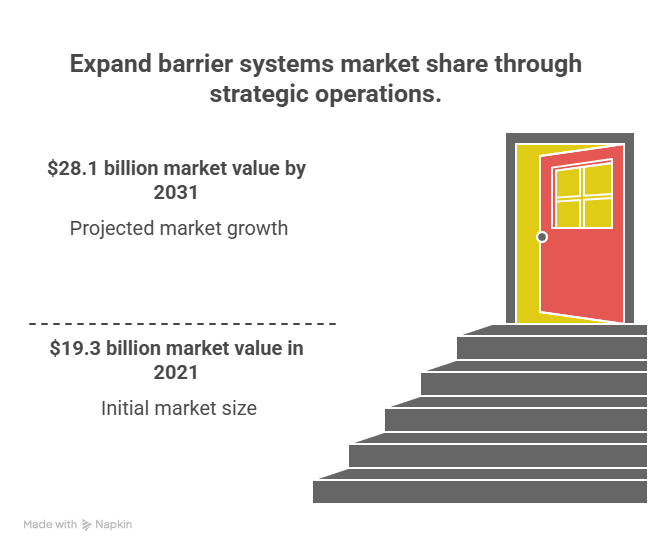
The global barrier systems market, valued at $19.3 billion in 2021, is projected to reach $28.1 billion by 2031, growing at a compound annual growth rate (CAGR) of 3.7% from 2022 to 2031. This growth is driven by increasing infrastructure investments in both developed and developing regions, coupled with the critical role of barrier systems in enhancing road safety and property management. Industry players are actively expanding their operations to strengthen their global market presence, capitalizing on the rising demand for advanced safety solutions across various applications.
Download PDF Sample Copy@ https://www.alliedmarketresearch.com/request-sample/1911
Market Dynamics
Barrier systems are essential for managing vehicular and pedestrian traffic, ensuring safety, and preventing unauthorized access to private properties. These systems are widely used in roadways, airports, railways, and commercial buildings, offering benefits like crash protection, traffic control, and enhanced security. The availability of barrier systems in materials such as steel, aluminum, plastic, wood, and concrete increases their versatility and cost-effectiveness, further driving market adoption.
Regional Insights
In 2021, Europe dominated the barrier systems market, holding over 37.4% of the global share, attributed to significant investments in infrastructure development and maintenance. The U.S. market is expected to grow at a CAGR of 3.6% from 2022 to 2031, driven by the need for advanced traffic management and safety solutions. The Asia-Pacific region is projected to be the fastest-growing market, fueled by rapid urbanization and infrastructure projects in countries like India and China, where government initiatives are boosting construction activities.
Segment Insights
The barrier systems market is segmented by device type, material, technology, application, and region. By device type, crash barrier systems led in 2021, accounting for over 61.5% of the revenue due to their critical role in reducing crash impacts on roadways. By material, the metal segment generated the highest revenue, driven by the durability and widespread use of metal crash barriers. By technology, flexible barriers are gaining traction for their ability to absorb impact, while rigid and semi-rigid systems remain popular for high-security applications. By application, the roadways segment dominated in 2021, while the railway segment is expected to grow at the fastest CAGR, driven by increasing rail and metro projects in emerging economies.
What are Barrier Systems?
Barrier systems are safety products designed to manage vehicular and pedestrian traffic, enhance road safety, and secure properties. These systems include fences, bollards, gates, crash barriers, and drop arms, used in applications ranging from roadways to commercial facilities. Constructed from materials like steel, tungsten, aluminum, plastic, wood, and concrete, barrier systems offer durability and versatility. They ensure smooth traffic flow, protect pedestrians and cyclists, and prevent unauthorized access, making them integral to modern infrastructure and property management.
Market Drivers
Infrastructure Investments
Rising infrastructure investments in both developed and developing regions are a key driver of the barrier systems market. Emerging economies like India and China are focusing on road, railway, and urban development projects, creating significant demand for barrier systems. For example, in 2022, India installed a rolling barrier guardrail system on the Nahan to Kumarhatti section of NH 907A, highlighting the growing emphasis on road safety.
Road Safety Awareness
Increasing awareness of road safety has boosted demand for barrier systems that provide crash protection. Flexible crash barriers, which reduce impact severity, are particularly valued for enhancing vehicle occupant safety. This trend is driving the adoption of advanced barrier systems in roadways, toll booths, and parking lots, contributing to market growth.
Real Estate and Property Management
The expansion of the real estate market, particularly in emerging economies, is driving demand for fencing and other barrier systems to secure properties and manage access. Barrier systems like drop arms and automated bollards are widely used in commercial buildings, parking areas, and pedestrian zones, enhancing security and operational efficiency.
Technological Advancements
Innovations in barrier system technologies, such as biometric access control and automated bollards, are expanding their applications. For instance, in October 2021, CAME introduced SYGMA 4, a centralized access control system for retractable bollards, simplifying their management in high-traffic areas. Such advancements improve usability and drive market adoption across various sectors.
Challenges
The barrier systems market faces challenges due to volatile raw material prices, particularly for metals like steel and aluminum, which increase production costs. The COVID-19 pandemic also disrupted the market, halting production and reducing infrastructure spending in 2020 and early 2021. Supply chain disruptions and economic slowdowns further impacted the industry, particularly in regions reliant on imported materials.
Impact of COVID-19
The COVID-19 pandemic significantly affected the barrier systems market, with lockdowns halting production and reducing demand for infrastructure projects. The economic slowdown led to decreased spending on residential and commercial construction, impacting the market in 2020. However, by mid-2022, the introduction of vaccines and declining COVID-19 cases facilitated a strong recovery. Manufacturing facilities resumed full-scale operations, and the resurgence of infrastructure projects restored market momentum, with companies showing notable signs of recovery.
Market Opportunities
The barrier systems market offers significant growth opportunities, particularly in emerging economies where rapid urbanization and infrastructure development are driving demand. The adoption of advanced technologies, such as automated control systems and biometric integration, is enhancing the functionality of barrier systems, making them suitable for high-security and high-traffic applications. Additionally, the focus on sustainable and cost-effective materials, such as recyclable plastics and composites, aligns with global environmental goals, creating new avenues for market expansion.
Competitive Landscape
The barrier systems market is competitive, with key players focusing on product innovation, strategic partnerships, and geographic expansion to strengthen their market position. Major companies include A-SAFE, Avon-barrier, Barrier1 Systems, Inc., DELTABLOC, Global GRAB Technologies, Inc., Gramm Barrier Systems Limited, Hill & Smith Barrier, Lindsay Corporation, Tata Steel Europe, and Valmont Structures Pvt. Ltd. These players are investing in advanced technologies and expanding their product portfolios to meet diverse customer needs, such as CAME’s SYGMA 4 system for retractable bollards.
Market Segmentation
The barrier systems market is segmented as follows:
- By Device Type: Fences, Bollards, Gates, Crash Barrier Systems, Drop Arms
- By Material: Metal, Non-Metal
- By Technology: Rigid, Semi-Rigid, Flexible
- By Application: Roadways, Airports, Railways, Others
- By Region: North America (U.S., Canada, Mexico), Europe (Germany, France, UK, Italy, Rest of Europe), Asia-Pacific (China, India, Japan, South Korea, Rest of Asia-Pacific), LAMEA (Latin America, Middle East, Africa)
In 2021, the crash barrier systems segment led by device type, metal by material, and roadways by application. The railway segment is expected to grow at the fastest CAGR. Europe held the largest market share, while Asia-Pacific is projected to grow the fastest.
Key Benefits for Stakeholders
This market analysis provides stakeholders with critical insights, including:
- Quantitative analysis of market segments, trends, and dynamics from 2021 to 2031.
- Identification of key drivers, restraints, and opportunities shaping the market.
- Porter’s Five Forces analysis to assess buyer and supplier dynamics.
- In-depth segmentation to pinpoint high-growth opportunities.
- Mapping of major countries by revenue contribution.
- Benchmarking of market players to understand competitive positioning.
- Comprehensive regional and global market trends to inform strategic decisions.
The global barrier systems market is poised for steady growth, driven by infrastructure investments, rising road safety awareness, and technological advancements. With a projected market size of $28.1 billion by 2031, the industry offers significant opportunities for stakeholders. Europe remains the largest market, while Asia-Pacific is expected to grow the fastest. Continued innovation and the expansion of infrastructure projects in emerging economies will drive the adoption of barrier systems, reinforcing their critical role in safety and property management.
About Us:
Allied Market Research (AMR) is a full-service market research and business-consulting wing of Allied Analytics LLP based in Portland, Oregon. Allied Market Research provides global enterprises as well as medium and small businesses with unmatched quality of “Market Research Reports” and “Business Intelligence Solutions.” AMR has a targeted view to provide business insights and consulting to assist its clients to make strategic business decisions and achieve sustainable growth in their respective market domain.
We are in professional corporate relations with various companies and this helps us in digging out market data that helps us generate accurate research data tables and confirms utmost accuracy in our market forecasting. Allied Market Research CEO Pawan Kumar is instrumental in inspiring and encouraging everyone associated with the company to maintain high quality of data and help clients in every way possible to achieve success. Each and every data presented in the reports published by us is extracted through primary interviews with top officials from leading companies of domain concerned. Our secondary data procurement methodology includes deep online and offline research and discussion with knowledgeable professionals and analysts in the industry.
Contact us:
United States
1209 Orange Street,
Corporation Trust Center,
Wilmington, New Castle,
Delaware 19801 USA.
Int’l: +1-503-894-6022
Toll Free: +1-800-792-5285
Fax: +1-800-792-5285
[email protected]
Construction article https://www.blogger.com/u/1/blog/posts/6325262245204971203
Construction blog https://vijayconma.medium.com/




