
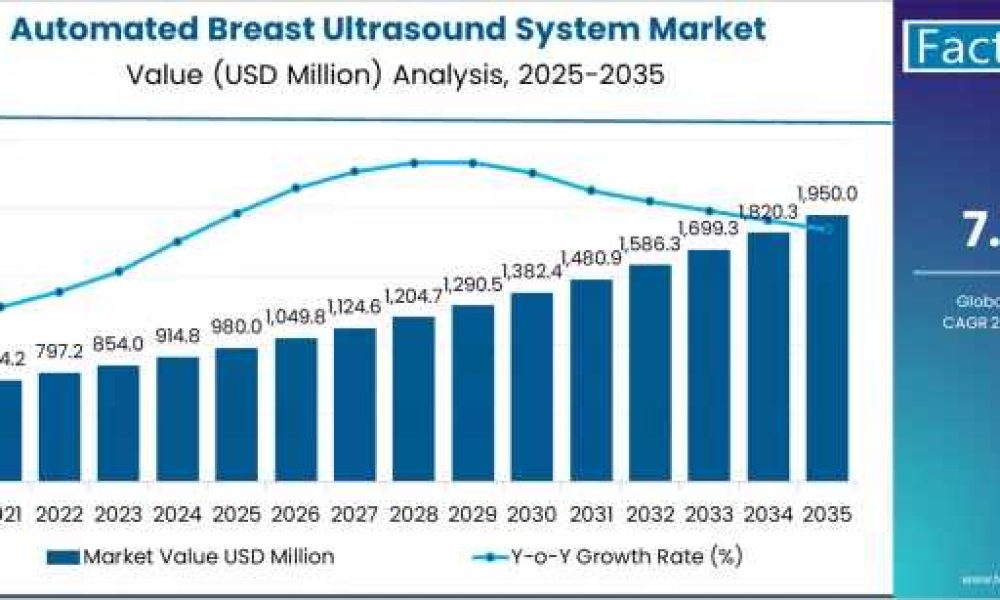
Global Automated Breast Ultrasound System (ABUS) Market Set to Transform Oncology Diagnostics; Forecasted to Reach New Heights by 2036
The global Automated Breast Ultrasound System (ABUS) market is entering a decade of unprecedented transformation, with new industry data projecting a robust growth trajectory through 2036. Driven by an urgent clinical shift toward personalized screening for women with dense breast tissue and the integration of sophisticated Artificial Intelligence (AI), the market is evolving from a niche supplemental tool into a cornerstone of modern oncological infrastructure.
As of early 2026, the global ABUS market is valued at approximately $1.03 billion and is expected to maintain a compound annual growth rate (CAGR) exceeding 12% over the next ten years. This growth is underpinned by a rising global incidence of breast cancer and a legislative push—particularly in North America and Europe—mandating that healthcare providers inform patients about breast density and the limitations of traditional mammography.
Request for Sample Report | Customize Report |purchase Full Report – https://www.factmr.com/connectus/sample?flag=S&rep_id=585
Addressing the “Dense Breast” Diagnostic Gap
The primary catalyst for the widespread adoption of ABUS technology is its unique ability to overcome the “masking effect” in dense breast tissue. Standard 2D mammography can miss up to one-third of cancers in dense breasts, where both connective tissue and tumors appear white on an X-ray.
“We are moving away from a ‘one-size-fits-all’ screening model,” says a lead medical analyst. “ABUS provides a standardized, operator-independent 3D volume of the breast that allows radiologists to see through dense tissue, significantly increasing the detection of small, invasive cancers that were previously occult.”
Market Drivers: AI Integration and Decentralized Care
The 2026–2036 forecast period highlights two critical shifts in the market:
The AI Revolution: Next-generation ABUS units are now shipping with embedded AI algorithms that provide real-time lesion characterization and triage. These tools reduce the “reading time” for radiologists by highlighting suspicious areas, thereby addressing the global shortage of specialized imaging staff.
The Rise of Diagnostic Centers: While hospitals currently hold a 54.7% market share, specialized diagnostic imaging centers and women’s health clinics are the fastest-growing segments. The portability and streamlined workflow of 2026-era systems allow for high patient throughput in outpatient settings.
Regional Outlook: Asia-Pacific Poised for Rapid Expansion
While North America remains the largest market—holding nearly 39% of global revenue due to established reimbursement codes and high awareness—the Asia-Pacific region is projected to witness the highest growth rate through 2036.
Rapid urbanization in China and India, coupled with significant government investment in women’s healthcare infrastructure, is driving a surge in demand. Furthermore, the higher prevalence of dense breast tissue among Asian populations makes ABUS a more culturally and clinically relevant diagnostic choice compared to traditional methods alone.
Competitive Landscape and Innovation
The market remains highly competitive, led by medical technology giants and agile innovators focusing on 3D/4D volumetric imaging. Key players currently shaping the 2026 landscape include:
| Key Market Leaders | Recent Strategic Focus |
| GE HealthCare | Advanced AI-driven Invenia platforms for high-volume screening. |
| Siemens Healthineers | Integration of ABUS with broader oncology workflow ecosystems. |
| Philips Healthcare | Focus on ergonomic design and cloud-based image analysis. |
| Canon Medical Systems | High-resolution transducer technology for deep-tissue penetration. |
| iSono Health | Pioneering wearable, automated 3D ultrasound systems. |
Future Outlook: 2026–2036
As the industry looks toward 2036, the focus is shifting toward “Radiomics”—the extraction of large amounts of data from medical images to predict treatment outcomes. The ABUS of the next decade will not only detect tumors but will likely provide biological signatures that help oncologists tailor chemotherapy and surgical plans to the individual patient.
About the Industry Report
The “Automated Breast Ultrasound System Market Analysis 2026-2036” is a comprehensive study of global trends, providing stakeholders with data-driven insights into technological shifts, regulatory changes, and investment opportunities in the breast imaging sector.
Related Reports
Automated Medical Washer Disinfector Market
Contact Us –
11140 Rockville Pike, Suite 400, Rockville,
MD 20852, United States
Tel: +1 (628) 251-1583 | [email protected]
About Fact.MR
Fact.MR is a global market research and consulting firm, trusted by Fortune 500 companies and emerging businesses for reliable insights and strategic intelligence. With a presence across the U.S., UK, India, and Dubai, we deliver data-driven research and tailored consulting solutions across 30+ industries and 1,000+ markets. Backed by deep expertise and advanced analytics, Fact.MR helps organizations uncover opportunities, reduce risks, and make informed decisions for sustainable growth.



