
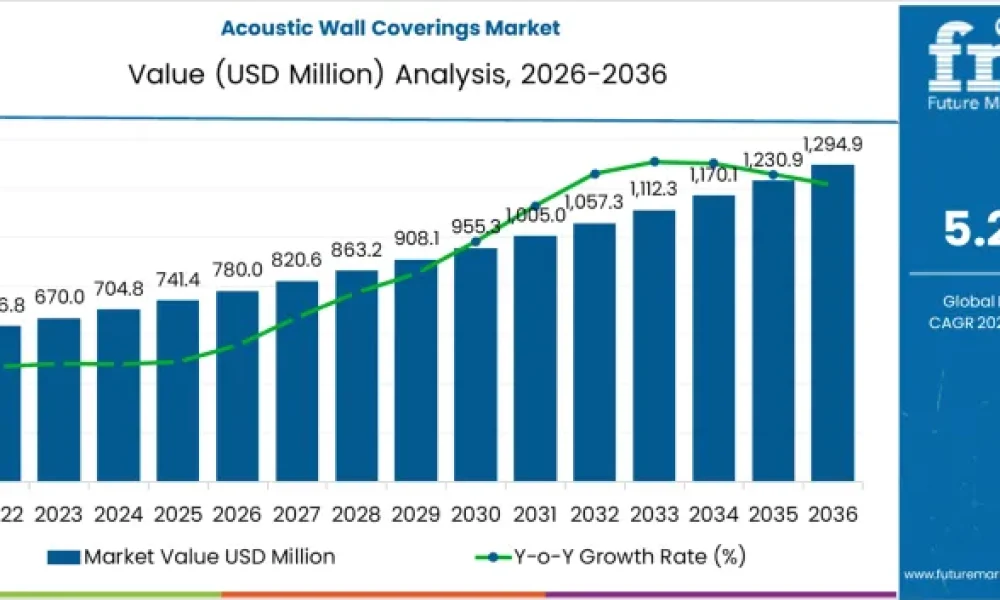
The global Acoustic Wall Coverings Market is projected to witness robust growth from USD 780.0 million in 2026 to an impressive USD 1,294.5 million by 2036, expanding at a steady CAGR of 5.2%. This surge reflects a fundamental shift in how interior spaces are designed, emphasizing functional acoustics over mere surface aesthetics. Both established manufacturers and innovative newcomers are capitalizing on evolving demands, leveraging new technologies and expanding their footprints in key emerging markets.
Gain access to detailed segment-wise analysis and forecast statistics – Request the Sample Report Today
Driving Forces Behind Market Growth
Interior environments such as open offices, hybrid classrooms, healthcare wards, and hospitality venues increasingly demand effective sound absorption solutions due to the rise in speech overlap and prolonged reverberation. Acoustic wall coverings have become indispensable where ceiling treatments fall short due to structural constraints or dense service installations. Facility planners and designers prioritize acoustic panels that offer excellent sound absorption, fire resistance, surface durability, and long-lasting appearance even under rigorous cleaning.
Key Segments of the Acoustic Wall Coverings Market
- Product Format
- Wall-Mounted Acoustic Panels: Leading the market with a 46% demand share due to versatile installation options and consistent absorption performance.
- Wall Tiles & Modular Systems: Gaining traction for their design flexibility and ease of retrofit.
- Acoustic Wallpapers & Films: Preferred for thin profiles but with limited absorption capacity.
- Other Formats: Include specialized or custom absorptive wall coverings.
- Material Composition
- Mineral Fiber: Dominates with 28% share owing to superior reverberation control and fire resistance.
- PET Felt & Polyester: Growing for sustainability benefits and reliable performance.
- Wood Wool & Perforated Wood: Favored for aesthetic-driven projects.
- Fabric-Wrapped Systems: Combine visual appeal with acoustic efficiency.
- End-Use Sectors
- Commercial Interiors: Command the largest share at 52%, reflecting dense workspace layouts requiring acoustic clarity.
- Education: Focus on speech intelligibility in classrooms and lecture halls.
- Healthcare: Acoustic comfort directly linked to patient outcomes and staff communication.
- Residential: Selective use primarily for comfort and privacy enhancement.
- Geographical Focus
- Fastest-growing countries include India (6.4% CAGR), Vietnam (6.0%), Indonesia (5.7%), Saudi Arabia (5.3%), and the UAE (5.1%), driven by urbanization, regulatory compliance, and performance-oriented construction.
Market Insights: Why Demand is Accelerating
- The acoustic wall coverings market is not merely riding the wave of decorative trends; its expansion is closely tied to how people occupy and utilize spaces. Open-plan office environments and hybrid learning models increase the need for effective noise management, essential for concentration and communication. Similarly, healthcare facilities adopt acoustic solutions to reduce noise pollution, which can affect patient recovery.
- Key performance features such as high sound absorption coefficients, compliance with fire safety regulations, and durability under frequent cleaning make mineral fiber and PET-based systems especially popular. Procurement strategies increasingly favor suppliers providing comprehensive acoustic design support and certified performance data, ensuring products meet stringent interior and regulatory requirements.
- Advancements in material science — including enhanced composite cores and innovative surface patterns — are enabling manufacturers to deliver better absorption across mid and high-frequency sound ranges without compromising thickness or design flexibility.
Established and Emerging Players Driving Innovation
The market features a blend of renowned industry giants and innovative newcomers striving to capture expanding opportunities:
- Armstrong World Industries continues to lead by integrating acoustic performance with modular architectural design, offering solutions adaptable to diverse commercial interiors.
- ROCKWOOL (Rockfon) emphasizes stone wool acoustic panels known for superior fire resistance and durability.
- Saint-Gobain leverages gypsum-based products to align acoustic solutions with comprehensive interior construction needs.
- Knauf focuses on standardized installation methods suited for commercial applications.
- Hunter Douglas blends acoustic control with premium metal and textile finishes, catering to high-end architectural projects.
New entrants and regional manufacturers, especially in Asia Pacific and the Middle East, are adopting cutting-edge technologies such as sustainable PET felt composites and digitally customizable acoustic panels, aiming to expand their market share through innovation and local adaptation.
Regional Market Highlights
- India: Growing at a 6.4% CAGR, driven by dense IT and coworking spaces requiring reverberation control, healthcare privacy needs, and retrofit activity.
- Vietnam: Expanding at 6.0%, fueled by commercial interiors and hospitality venues emphasizing guest comfort.
- Indonesia: Demand rising at 5.7% due to institutional infrastructure and urban noise challenges.
- Saudi Arabia: Increasing at 5.3%, with focus on government, healthcare, and hospitality projects aligning with design-stage compliance.
- UAE: Moderate growth at 5.1%, led by premium commercial developments and refurbishment-driven replacements.
Market Challenges and Opportunities
While acoustic wall coverings enjoy rising demand, market scalability is influenced by:
- Fire and Safety Compliance: Increasing material and certification costs pose challenges for cost-sensitive projects.
- Durability and Maintenance: High-traffic areas demand products that resist staining and damage while maintaining acoustic performance.
- Customization vs. Standardization: Unique finishes and branding reduce standardization, requiring project-based procurement.
- Retrofit Complexity: Labor costs and wall preparation for retrofit installations can limit broad adoption in older buildings.
Despite these hurdles, the trend toward functional, well-performing interiors supported by noise control standards offers significant growth potential, especially in emerging economies where urbanization and commercial construction intensify.
Looking Forward: Strategic Outlook for Stakeholders
For manufacturers and suppliers, the future lies in developing acoustic wall coverings that balance performance, aesthetics, sustainability, and ease of installation. Partnerships with interior fit-out contractors, distributors, and direct manufacturer sales channels are critical to widening reach and influence.
Moreover, technology integration such as digitally-enabled design tools, modular systems for flexible deployment, and eco-friendly materials will drive competitive advantage.
Have a specific Requirements and Need Assistant on Report Pricing or Limited Budget please contact us – [email protected]
About Future Market Insights (FMI)
Future Market Insights, Inc. (FMI) is an ESOMAR-certified, ISO 9001:2015 market research and consulting organization, trusted by Fortune 500 clients and global enterprises. With operations in the U.S., UK, India, and Dubai, FMI provides data-backed insights and strategic intelligence across 30+ industries and 1200 markets worldwide
Why Choose FMI: https://www.futuremarketinsights.com/why-fmi



