
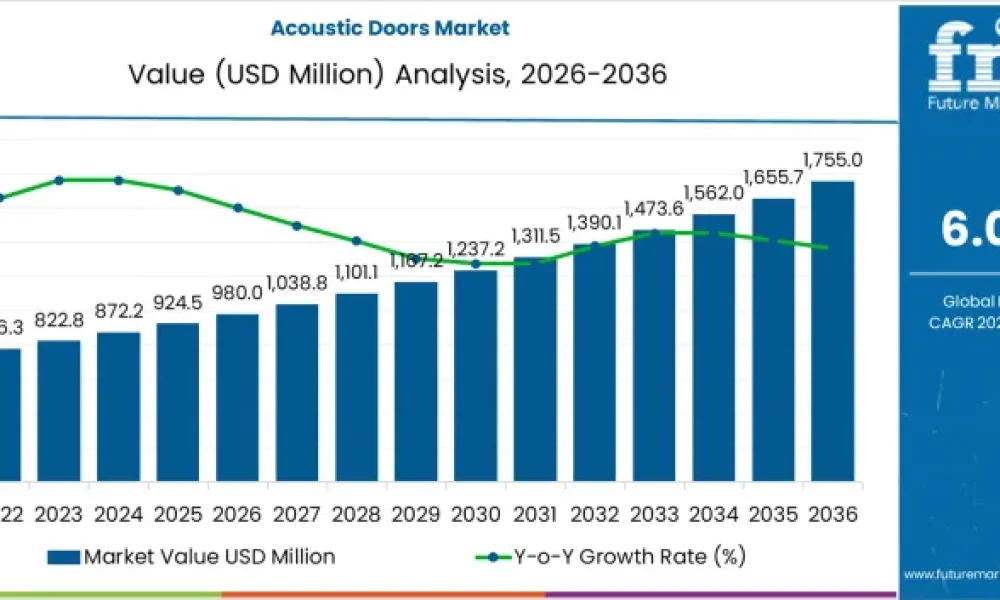
The global acoustic doors market is entering a decade of steady, compliance-driven expansion as sound control becomes a core requirement in modern building design rather than an optional enhancement. According to the latest market outlook, the acoustic doors market is projected to grow from USD 980.0 million in 2026 to USD 1,755.0 million by 2036, registering a CAGR of 6.0% over the forecast period.
This growth reflects long-term structural shifts in commercial, institutional, and infrastructure construction, where noise management directly impacts productivity, privacy, safety, and regulatory approval. Acoustic doors are increasingly specified at the design stage in offices, hospitals, educational campuses, hospitality venues, studios, and public buildings, ensuring predictable sound attenuation aligned with building codes and functional zoning requirements.
Gain access to detailed segment-wise analysis and forecast statistics – Request the Sample Report Today
Market Overview: Sound Control as a Design Mandate
Demand for acoustic doors is anchored in environments where sound transmission class (STC) ratings, fire resistance, accessibility compliance, and durability must work together as a unified system. Unlike cyclical construction materials, acoustic doors benefit from compliance-led procurement, particularly in regions with strict noise regulations and dense urban development.
Spending remains concentrated in commercial and institutional projects, where acoustic performance is verified during approvals. Performance consistency, installation accuracy, and long-term seal integrity strongly influence repeat demand, favoring manufacturers that deliver certified ratings and tight manufacturing tolerances over low-cost alternatives.
Why Is Demand for Acoustic Doors Growing
The rising need for acoustic zoning within buildings is a primary growth driver. Offices require separation between collaborative and quiet spaces, hospitals demand patient privacy, educational institutions need controlled learning environments, and hotels rely on sound isolation to protect guest experience.
Key demand drivers include:
- Stricter building noise regulations and standards
- Growth of mixed-use and high-density developments
- Expansion of healthcare and education infrastructure
- Rise of flexible workspaces and retrofit compliance audits
- Advances in engineered door cores and sealing technologies
Facility planners increasingly coordinate acoustic door selection with wall assemblies, HVAC systems, and access control solutions, reinforcing the role of doors as part of a comprehensive acoustic strategy.
Key Segments of the Acoustic Doors Market
By Door Type
- Single-Leaf Acoustic Doors (largest share – 46.0%)
- Double-Leaf Acoustic Doors
- Sliding Acoustic Doors
- Other Configurations
By Application
- Commercial Buildings (44.0% share)
- Hospitals & Healthcare
- Education
- Residential
By Performance Rating
- STC 40–50 (largest share – 44.0%)
- STC 30–40
- Above STC 50
- Other Ratings
By Sales Channel
- Specialist Contractors
- Direct Manufacturer Sales
- Building Distributors
- Other Channels
By Region
- Asia Pacific
- Europe
- North America
- Latin America
- Middle East & Africa
Segment Insights: What Leads and Why?
- Single-leaf acoustic doors dominate due to ease of installation, compatibility with standard openings, and reliable sealing performance.
- Commercial buildings lead applications, driven by productivity, privacy, and workplace noise compliance.
- STC 40–50 doors represent the most widely adopted performance range, offering a balance between effective noise reduction, cost, and manageable thickness for standard installations.
These segments reflect a market preference for practical, code-compliant solutions rather than extreme performance levels limited to niche applications.
Regional Growth Outlook: Emerging Markets Lead Expansion
Fastest-growing countries include:
- India (7.8% CAGR): Driven by IT offices, hospitals, educational institutions, and high urban noise exposure.
- Vietnam (7.2% CAGR): Supported by hospitality projects, serviced apartments, and flexible office developments.
- Indonesia (6.9% CAGR): Growth fueled by airports, government buildings, and institutional construction.
- Saudi Arabia (6.4% CAGR): Public infrastructure, healthcare, and hospitality megaprojects integrating acoustic compliance at design stage.
- UAE (6.1% CAGR): Premium commercial buildings, mixed-use developments, and tenant-led refurbishments.
Across these regions, growth is shaped by regulatory enforcement and functional performance requirements, not decorative interior trends.
Competitive Landscape: Established Leaders and Emerging Innovators
The acoustic doors market features a mix of global leaders and expanding regional manufacturers, creating opportunities for both established brands and new entrants investing in advanced materials and certified performance.
- ASSA ABLOY leads with a broad portfolio of certified acoustic door systems for commercial and institutional projects.
- dormakaba integrates acoustic performance with access control and fire safety solutions.
- Allegion focuses on healthcare, education, and office specifications.
- Hörmann emphasizes precision-engineered, high-rating acoustic doors.
- JELD-WEN, along with Masonite, Schüco, and Howden Joinery, addresses mid-range and architectural acoustic needs.
New and expanding manufacturers are investing in engineered cores, improved sealing systems, and faster certification cycles to compete in specification-driven procurement environments.
Outlook: Technology, Compliance, and Opportunity
From 2026 to 2036, the acoustic doors market will continue to grow as sound control becomes inseparable from building functionality. Manufacturers that align product innovation with regulatory compliance, installer support, and long-term performance verification will be best positioned to expand globally.
For both established players and new entrants, the market offers strong opportunities to scale through certified technologies, regional partnerships, and compliance-focused product development, making acoustic doors a critical component of next-generation building design.
Have a specific Requirements and Need Assistant on Report Pricing or Limited Budget please contact us – [email protected]
About Future Market Insights (FMI)
Future Market Insights, Inc. (FMI) is an ESOMAR-certified, ISO 9001:2015 market research and consulting organization, trusted by Fortune 500 clients and global enterprises. With operations in the U.S., UK, India, and Dubai, FMI provides data-backed insights and strategic intelligence across 30+ industries and 1200 markets worldwide
Why Choose FMI: https://www.futuremarketinsights.com/why-fmi



