
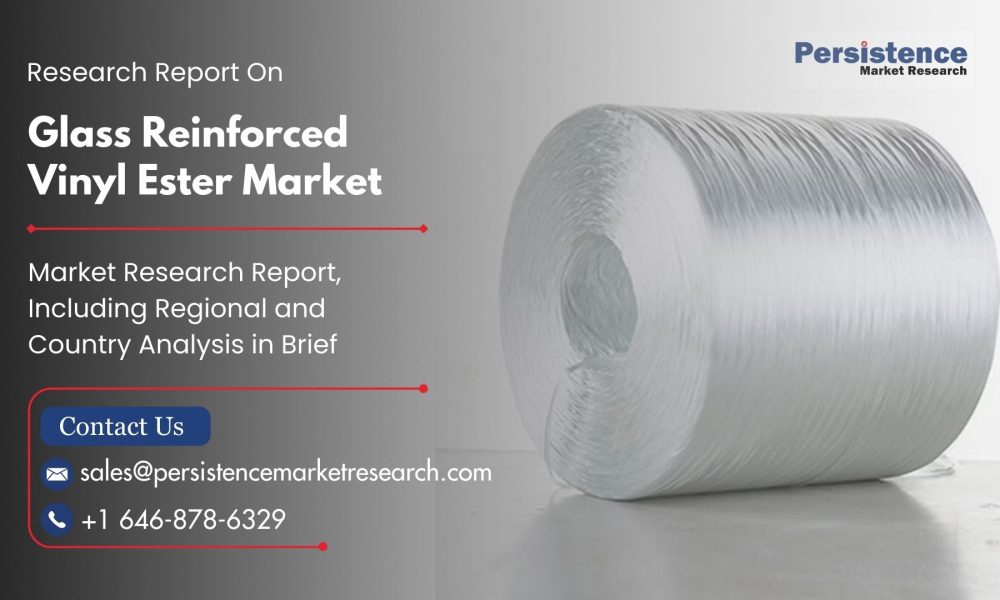
Glass Reinforced Vinyl Ester Market: Durable Materials Powering Industrial Growth
In an era defined by rapid industrialization, environmental regulations, and technological innovation, advanced composite materials are increasingly replacing traditional metals and plastics across critical applications. Among these high-performance materials, glass reinforced vinyl ester (GRVE) composites stand out due to their exceptional combination of strength, corrosion resistance, and durability. Used in demanding environments such as chemical processing, wastewater infrastructure, marine systems, and energy sectors, these materials are driving a growing market that’s expected to pass US$2 billion by 2033, up from an estimated US$1.2 billion in 2026.
This blog explores the current market landscape, growth drivers, challenges, and future opportunities in the glass reinforced vinyl ester market.
What Is Glass Reinforced Vinyl Ester?
Glass reinforced vinyl ester refers to a composite material made by reinforcing vinyl ester resin with glass fibers. Vinyl ester itself is a type of thermoset resin that occupies a middle ground between polyester and epoxy in terms of performance — offering superior chemical resistance and mechanical strength compared to polyester, while being more cost-effective than many epoxy systems.
When glass fibers are incorporated into the resin matrix, the resulting composite becomes lightweight, strong, and highly resistant to harsh environments — making it ideal for applications where traditional materials such as steel or concrete might fail due to corrosion, fatigue, or weight limitations.
Get Your FREE Sample Report Instantly – Click Now: https://www.persistencemarketresearch.com/samples/32699
Market Size and Growth Forecast
The global glass reinforced vinyl ester market is projected to grow at a compound annual growth rate (CAGR) of approximately 7.8% between 2026 and 2033. During this period, the market value is expected to increase from around US$1.2 billion to about US$2.0 billion due to rising industrial demand, infrastructure investment, and expanding applications in newer sectors like renewable energy and electric vehicles.
This growth trajectory reflects broader trends in material science, where industries seek materials that offer better performance, longer lifespans, and lower maintenance costs than conventional options.
Key Market Drivers
- Demand for Corrosion-Resistant Materials in Industrial Applications
One of the most significant drivers of the GRVE market is the increasing demand for materials that withstand aggressive chemical environments. Traditional metals corrode under exposure to acids, solvents, and saltwater — leading to frequent replacement and high maintenance costs. Glass reinforced vinyl ester composites, with their inherent resistance to corrosion, offer a long-term solution for pipelines, tanks, storage vessels, and industrial equipment.
Industries such as chemical processing, wastewater treatment, oil and gas, and power generation extensively deploy vinyl ester composites for handling corrosive fluids, aggressive chemicals, and high-pressure applications, supporting steady material demand.
- Infrastructure Modernization
Global infrastructure modernization — especially in emerging economies — is a major growth catalyst. Aging water and wastewater treatment systems, chemical storage facilities, and industrial plants require upgraded materials that ensure reliability and compliance with environmental standards. This has elevated consumption of vinyl ester composites in pipes, tanks, and structural components.
In regions like India, initiatives such as the National Mission for Clean Ganga and other infrastructure programs are boosting demand for corrosion-resistant piping and storage systems.
- Renewable Energy and Electrification Trends
The renewable energy sector, particularly offshore wind energy, is another rising opportunity for GRVE materials. Larger wind turbine blades require lightweight materials that maintain strength under prolonged environmental stress. Glass reinforced composites, including vinyl ester-based systems, are increasingly used in turbine blades and other structural components.
Similarly, the electric vehicle (EV) market is driving demand for composites in battery enclosures, thermal management systems, and structural components where lightweight, high-strength materials contribute to efficiency and safety.
Get a Customized Market View in One Click: https://www.persistencemarketresearch.com/request-customization/32699
Segment Insights: Resin, Application, and End-Use Industries
Resin Type Insights
Among different vinyl ester resin types — including Bisphenol A, Novolac, and Brominated variants — Bisphenol A epoxy vinyl ester remains the dominant resin segment due to its balanced performance in handling chemical exposure, mechanical stress, and thermal conditions. Established production infrastructure and broad industrial usage further strengthen its market position.
Application Segments
The pipes and tanks segment accounts for the largest portion of the market, representing roughly 43% of demand. These applications benefit most from vinyl ester’s chemical resistance and structural durability, particularly in industrial fluid transport and storage.
Other important applications include marine components, automotive parts, building and construction materials, and electrical and electronics components. Each of these markets increasingly favors composites over metals and traditional polymers for reasons like corrosion resistance, weight reduction, and design flexibility.
End-Use Industries
The chemical processing industry leads end-use demand due to aggressive chemical handling environments requiring corrosion-resistant materials. Wastewater treatment is the fastest-growing end-use category, driven by urbanization, stricter discharge regulations, and the need for reliable treatment infrastructure worldwide.
Oil and gas, as well as power generation industries, also contribute significantly to demand due to the need for high-performance composites that endure pressure, corrosive fluids, and extreme temperatures.
Regional Market Dynamics
North America Leads Adoption
North America holds the largest share of the global market (about 38.6%), supported by advanced manufacturing capabilities, stringent environmental regulations, and strong industrial demand. In the United States, regulatory bodies such as the EPA and OSHA enforce high performance and safety standards, nudging companies toward premium corrosion-resistant materials like glass reinforced vinyl ester composites.
Europe: Mature but Challenged
Europe represents a mature but relatively slower-growing market. Despite having established industrial bases in Germany, the UK, and other economies, stringent environmental emissions rules and higher production costs have constrained some segments. The transition to compliant manufacturing techniques in the region has shifted some capacity to resin transfer molding and winding technologies.
Asia Pacific: Fastest Growing Region
Asia Pacific is projected to grow at an estimated 9.6% CAGR through 2033, driven by rapid industrialization, expanding infrastructure projects, and increasing renewable energy deployment. China dominates regional consumption due to high manufacturing activity, while India’s extensive wastewater and industrial initiatives further accelerate demand.
Market Challenges
Despite strong growth prospects, the glass reinforced vinyl ester market faces several hurdles:
- Volatile Raw Material Costs: Styrene, a key component of vinyl ester resins, is tied to volatile petrochemical markets, exposing manufacturers to price fluctuations that can impact profitability and pricing.
- Environmental Regulation Compliance: Stricter regulations governing volatile organic compound (VOC) emissions and hazardous materials require costly process adjustments — particularly in North America and Europe — raising barriers for smaller producers.
- Competition from Alternative Materials: Thermoplastics and other composites compete with vinyl ester based on cost, recyclability, or processing advantages in specific applications.
Competitive Landscape
The GRVE market is moderately consolidated. Leading multinational manufacturers such as INEOS Composites, Polynt-Reichhold Group, and Scott Bader Company Ltd. dominate approximately 60% of global share, leveraging advanced formulations, integrated supply chains, and technical support services.
Other major players include Ashland Global Holdings, Hexion Inc., BASF SE, Mitsubishi Corporation, Sika AG, and regional producers like Swancor Holding Co., Ltd. Companies differentiate themselves through product innovation, customized resin systems, regulatory compliance, and global distribution networks.
Future Outlook and Opportunities
Looking ahead, the market is poised for continued expansion, with key growth avenues including:
- Renewable Energy Components: As wind and solar energy capacity expands globally, composites like glass reinforced vinyl ester will be increasingly used in blades, housings, and structural elements.
- EV and Thermal Management Materials: Electric vehicle adoption will drive demand for advanced composites tailored to battery enclosures and thermal systems.
- Bio-Based and Sustainable Resins: Demand for environmentally friendly composite solutions is encouraging development of bio-derived vinyl ester formulations.
- Emerging Market Penetration: Latin America, the Middle East, and Africa are likely to see increasing adoption as infrastructure projects and industrial investments grow.
For In-Depth Competitive Analysis, Buy Now: https://www.persistencemarketresearch.com/checkout/32699
Conclusion
The glass reinforced vinyl ester market is on a robust growth path, driven by industrial demand for durable, high-performance composite materials that outperform traditional materials in harsh environments. With broad applications spanning chemical processing, water infrastructure, marine systems, renewable energy, and beyond, GRVE composites represent a material class critical to modern industrial and sustainable development. Rising investments, technological innovation, and environmental compliance commitments position this market for continued expansion through 2033 and beyond.
About Persistence Market Research:
Persistence Market Research delivers strategic research solutions that drive business growth. Founded in 2012 and registered in England and Wales in 2023 as Persistence Research & Consultancy Services Ltd., we have completed 3,600+ custom and syndicated studies and supported 2,700+ projects for leading research firms. Combining traditional methodologies with modern tools, we provide actionable insights to multinational corporations, consultants, investors, and government bodies, earning strong trust through long-term client relationships.
Contact Us:
Persistence Market Research
Second Floor, 150 Fleet Street,
London, EC4A 2DQ, United Kingdom
USA Phone: +1 646-878-6329
UK Phone: +44 203-837-5656
Email: [email protected]
Web: https://www.persistencemarketresearch.com




