
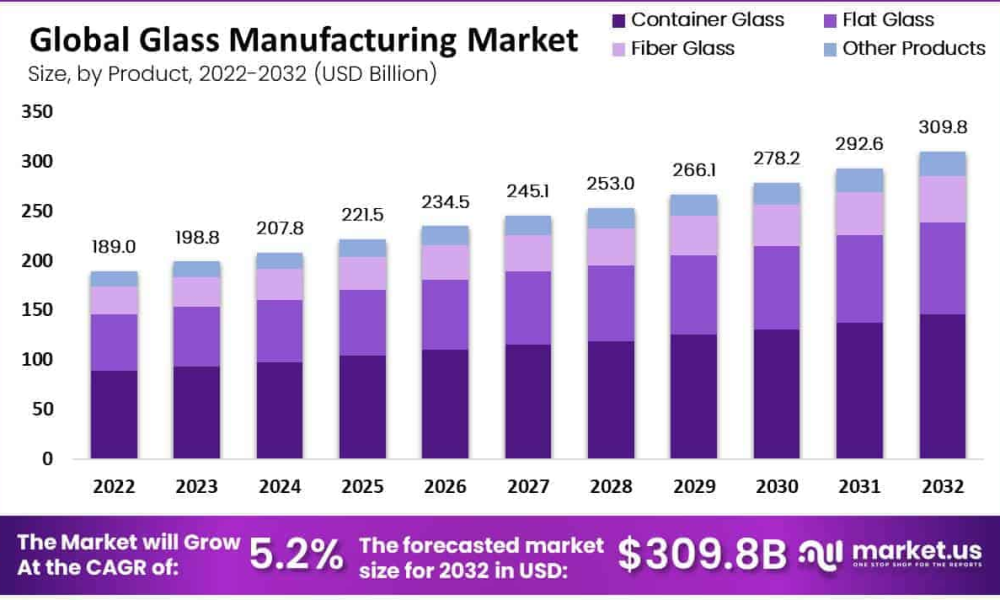
New York, NY – July 15, 2025 – The Global Glass Manufacturing Market is growing fast, driven by high demand from industries like construction, automotive, and packaging. In 2022, the market was valued at USD 189.0 billion, and it is expected to reach USD 309.8 billion by 2032, growing at a 5.2% CAGR from 2023 to 2032.
The rising need for energy-efficient and sustainable glass in buildings, along with the increasing use of glass in solar panels and electronics, is boosting the Glass Manufacturing market demand. Urbanization, smart city projects, and the popularity of lightweight, durable glass in cars and consumer goods also fuel growth.
Using recycled glass, or cullet, in manufacturing significantly lowers energy consumption. Industry data indicates that for every 10% of cullet incorporated into the production process, energy savings range from 2-3%, as cullet melts at a lower temperature than raw materials.
Globally, governments are promoting recycled material use through policies and regulations. In the European Union, ambitious recycling targets and directives aim to boost recycling rates for materials like glass, with a specific goal of achieving and sustaining a 75% recycling rate for glass packaging.
The Glass Manufacturing market is expanding due to new technologies, like smart glass and advanced coatings, which improve performance and energy savings. Emerging economies in Asia-Pacific and Africa offer big opportunities, as construction and infrastructure projects increase. With more companies investing in eco-friendly and recyclable glass, the market is set to grow even further, making it a key industry for future development.
As global efforts to cut energy use intensify, energy-efficient buildings are increasingly prioritized. Glass is critical in these efforts due to its impact on building energy performance. For example, low-emissivity (low-E) glass in windows can reduce energy loss by up to 50%, according to the U.S. Department of Energy (DOE).
Important Revelation
- Glass Manufacturing Market size is expected to be worth around USD 309.8 billion by 2033, from USD 189 billion in 2023, growing at a CAGR of 5.2%
- Flat glass held a dominant glass manufacturing market position, capturing more than a 46.3% share.
- Float Process held a dominant glass manufacturing market position, capturing more than a 54.5% share.
- Construction held a dominant glass manufacturing market position, capturing more than a 44.3% share.
➤ Download Exclusive Sample Of This Premium Report (Including Full TOC, Table & Figures): https://market.us/report/glass-manufacturing-market/request-sample/
Report Segmentation
By Product Analysis
- In 2023, flat glass emerged as the leading product segment in the global glass manufacturing market, accounting for over 46.3% of the total market share. This dominance was primarily attributed to its widespread application in the construction and automotive industries, where it is extensively used for windows, facades, and windshields due to its clarity, strength, and durability. The growing pace of residential and commercial construction activities, along with advancements in vehicle design and safety features, continued to support the demand for flat glass.
- Container glass also held a significant position in the market, driven by its extensive use in packaging applications, particularly within the food and beverage industry. Its inert nature ensures product integrity by preventing any chemical interaction with the contents, thereby extending shelf life and maintaining product quality. Rising consumer awareness and regulatory support for sustainable and recyclable packaging materials have further bolstered the demand for container glass.
- Fiberglass represented another key segment, with strong demand across insulation applications in the construction sector and industrial manufacturing. Its superior thermal and acoustic insulating properties, combined with lightweight and high-strength characteristics, have made it indispensable for energy-efficient buildings and lightweight automotive components.
By Manufacturing Process
- The Float Process held the dominant position in 2023, capturing over 54.5% of the global glass manufacturing market. This method is preferred for producing flat glass due to its capability to yield uniform, high-quality sheets that are essential in both construction and automotive applications. Its operational efficiency and scalability have positioned it as the most cost-effective process for mass production.
- The Blown Process, primarily used in the manufacturing of container glass, involves shaping molten glass through the introduction of air. This technique remains popular for its ability to produce distinct forms and designs, making it ideal for decorative and specialty containers.
- Pressing and Casting processes are employed where complex and precise geometries are required, such as in glassware, lighting components, and optical parts. These techniques allow for detailed control over form and thickness, enabling the production of high-specification items.
- The Drawing Process is particularly used for manufacturing fiberglass and select types of flat glass. By drawing molten glass through dies, the process enables the production of long fibers and uniform sheets, essential in applications demanding tensile strength and dimensional consistency.
By Application Analysis
- The construction sector led the application segment in 2023, contributing more than 44.3% to the global glass manufacturing market. Glass is heavily utilized in architectural projects for windows, facades, doors, and interior features, valued for its aesthetic appeal, natural light transmission, and insulation properties. The global emphasis on sustainable building practices and energy-efficient materials has accelerated the demand for innovative glass solutions with enhanced thermal and solar performance.
- Packaging followed as a major application area, with glass used predominantly for food and beverage containers. Its chemical stability and recyclability make it a preferred choice for brands focusing on eco-friendly and health-conscious packaging. Regulatory pressures and shifting consumer preferences towards sustainable alternatives have positively influenced the uptake of glass packaging.
- In the transportation sector, glass is integral to safety and performance, especially in automobiles and aircraft. Applications such as windshields, side windows, and sunroofs rely on treated glass that enhances visibility, resists impact, and supports structural integrity.
- The electrical and electronics segment also represents a critical area of demand, where glass is used in display technologies, insulation, and fiber optics. Requirements for precision, transparency, and durability drive innovation in this space.
- Telecommunication is another significant area, with fiber optic glass playing a pivotal role in modern communication infrastructure. As global broadband penetration expands, so does the demand for high-performance glass fibers capable of supporting fast, reliable data transmission.
Market Key Segmentation
Based on Product
- Container Glass
- Flat Glass
- Fiber Glass
- Other Products
By Manufacturing Process
- Float Process
- Blown Process
- Pressing and Casting
- Drawing Process
- Others
Based on Application
- Packaging
- Construction
- Transportation
- Electrical & Electronics
- Telecommunication
- Other Applications
Regional Analysis
Asia Pacific Emerges as the Leading Region in the Global Glass Manufacturing Market
In 2023, Asia Pacific held the dominant position in the global glass manufacturing market, accounting for the largest share of approximately 41%. The region is expected to maintain this lead, registering a compound annual growth rate (CAGR) of 5.8% during the forecast period.
This growth is primarily fueled by rapid urbanization and robust expansion in the construction sector, particularly in emerging economies such as China and India. The increasing demand for glass products across residential, commercial, and industrial infrastructure projects continues to drive regional market growth.
Meanwhile, North America is projected to witness a revenue-based CAGR of 5.3% over the forecast period. The region’s growth is supported by rising investments across key end-use industries, including food and beverage, pharmaceuticals, and construction. The focus on sustainable packaging and infrastructure modernization is further contributing to the growing demand for glass manufacturing in the region.
Competitive Landscape
- 3B – the fiberglass company
- AGC Inc.
- AGI glaspac
- Amcor
- Central Glass Co. Ltd.
- Fuyao Glass Industry Group Co. Ltd.
- Guardian Industries
- Heinz Glass
- Koa Glass
- Nihon Yamamura
- Nippon Sheet Glass Co., Ltd.
- NSG Co., Ltd
- O-I Glass Inc.
- Owens-Illinois Inc.
- Saint Gobain
- Vitro
Get in Touch with Us:
Market.us (Powered By Prudour Pvt. Ltd.)
Address: 420 Lexington Avenue, Suite 300, New York City, NY 10170, United States
Send Email: [email protected]
Refer To More Related Reports:
Formwork and Scaffolding Market
Fortified Rice Market
Frozen Food Market



