
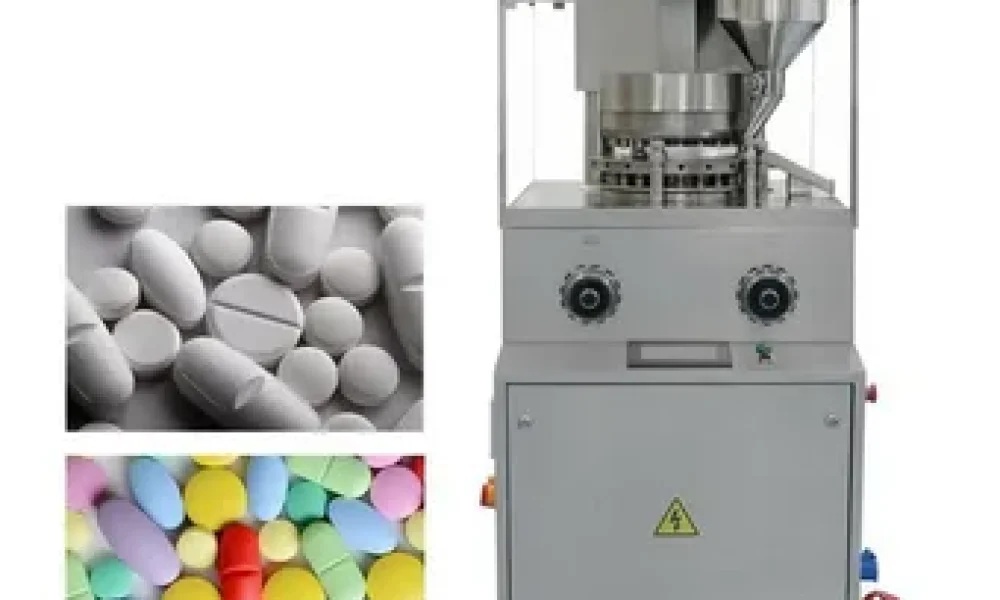
The global Pill Pressing Machine Market is entering a decade of robust expansion, projected to grow from USD 2.8 billion in 2025 to USD 4.6 billion by 2035. This growth, representing a 64.3% increase at a CAGR of 5.1%, underscores the critical role of tablet presses in ensuring scalable, compliant, and efficient pharmaceutical and nutraceutical production worldwide.
Market Growth Outlook: A Two-Phase Decade
The market will grow by a 1.6 multiple over ten years, adding USD 1.8 billion in new value.
- 2025–2030 (First Phase): The market is expected to advance from USD 2.8 billion to USD 3.6 billion, contributing 44.4% of total growth. This stage is driven by the surge in generic medicines, nutraceuticals, and dietary supplements, especially in Asia-Pacific and North America. Rising pharmaceutical output demands high-speed, GMP-compliant equipment to meet global drug supply needs.
- 2030–2035 (Second Phase): Growth accelerates from USD 3.6 billion to USD 4.6 billion, contributing 55.6% of decade growth. This momentum comes from smart automation, IoT-enabled monitoring, and modular tooling for diverse pill formats. With personalized medicine and precision healthcare gaining traction, manufacturers are investing in next-generation rotary and multi-layer presses that combine output efficiency with digital intelligence.
Request Your Sample Now: https://www.futuremarketinsights.com/reports/sample/rep-gb-24687
Technology and Segmental Trends
- Machine Type: Rotary pill press machines are forecast to hold 42.8% share in 2025, delivering high precision and speed. Their adaptability for multi-layered and shaped tablets makes them indispensable for complex formulations.
- Automation: Fully automatic presses will lead with 44.5% share in 2025, reflecting industry demand for continuous production, reduced labor costs, and real-time monitoring. Their integration with Industry 4.0 technologies is making them the standard in large-scale facilities.
- Capacity: Medium-capacity machines (50,001–200,000 tablets/hour) will capture 37.6% share in 2025, offering the best balance of throughput and flexibility for mid-sized pharma and nutraceutical producers.
- Applications: Pharmaceutical tablet production remains the dominant segment at 46.2% in 2025, as chronic disease prevalence and rising healthcare access fuel medicine demand. Nutraceuticals and dietary supplements continue to grow in parallel.
- End Use: Pharmaceutical manufacturers will account for 48.9% share in 2025, as their need for high-volume, GMP-certified equipment drives consistent adoption.
Regional Growth Dynamics
- Asia-Pacific leads as the fastest-growing region, with China expanding at 5.6% CAGR and India at 5.5% CAGR, thanks to their generics dominance, contract manufacturing services, and healthcare infrastructure growth.
- North America will remain a high-value market, with the U.S. growing at 5.3% CAGR, driven by FDA-compliant high-speed presses for pharmaceuticals, nutraceuticals, and OTC products.
- Europe, led by Germany (5.2% CAGR) and the UK (5.1% CAGR), emphasizes modular, high-precision presses tailored for multi-product lines and clinical research needs.
- Japan (5.0% CAGR) and South Korea (5.1% CAGR) prioritize compact, automated, and precision-driven machines to meet their advanced pharma and supplement demands.
Key Drivers and Restraints
Growth Drivers:
- Rising global demand for pharmaceuticals, generics, and nutraceuticals.
- Adoption of high-speed, multi-layer, GMP-certified presses to ensure quality and compliance.
- Expansion of automation, real-time monitoring, and digital analytics to improve efficiency.
- Growth in personalized medicine and combination drugs, requiring advanced multi-layer capabilities.
Challenges:
- High capital costs and maintenance requirements limit adoption among SMEs.
- Stringent regulatory compliance increases validation complexity.
- Mechanical wear from continuous operation demands skilled servicing.
Despite these hurdles, the industry is rapidly moving toward automation, continuous manufacturing, and predictive analytics as long-term growth enablers.
Get the Report Brochure Now: https://www.futuremarketinsights.com/reports/brochure/rep-gb-24687
Established Leaders and Emerging Innovators
The competitive landscape is moderately fragmented, with established giants, mid-sized specialists, and regional innovators shaping the industry:
- Global Leaders: Fette Compacting, KORSCH AG, and I.M.A. Industria Macchine Automatiche S.p.A. dominate with high-speed rotary presses, multi-layer technology, and GMP-certified designs. Their strategies are increasingly focused on digital monitoring, SaaS integration, and continuous manufacturing platforms.
- Mid-Sized Players: Syntegon Technology GmbH, Romaco Group, and Natoli Engineering offer servo-driven controls, automated weight adjustment, and advanced inspection systems. They are advancing solutions for oral solid dosage forms and complex drug formulations.
- Emerging & Regional Manufacturers: Grand Group, SaintyCo, Fluid Pack, and Lodha International LLP serve cost-sensitive and SME markets with modular, flexible, and affordable machines. Their emphasis is on scalability, simplified maintenance, and incremental automation.
- New Entrants: Companies like Cadmach Machinery are building momentum with energy-efficient, modular presses tailored to nutraceutical startups and contract manufacturers. These entrants are lowering barriers for SMEs while ensuring GMP compliance.
Recent Industry Developments
- June 2025 – Fette Compacting partnered with CDMO CMIC to create a GMP-certified platform for continuous tableting, allowing pharma firms to validate processes from formulation to clinical samples under one roof.
- March 2025 – KORSCH AG launched the X 3 Tablet Press, a mid-range rotary press with 266,400 tablets/hour output, high containment (OEB 3–5), and quick turret changes—designed for both efficiency and ergonomics.
These moves demonstrate how leaders are aligning innovation with real-world production needs, compliance, and operational flexibility.
Outlook: Smarter, Software-Driven, and Sustainable
By 2035, smart-enabled and software-driven presses are projected to represent over 40% of the market value. Advanced features such as AI-powered defect detection, IoT-enabled maintenance, and predictive analytics will define the future of pill pressing.
Sustainability is also shaping equipment design, with manufacturers introducing energy-efficient systems, modular tooling, and recyclable materials. These solutions reflect a growing industry alignment with eco-conscious practices and global healthcare demands.
Conclusion
The global pill pressing machine market is at the center of a healthcare revolution. From mass-producing essential medicines to supporting nutraceutical and personalized medicine growth, these machines are not just industrial tools—they are enablers of global health security.
Established leaders are scaling up innovation, while emerging players are democratizing access with cost-efficient, automated presses. Together, they are building a resilient ecosystem where precision, compliance, and efficiency drive the next decade of pharmaceutical manufacturing.



