
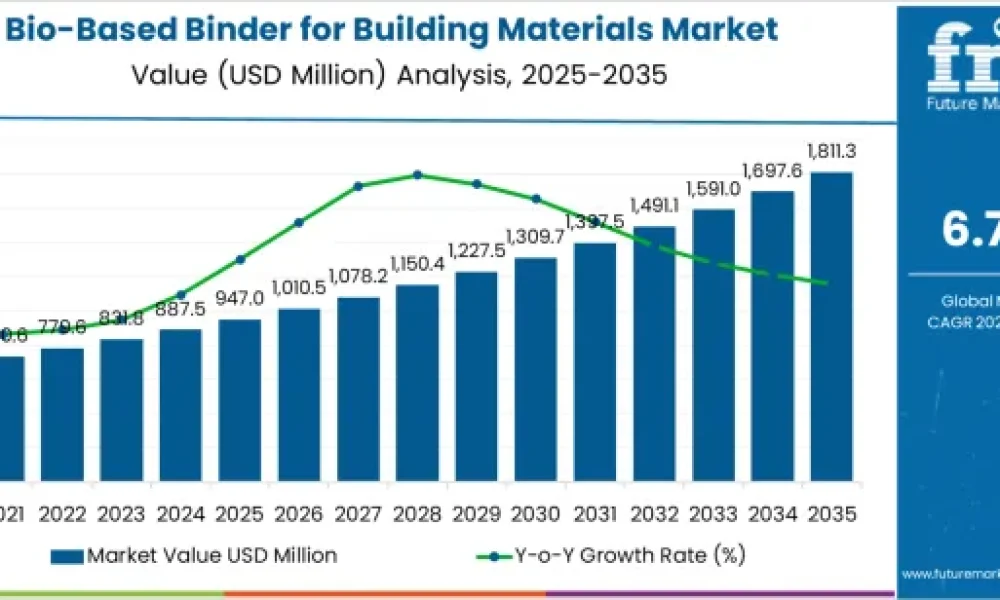
The Global Bio-Based Binder for Building Materials Market is projected to grow from an estimated USD 947.0 million in 2025 to USD 1,811.3 million by 2035, reflecting a robust compound annual growth rate (CAGR) of 6.7% over the forecast period as sustainable building materials gain traction across construction sectors worldwide. This forecast highlights the rapid transition toward renewable feedstock binders driven by environmental regulations, green building frameworks, and heightened demand for low-VOC, high-performance construction inputs that align with global carbon reduction goals.
Key Market Insights at a Glance
As the building industry intensifies its focus on sustainability, bio-based binders derived from starch, lignin, plant resins and other natural polymers are emerging as vital alternatives to conventional petrochemical adhesives. Starch-based binders remain the most dominant product category, capturing the largest share of market revenue owing to their biodegradability, availability, and strong adhesive characteristics suited for a broad range of construction materials. The largest end-use application continues to be wall materials, driven by strong uptake in residential and commercial construction where green building certifications increasingly prioritize reduced emissions and renewable content. Demand is particularly strong in Europe, Asia Pacific, and North America, with countries such as China, India and Germany registering significantly higher growth rates than the global average as domestic policies and infrastructure expansion fuel adoption.
Segment Overview
The market’s core segmentation reveals meaningful differentiation by binder type and application. The starch-based classification, holding roughly 28% of the market share, leads due to its cost-effectiveness and biodegradability that resonate with green construction priorities. Beyond starch, protein-based and other bio-derived categories are gaining incremental adoption as technological advances improve performance, particularly in moisture resistance and curing strength. On the application side, wall systems represent the largest revenue contributor, with builders valuing the enhanced indoor air quality and reduced volatile organic compound (VOC) emissions that bio-based binders provide. Furniture manufacturing and specialty construction composites also contribute to market growth, especially where aesthetic, lightweight and sustainable material profiles are desirable.
Regional Overview
Regionally, Europe stands out as the most mature market thanks to stringent green building codes, availability of advanced bio-feedstock supply chains, and widespread certification standards. Asia Pacific, led by rapid urbanization in China and India, is the fastest-growing region, with growth propelled by smart city initiatives, infrastructure spending, and rising environmental consciousness among developers. North America also demonstrates stable expansion supported by federal sustainability policies and increasing net-zero construction projects. Together, these regions encapsulate the majority of demand while emerging markets in Latin America and the Middle East & Africa are beginning to adopt bio-based solutions as cost and performance barriers ease.
To access the complete data tables and in-depth insights, request a sample report here
Competitive Landscape
Competition in the global bio-based binder market is moderately concentrated around established chemical and construction material leaders, yet innovation from specialized players continues to uplift the sector. Industry incumbents with broad R&D capabilities, such as BASF and Cargill, leverage hybrid binder formulations that blend renewable polymers with performance enhancers, ensuring compatibility with existing production systems. Other notable players like Stora Enso, CONCR3DE and Teknos emphasize niche applications such as insulation composites and additive manufacturing resins that cater to evolving construction trends. Partnerships between renewable chemistry innovators and major material manufacturers further reinforce market dynamism, enabling rapid commercialization of next-generation bio-based binders that meet rigorous structural and environmental standards.
Market Outlook: Powering the Next Decade
Looking ahead, the market outlook is defined by accelerated adoption of circular economy principles and demand for carbon-neutral building materials that support climate action targets. Technological improvements in bio-polymer modification, cost-effective production scaling, and lifecycle performance validation will underpin future growth. Green certification requirements and tightening regulations on embodied carbon and VOC emissions are expected to be fundamental drivers, compelling construction firms to prioritize bio-based binder solutions. Over the next decade, sustainability considerations will evolve from differentiators to baseline expectations, supporting not just growth in niche green projects but mainstream construction frameworks globally.
Key Players of Sustainable Label Industry
Leading firms at the forefront of this transformation include industry stalwarts such as Stora Enso, BASF, Cargill, Trinseo, Dow, and Lumiforte, among others. These companies are investing in sustainable chemistry R&D, strategic alliances, and commercial partnerships aimed at enhancing binder performance while expanding production footprints to meet regional demand.
Recent Strategic Developments
Recent strategic developments in the sector highlight an uptick in collaborative ventures aimed at refining bio-based binder technologies and expanding market reach. R&D investments emphasize hybrid systems that balance renewable content with mechanical robustness, while commercial rollouts are increasingly supported by pilot projects in green construction applications. Industry leaders are also focusing on supply chain integration to reduce raw material volatility and improve cost competitiveness relative to traditional binder chemistries.
Have a specific Requirements and Need Assistant on Report Pricing or Limited Budget please contact us – [email protected]
About Future Market Insights (FMI)
Future Market Insights, Inc. (FMI) is an ESOMAR-certified, ISO 9001:2015 market research and consulting organization, trusted by Fortune 500 clients and global enterprises. With operations in the U.S., UK, India, and Dubai, FMI provides data-backed insights and strategic intelligence across 30+ industries and 1200 markets worldwide.
Why Choose FMI: https://www.futuremarketinsights.com/why-fmi



