
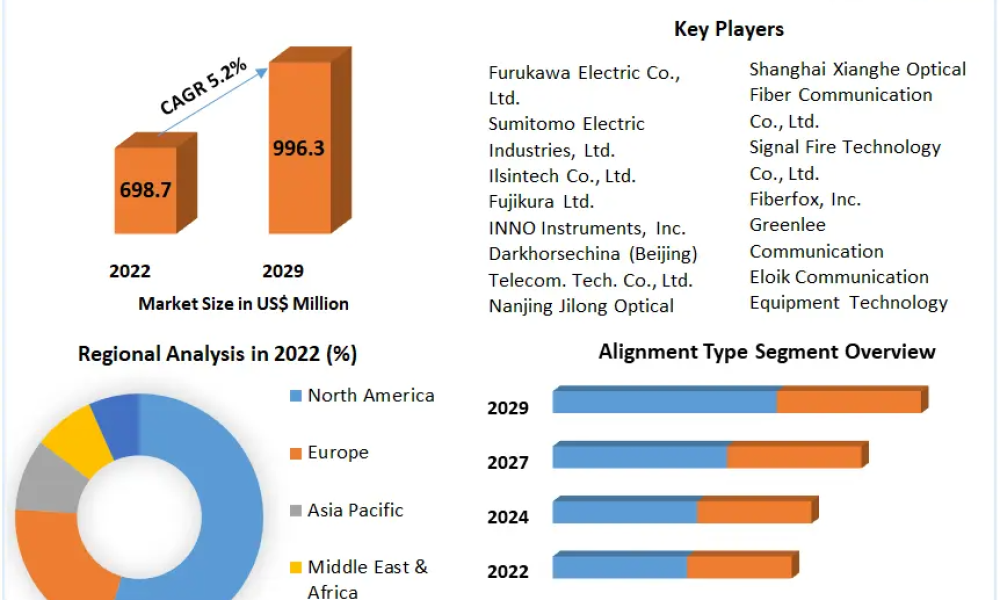
As per a recent study released by Maximize Market Research, titled, “Fusion Splicer Market,” The Fusion Splicer Market, valued at USD 698.73 million in 2022 and is forecasted to grow at a CAGR of 5.2% to reach approximately USD 996.37 million by 2029.
Fusion Splicer Market Overview:
A fusion splicer is a device that fuses two optical fibers end-to-end using an electric arc, producing a seamless joint with minimal loss of signal. This technology is foundational for fiber-optic networks, as it enables efficient, high-bandwidth data transmission over long distances. The market report segments the global fusion splicer market by alignment type (core alignment, cladding alignment), by application (telecommunications, aerospace & defense, premises & enterprise, cable TV, and others), and across regions including North America, Europe, Asia Pacific, Middle East & Africa, and South America.
Over the historical period (2017–2022), the market has matured steadily, with growing investment in fiber-optic infrastructure, the expansion of telecommunications networks, and the rising demand for high-speed internet and data services. The report provides a deep analysis of market drivers, restraints, opportunities, and challenges, along with competitive intelligence and strategic recommendations for stakeholders seeking to navigate evolving market dynamics.
Download a Free Sample Report Today : https://www.maximizemarketresearch.com/request-sample/33379/
Fusion Splicer Market Dynamics
One of the key drivers for the fusion splicer market is the continual expansion of fiber infrastructure in telecommunications and data center networks worldwide. As operators push for higher speeds, lower latency, and denser fiber deployments, there is a growing requirement for reliable splicing tools to ensure optical continuity and performance. Also, as end devices integrate sensors, optics, and photonics components, manufacturers are seeking more sophisticated, compact, and automated splicing solutions to support next-generation connectivity.
On the flip side, the high cost of fusion splicers constitutes a significant restraint. Even entry-level units can cost in the thousands of dollars, making them less accessible for smaller operators or in emerging markets. Further, fusion splicers often require stable power sources and careful operational handling, which can limit deployment flexibility in harsh or remote environments. These cost and logistical hurdles can slow adoption in price-sensitive or resource-constrained regions.
Fusion Splicer Market Outlook and Future Trends :
Looking ahead, the fusion splicer market is expected to benefit from innovation in automation, artificial intelligence, and compact designs. Manufacturers are likely to invest in smart splicing systems that offer self-calibration, real-time diagnostics, and predictive maintenance capabilities, reducing the need for skilled labor and improving deployment efficiency. Integration with remote management systems may allow network operators to monitor and operate splicing workflows from centralized control centers.
Another future trend involves the miniaturization and portability of splicers to support field deployments in challenging environments (e.g., mobile base stations, remote fiber to the home (FTTH) rollouts, underground installations). Lower-cost variants, hybrid splicing techniques, and increased modularity are likely to emerge to cater to niche applications and emerging markets. Over time, standardization and economies of scale may push down capital costs and foster broader adoption across regions.
Fusion Splicer Market Regional Insights:
The Asia Pacific (APAC) region is poised to be the fastest-growing market for fusion splicers, with significant activity in China, India, Japan, South Korea, and Southeast Asia. Government initiatives to expand broadband access, upgrade telecom infrastructure, and promote “fiber to the premises” networks are driving strong demand in the region. In China, national strategies supporting domestic manufacturing and network modernization (e.g., “Made in China 2029”) are expected to accelerate the uptake of advanced fusion splicing solutions. Meanwhile, in developed markets such as North America and Western Europe, demand will largely come from maintenance, upgrades, and densification of existing fiber networks.
Fusion Splicer Market Segmentation
by Alignment Type
Core Alignment
Cladding Alignment
by Application
Telecommunications
Aerospace & Defense
Premises & Enterprise
Cable TV
Other
Some of the current players in the Fusion Splicer Market are:
1.Furukawa Electric Co., Ltd.
2. Sumitomo Electric Industries, Ltd.
3. Ilsintech Co., Ltd.
4. Fujikura Ltd.
5. INNO Instruments, Inc.
6. Darkhorsechina (Beijing) Telecom. Tech. Co., Ltd.
7. Nanjing Jilong Optical Communication Co., Ltd.
8. China Electronics Technology Group Corporation
9. Shenzhen Ruiyan Communication Equipment Co., Ltd.
10. Shanghai Xianghe Optical Fiber Communication Co., Ltd.
About Maximize Market Research:
Maximize Market Research is one of the fastest-growing market research and business consulting firms serving clients globally. Our revenue impact and focused growth-driven research initiatives make us a proud partner of majority of the Fortune 500 companies. We have a diversified portfolio and serve a variety of industries such as IT & telecom, chemical, food & beverage, aerospace & defense, healthcare and others.
Contact Maximize Market Research:
MAXIMIZE MARKET RESEARCH PVT. LTD.
⮝ 3rd Floor, Navale IT park Phase 2,
Pune Banglore Highway, Narhe
Pune, Maharashtra 411041, India.
✆ +91 9607365656
🖂 [email protected]




