
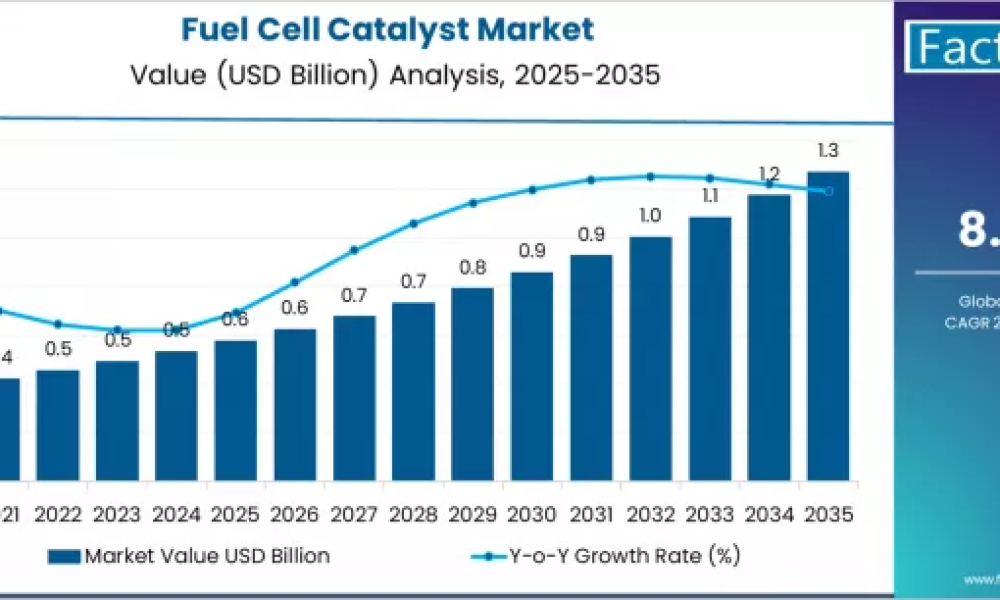
The global fuel cell catalyst market is experiencing rapid acceleration, underpinned by the worldwide shift toward hydrogen-based energy systems, significant technological progress in catalyst materials, and expanding fuel-cell applications in automotive and stationary power segments. Market analysis suggests that the industry will grow from an estimated USD 614.3 million in 2025 to about USD 1.34 billion by 2035, at a compound annual growth rate (CAGR) of roughly 8.1%.
Key Market Highlights
2025 Market Size: USD 614.3 million
2035 Forecast Value: USD 1,338.6 million
Projected CAGR (2025–2035): ~8.1%
Leading Catalyst Type: Platinum-based catalysts
Top Application: Hydrogen fuel cells
High-Growth Regions: East Asia (especially China), North America, Europe
Major Players: Johnson Matthey; Umicore; BASF; 3M; Heraeus; De Nora; Fuel Cells Etc.; Haldor Topsoe; Tanaka Holdings; Pyrochem
To access the complete data tables and in-depth insights, request a Discount On The Report here: https://www.factmr.com/connectus/sample?flag=S&rep_id=10656
Major Growth Drivers
Hydrogen Economy Expansion
The global push for green hydrogen is fueling demand for efficient catalysts. Fuel cells are integral to hydrogen-powered vehicles and stationary systems, making catalysts a cornerstone of scalable hydrogen infrastructure.Automotive & Stationary Adoption
Fuel-cell–electric vehicles (FCEVs) and distributed power systems are increasingly using catalysts that enable high performance and long life. Catalyst suppliers are benefiting from growing orders from both carmakers and distributed energy providers.Innovation to Cut Precious Metal Use
Catalyst developers are innovating to reduce the amount of platinum and other noble metals needed—through more efficient catalyst designs or non-precious-metal alternatives—lowering costs while maintaining performance.Durability & Performance Improvements
Advanced catalyst formulations are improving electron transfer rates, reducing overpotentials, and enhancing resilience against poisoning agents (like carbon monoxide), which helps extend fuel cell longevity.Regulatory & Policy Support
Government incentives, clean energy targets, and hydrogen strategy roadmaps are accelerating investment in fuel-cell technologies and associated catalyst development.
Market Segmentation
By Type:
Platinum-Based Catalysts
Platinum-Ruthenium Alloy Catalysts
Non-Precious Metal Catalysts (NPMCs)
Others
By Application:
Hydrogen Fuel Cells (dominant)
Methanol Fuel Cells
Other Fuel Cell Types
By Region:
East Asia (largest share)
North America
Europe
Rest of the World
Challenges & Risks
High Cost of Precious Metals: Platinum and related noble metals remain expensive, making catalyst cost a critical challenge.
Supply Chain Risk: Precious metal supply constraints or price volatility could disrupt production and margins.
Performance vs. Cost Trade-offs: Non-precious catalysts still face challenges in matching the durability and activity of platinum-based ones.
Certification & Reliability: Fuel-cell systems require highly reliable catalysts that meet stringent performance and lifetime criteria, especially in automotive use.
Competitive Landscape
Major players in the fuel cell catalyst market are focusing on:
Developing low-loading and more efficient platinum catalysts
Scaling up non-precious metal catalysts to reduce reliance on noble metals
Partnering with OEMs and hydrogen infrastructure firms to co-develop and supply catalyst solutions
Investing in R&D to improve catalyst lifetime and resilience
Expanding capacity in regions with strong hydrogen economy growth (e.g., Asia-Pacific)
Strategic Recommendations
Prioritize Precious Metal Reduction: Invest in catalyst designs that lower platinum usage without compromising performance.
Accelerate Non-Precious Catalyst R&D: Fast-track development of cost-effective alternatives to noble metals.
Build Regional Manufacturing: Establish production nodes in key hydrogen markets to serve growing local demand.
Expand Collaboration: Work closely with fuel-cell manufacturers, automakers, and electrolyzer firms to co-develop integrated systems.
Strengthen Longevity Testing: Enhance durability testing and certification programs to validate long-term catalyst performance.
Market Outlook
With projected revenues of USD 1.34 billion by 2035, the fuel cell catalyst market is positioned for strong growth. As hydrogen adoption spreads and catalyst technologies evolve, companies that offer efficient, cost-effective, and durable catalysts will play a vital role in powering the green hydrogen transition.
Have specific requirements or need assistance on report pricing or have a limited budget? Please contact [email protected]
About Fact.MR:
Fact.MR is a global market research and consulting firm, trusted by Fortune 500 companies and emerging businesses for reliable insights and strategic intelligence. With a presence across the U.S., UK, India, and Dubai, we deliver data-driven research and tailored consulting solutions across 30+ industries and 1,000+ markets. Backed by deep expertise and advanced analytics, Fact.MR helps organizations uncover opportunities, reduce risks, and make informed decisions for sustainable growth.



