
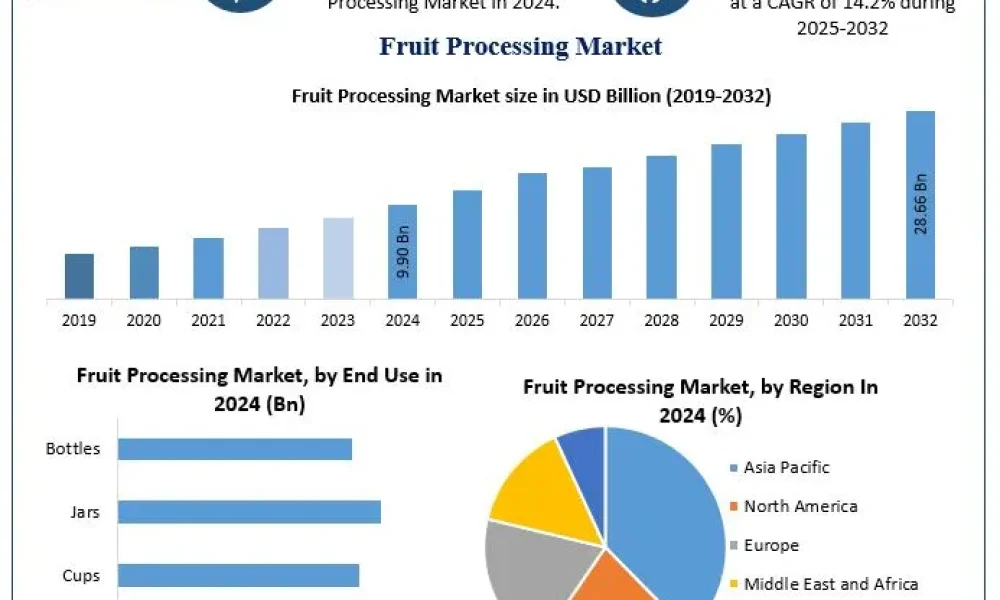
Fruit Processing Market Overview:
Fruit Processing Market valued at USD 9.90 billion in 2024, is projected to surge to USD 28.66 billion by 2032, achieving a remarkable CAGR of 14.2%. Driven by rising demand for convenient, nutrient-rich processed fruits, expanding e-commerce for ready-to-eat products, and innovations in preservation technologies, Asia Pacific dominates due to massive production capacities, favorable climates, and booming export markets in China, India, and Southeast Asia.
Key Highlights & Insights
Market Size & Growth: Expected to expand from USD 9.90 billion (2024) to USD 28.66 billion (2032) at a CAGR of 14.2%.
Dominating Region: Asia Pacific holds the largest share, fueled by abundant fruit supply, advanced processing infrastructure, and surging demand for juices, purees, and dried fruits in emerging economies.
Leading Segment: Fruit juices and concentrates capture over 40% market share, popular for their versatility in beverages, snacks, and industrial applications.
Key Driver: Health-conscious consumer trends favoring plant-based, preservative-free products, alongside growth in convenience foods amid urbanization and busy lifestyles.
► Get a sample of the report:https://www.maximizemarketresearch.com/request-sample/221418/
Recent Developments
2024: Dole Food Company (U.S./global) expanded aseptic processing facilities in Asia Pacific for tropical fruit purees targeting export markets.
2025: Nestlé (Switzerland) launched fortified fruit snacks with extended shelf life using high-pressure processing (HPP) technology in Europe and North America.
2024: ITC Limited (India) invested in dehydration plants for mango and pineapple products, boosting Asia Pacific’s dried fruit exports.
Partnerships between processors and e-commerce giants accelerate ready-to-eat fruit pouch distribution worldwide.
FAQs:
What technologies are transforming fruit processing? HPP and pulsed electric field preserve nutrients without heat, extending shelf life while maintaining freshness.
Why is demand for organic processed fruits rising? Consumers seek clean-label products free from chemicals, driving a 20%+ growth in certified organic segments.
How does e-commerce impact the market? Online platforms enable global reach for premium, exotic processed fruits like açaí purees and dragon fruit juices.
Market Dynamics
Growth Drivers:
Surge in health-focused diets promoting fruit-based snacks, juices, and functional foods.
Expansion of foodservice and retail for frozen, canned, and dried fruits amid urbanization.
Technological advances like HPP ensuring nutrient retention and food safety.
Rising exports from Asia Pacific to meet global demand for tropical processed fruits.
Challenges:
Perishability of raw fruits complicating supply chains and increasing waste.
Stringent food safety regulations raising compliance costs.
Competition from fresh produce in fruit-abundant regions.
Opportunities:
Plant-based and vegan product innovations for meat alternatives and dairy-free items.
Sustainable packaging and organic certifications attracting eco-conscious buyers.
Emerging markets in Latin America and Africa with untapped fruit resources.
Regional Analysis
Asia Pacific: Dominant leader with China and India’s processing plants driving juices and concentrates; rapid urbanization boosts convenience demand.
Europe: Mature market emphasizing organic and premium products; strong in canned and frozen segments.
North America: High-value growth via advanced tech and health snacks; U.S. processes 22 million tons annually.
Latin America & Middle East/Africa: Export powerhouses for tropical fruits, with rising local processing.
Product Segmentation
By Type: Juices/concentrates (leading >40%), purees, dried/dehydrated, canned, frozen.
By Fruit Type: Citrus, berries, tropical (mango, pineapple), stone fruits.
By Application: Beverages (largest), bakery/confectionery, dairy, snacks, others.
By Distribution: Supermarkets, online, foodservice, industrial.
Key Trends
Adoption of HPP and microwave processing for nutrient-rich, ready-to-eat fruits.
Boom in organic and plant-based fruit preparations for vegan diets.
Sustainable, recyclable packaging aligning with circular economy goals.
E-commerce enabling subscription models for fruit pouches and smoothies.
Fortification with vitamins/superfoods for functional beverages.
Quote
“Asia Pacific’s dominance in fruit processing underscores its role as the global fruit basket, powered by innovation and scale. As health trends converge with convenience, processed fruits will redefine snacking and nutrition worldwide,” stated an industry leader.
Conclusion
The fruit processing market is ripe for explosive growth, blending health innovation with scalable technologies to deliver year-round fruit goodness. Led by Asia Pacific’s production prowess and propelled by global wellness shifts, it promises nutritious convenience for consumers while opening vast opportunities for processors through 2032.
◉ Get Market Research Latest Trends
♦ Global Automotive Front End Module Market
♦ Maximize Market Research is launching a subscription model for data and analysis in the MMR Statistics
Contact Maximize Market Research:
3rd Floor, Navale IT Park, Phase 2
Pune Bangalore Highway, Narhe,
Pune, Maharashtra 411041, India
[email protected]
+91 96071 95908, +91 9607365656
About Maximize Market Research:
Maximize Market Research is a multifaceted market research and consulting company with professionals from several industries. Some of the industries we cover include medical devices, pharmaceutical manufacturers, science and engineering, electronic components, industrial equipment, technology and communication, cars and automobiles, chemical products and substances, general merchandise, beverages, personal care, and automated systems. To mention a few, we provide market-verified industry estimations, technical trend analysis, crucial market research, strategic advice, competition analysis, production and demand analysis, and client impact studies.




