
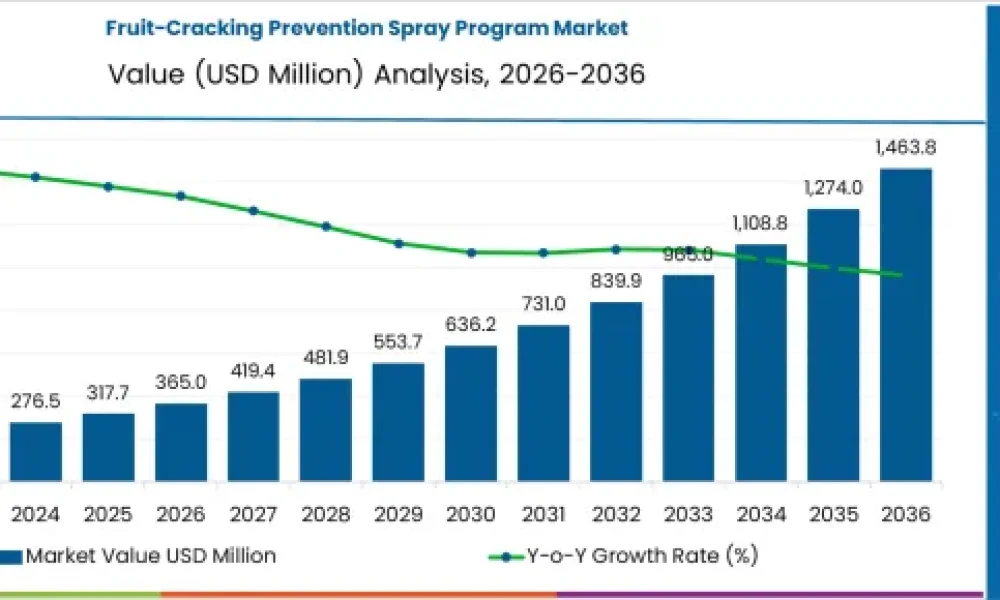
The global Fruit-Cracking Prevention Spray Program market is set for high-growth expansion, projected to rise from USD 365 million in 2026 to USD 1,463.8 million by 2036, advancing at a robust CAGR of 14.9% over the forecast period. This growth reflects increasing adoption of preventive spray solutions designed to reduce fruit cracking caused by erratic rainfall, rapid moisture absorption, and temperature fluctuations. As growers face mounting pressure to preserve fruit quality, minimize yield losses, and meet premium export standards, fruit-cracking prevention programs are becoming a core component of modern horticultural practices.
Key Market Insights at a Glance
Fruit cracking remains one of the most persistent physiological disorders affecting high-value fruits such as cherries, apples, tomatoes, citrus fruits, and berries. The rising frequency of extreme weather events has intensified this challenge, driving strong demand for spray programs that enhance fruit skin strength, elasticity, and water-uptake regulation. Among available solutions, calcium-boron-based formulations currently command approximately 34% of the global market share, owing to their proven ability to reinforce cell wall structure and improve fruit firmness. From a functional perspective, cell wall strengthening mechanisms account for nearly 38% of overall adoption, highlighting the industry’s preference for solutions that deliver long-term structural resilience rather than short-term surface protection.
Segment Overview
By chemistry type, the market is segmented into calcium-boron sprays, elastic film-forming anti-crack coatings, silicon and mineral barrier programs, and advanced osmoregulation blends. Calcium-boron sprays continue to dominate due to strong agronomic validation and broad crop compatibility, while film-forming and mineral-based solutions are gaining traction in regions with heavy rainfall and high humidity. From a physiological standpoint, solutions focused on cuticle elasticity enhancement, water absorption control, and growth stress moderation are increasingly integrated into comprehensive spray programs tailored to specific crop cycles and climatic risks.
Regional Overview
Asia Pacific represents the fastest-growing regional market, supported by large-scale fruit cultivation and rising investment in yield-protection technologies. China leads with a CAGR of 15.8%, driven by commercial orchard expansion and quality-driven export demand. India follows at 15.2% CAGR, reflecting modernization in agronomic practices and increasing awareness of preventive crop care. Brazil is expanding at 14.6%, supported by its strong tropical fruit industry, while the United States and Italy are growing at 13.9% and 13.4% respectively, driven by premium fruit demand, strict quality standards, and reduced tolerance for post-harvest losses.
To access the complete data tables and in-depth insights — Request Your Sample Report Now
Competitive Landscape
The market is moderately consolidated, with established agrochemical and plant nutrition companies actively enhancing their portfolios through formulation innovation and strategic partnerships. Key players include SePRO Corporation, Oro Agri International, AgroLiquid, Koch Agronomic Services, and Agro-K Corporation. Competitive differentiation is increasingly driven by formulation efficiency, compatibility with precision agriculture systems, and the ability to perform under diverse climatic conditions. Companies are also emphasizing technical advisory services to support growers with optimized spray timing and dosage strategies.
Market Outlook: Powering the Next Decade
Over the next decade, the Fruit-Cracking Prevention Spray Program market is expected to benefit from the convergence of climate-resilient farming practices and data-driven agriculture. Integration of weather forecasting tools, soil moisture sensors, and predictive analytics will enhance spray precision and effectiveness. Preventive crop protection strategies are becoming a priority as growers seek to stabilize revenues and reduce dependency on reactive interventions. Emerging markets are expected to witness accelerated adoption as awareness of physiological disorder management improves and access to advanced agro-inputs expands.
Key Players of Sustainable Label Industry
Sustainability is increasingly shaping purchasing decisions, with growers favoring low-residue, environmentally responsible formulations that align with regulatory compliance and consumer expectations. Companies investing in bio-based ingredients, reduced chemical load, and resource-efficient solutions are well positioned to capture long-term growth opportunities within the sustainable agriculture ecosystem.
Recent Strategic Developments
Recent industry developments include the launch of multi-functional spray programs combining anti-cracking agents with micronutrients and plant health enhancers. Strategic collaborations between agritech firms and research institutions are enabling localized product customization, while precision spraying technologies are improving application efficiency and return on investment for growers.
Have a specific Requirements and Need Assistant on Report Pricing or Limited Budget please contact us – [email protected]
About Future Market Insights (FMI)
Future Market Insights, Inc. (FMI) is an ESOMAR-certified, ISO 9001:2015 market research and consulting organization, trusted by Fortune 500 clients and global enterprises. With operations in the U.S., UK, India, and Dubai, FMI provides data-backed insights and strategic intelligence across 30+ industries and 1200 markets worldwide.
Why Choose FMI: https://www.futuremarketinsights.com/why-fmi



