
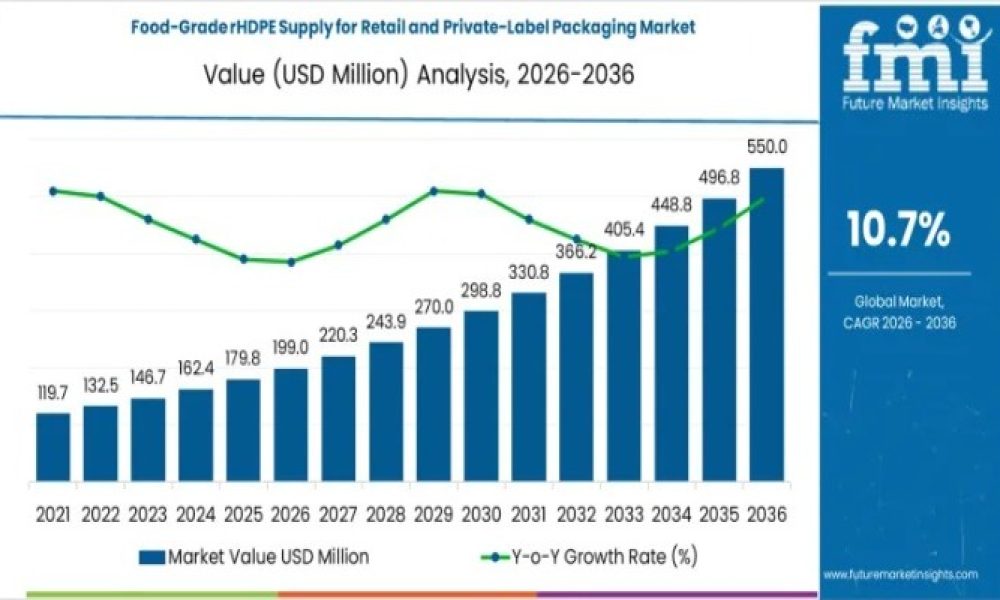
The global food-grade rHDPE supply for retail and private-label packaging market is entering a decisive growth phase as regulatory pressure, retailer sustainability mandates, and private-label expansion reshape procurement strategies across the packaging value chain. Valued at USD 199 million in 2026, the market is projected to reach USD 550.0 million by 2036, expanding at a robust CAGR of 10.7% over the forecast period.
This growth reflects a structural shift in how recycled plastics are sourced, certified, and monetized. Rather than competing purely on throughput, suppliers are increasingly differentiated by feedstock quality, compliance documentation, and delivery reliability. As food-contact standards tighten globally, value creation is moving upstream toward recyclers and compounders capable of delivering consistent, traceable, food-grade rHDPE at industrial scale.
Unlock Growth Potential – Request Your Sample Now and Explore Market Opportunities!
Market Snapshot: Food-Grade rHDPE Supply for Retail and Private-Label Packaging
- Market Value (2026): USD 199 million
- Forecast Value (2036): USD 550.0 million
- Forecast CAGR (2026–2036): 10.7%
- Leading Product Type: Post-consumer food-grade rHDPE
- Key Growth Regions: Asia Pacific, Europe, North America
- Major Players: Veolia, ALPLA Group, Plastipak Holdings, Biffa Polymers, Indorama Ventures, MBA Polymers, KW Plastics
Compliance, Not Volume, Is Driving Value Creation
Between 2026 and 2036, market expansion is shaped less by overall packaging growth and more by substitution of virgin HDPE with certified recycled alternatives. Retailers and private-label brand owners are under mounting pressure to meet recycled content mandates while maintaining food safety and operational consistency.
As a result, pricing power is increasingly concentrated among suppliers that can deliver:
- Audited feedstock streams with low contamination risk
- Multi-stage washing and decontamination processes
- Lot-to-lot consistency in melt flow, color, and odor
- Full traceability and regulatory documentation
Margins are now closely tied to regulatory alignment and contract duration, rather than resin volume alone. Suppliers unable to guarantee consistent food-grade quality face price pressure despite overall market growth.
Adoption Curve Reflects Maturing Circular Supply Chains
The market follows a classic two-stage adoption pattern:
- Early adoption (2026–2031):
- Accounts for ~36% of total decade growth
- Driven by pilot projects, early regulatory compliance, and initial private-label integration
- Acceleration phase (2031–2036):
- Adoption intensifies as mandates are enforced
- Private-label portfolios fully integrate rHDPE
- Supply reliability becomes a primary competitive lever
During this transition, competitive advantage increasingly favors integrated players that control feedstock sourcing, processing efficiency, and certification workflows end-to-end.
Post-Consumer Food-Grade rHDPE Leads Product Demand
Among product grades, post-consumer food-grade rHDPE dominates, accounting for approximately 44% of total demand. Its leadership reflects its ability to balance high recycled content targets with food-contact compliance.
Key drivers of post-consumer rHDPE adoption include:
- Compatibility with blow molding and injection molding
- Traceable input streams aligned with EU and North American regulations
- Consistent mechanical and chemical performance for bottles and containers
This grade is widely used in retail bottles, high-volume containers, and closures, where compliance certainty and processing stability are essential.
Retail Bottles Anchor Application Demand
By application, retail packaging bottles represent the largest segment, accounting for roughly 49% of total market demand. Their dominance is driven by:
- High material intensity in beverages, dairy, and liquid foods
- Predictable geometries that support recycled content integration
- Strong regulatory and retailer scrutiny on rigid food packaging
Bottles offer converters the best balance of volume, standardization, and risk control, making them the primary entry point for industrial-scale food-grade rHDPE adoption.
Regional Momentum Highlights Regulatory Leadership
Growth trajectories vary by region, reflecting differences in regulation, retail maturity, and recycling infrastructure:
- India (CAGR 11.0%)
- Fastest-growing market
- Driven by private-label expansion, organized recycling, and global sourcing standards
- China (CAGR 9.5%)
- Growth led by export-oriented FMCG packaging
- Compliance with international food-contact standards is the primary driver
- Brazil (CAGR 8.9%)
- Growth supported by packaging modernization and recycler-converter collaboration
- United States (CAGR 7.8%)
- Retailer sustainability commitments fuel demand
- Focus on odor control, color consistency, and documentation
- United Kingdom (CAGR 7.4%)
- Steady adoption aligned with European compliance frameworks
- Emphasis on traceability and incremental virgin resin substitution
Supplier Partnerships and Traceability Define the Next Decade
Across regions, the market is moving toward long-term offtake agreements, digital traceability tools, and standardized processing lines. Success increasingly depends on:
- Integrated recycler-converter-retailer partnerships
- Inline quality monitoring and batch certification
- Audit-ready documentation supporting food-contact approval
Leading suppliers such as Veolia, ALPLA Group, Plastipak Holdings, Biffa Polymers, Indorama Ventures, MBA Polymers, and KW Plastics are investing in feedstock security, process control, and compliance infrastructure to defend margin positions.
Why FMI: https://www.futuremarketinsights.com/why-fmi
About Future Market Insights (FMI)
Future Market Insights, Inc. (FMI) is an ESOMAR-certified, ISO 9001:2015 market research and consulting organization, trusted by Fortune 500 clients and global enterprises. With operations in the U.S., UK, India, and Dubai, FMI provides data-backed insights and strategic intelligence across 30+ industries and 1200 markets worldwide.



