
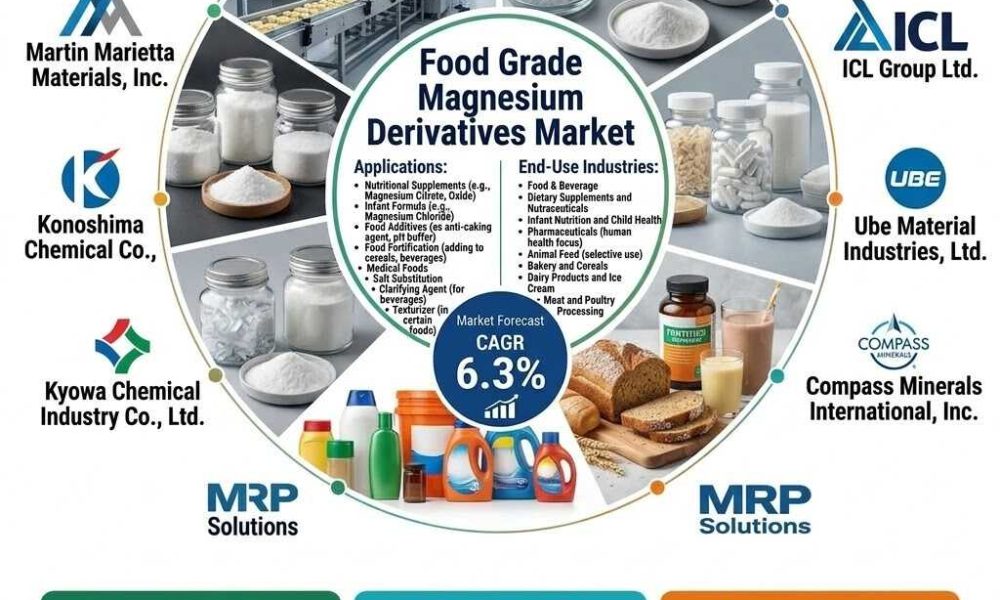
The global Food Grade Magnesium Derivatives Market is projected to grow from USD 1.9 billion in 2026 to USD 3.5 billion by 2036, expanding at a 6.3% CAGR, according to Fact.MR analysis. The market crossed USD 1.8 billion in 2025 as food, beverage, nutraceutical, and pharmaceutical formulators increased purchases of documented food-grade magnesium ingredients.
The market is expected to create an absolute opportunity of USD 1.7 billion through 2036. Magnesium Oxide, Food & Beverage Fortification, and Powder are identified as the leading segments in 2026, with projected shares of 34.0%, 38.0%, and 57.0%, respectively.
Get detailed market forecasts, competitive benchmarking, and pricing trends: https://www.factmr.com/connectus/sample?flag=S&rep_id=15857
Mineral fortification remains a central demand driver
Food and beverage manufacturers require consistent magnesium delivery across processing and shelf life. Magnesium derivatives are selected not only for mineral content but also for their behavior within specific product matrices.
Magnesium oxide remains important in dry systems because it combines concentrated mineral delivery with properties that can support anticaking, drying, moisture management, and pH control. Other derivatives, including magnesium citrate and magnesium chloride, serve applications where solubility, sensory performance, or liquid compatibility are more important.
Nutraceutical and pharmaceutical buyers place additional emphasis on food- or pharmaceutical-grade specifications, certificates of analysis, traceability, and controlled change management.
Beverage manufacturers also need to evaluate dissolution, sedimentation, bitterness, and interactions with acids or sweeteners before approving a magnesium source.
Magnesium Oxide leads the product segment
Magnesium Oxide is projected to account for 34.0% of the market in 2026. Its high elemental magnesium content and stability in dry systems support its use in large-volume formulations.
Light, heavy, and food-grade calcined grades allow suppliers to address differences in bulk density, reactivity, surface behavior, and handling. Magnesium citrate, chloride, hydroxide, lactate, and sulfate serve additional formulation requirements.
Food & Beverage Fortification leads the application segment with a projected 38.0% share in 2026. Applications include powder mixes, dairy products, bakery products, and functional beverages.
Powder is expected to hold a 57.0% share in 2026. Fine, granular, and micronized formats support dry blending, premixing, tableting, encapsulation, dispersion, and controlled dissolution.
Qualification requirements are shaping purchasing decisions
Food-grade magnesium procurement increasingly involves technical and documentary evaluation. Buyers may review particle size, bulk density, flow behavior, moisture response, dissolution, taste, label requirements, and lot-to-lot consistency depending on the application.
Direct technical engagement is particularly relevant because food, nutraceutical, and pharmaceutical manufacturers may require specifications, certificates of analysis, samples, and application support before approving a supplier for volume purchases.
The report also identifies country-specific authorization and serving-size considerations as factors that can extend qualification timelines.
Japan records the highest growth among highlighted countries
Japan is projected to expand at a 7.0% CAGR through 2036, followed by the UK at 6.7%, the USA at 6.4%, Germany at 6.1%, and France at 5.8%.
The country-level outlook reflects differences in formulation requirements, documentary controls, claims review, food-use requirements, and market-access conditions.
Competitive landscape
The competitive landscape includes Grecian Magnesite S.A., Martin Marietta Materials, Inc., Nedmag B.V., Konoshima Chemical Co., Ltd., Lehmann&Voss&Co., Tateho Chemical Industries Co., Ltd., ICL Group Ltd., Ube Material Industries, Ltd., Kyowa Chemical Industry Co., Ltd., and Compass Minerals International, Inc.
The report notes that commercial credibility depends on specification clarity, purity control, grade consistency, and application support. Supplier capabilities around change control and repeat delivery also influence qualification and continued purchasing.
Analyst perspective
Shambhu Nath Jha, Principal Consultant at Fact.MR, states:
“Food-grade magnesium is not bought on chemistry alone. The commercial decision turns on how a grade behaves in a specific matrix; how clearly its use is documented for the destination market; and whether the supplier can hold purity and particle characteristics from lot to lot. Suppliers that solve taste; flow; dissolution; and change-control problems before scale-up will be harder to replace.”
About the report
The Food Grade Magnesium Derivatives Market report provides strategic intelligence across product chemistry, application fit, physical form, distribution channel, end-use requirements, regional markets, and competitive activity.
The study covers food-grade magnesium oxide, citrate, chloride, hydroxide, lactate, and sulfate sold as ingredients, additives, mineral sources, or pharmaceutical excipients. It excludes downstream finished products and non-food applications such as industrial, refractory, feed, and deicing grades.
The forecast covers 2026 to 2036 and uses a hybrid bottom-up and top-down approach incorporating supplier revenue, product and application demand, trade and regulatory evidence, channel structure, and country-level adoption conditions.
To view Related Reports
About Fact.MR
Fact.MR’s market analysis covers defined market boundaries, segment-level demand, regional conditions, competitive activity, and market forecasts to support business and market assessment.



