
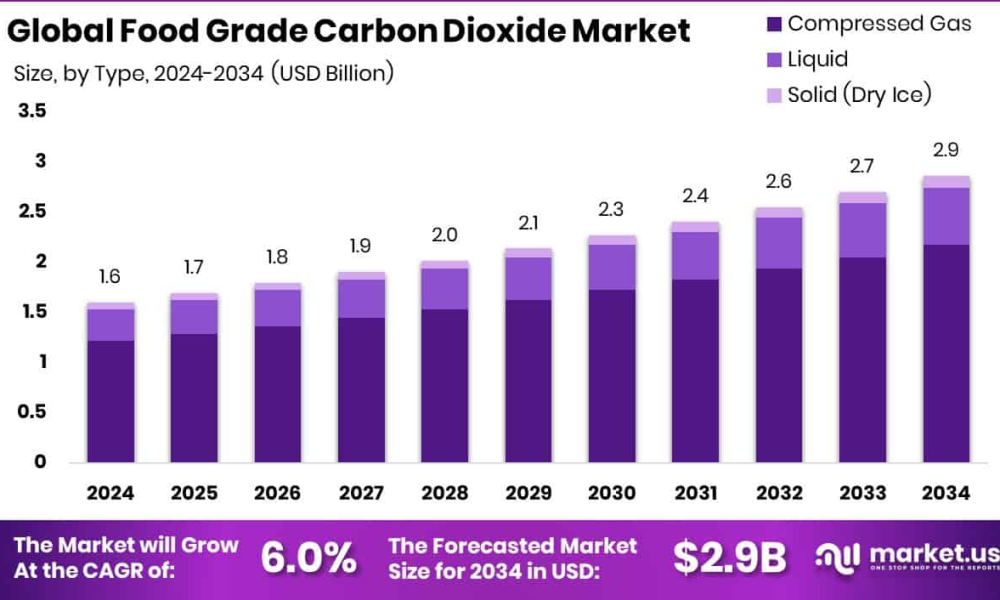
According to market.us, The Global Food Grade Carbon Dioxide Market is projected to reach approximately USD 2.9 billion by 2034, rising from USD 1.6 billion in 2024, with a compound annual growth rate (CAGR) of 6.0% from 2025 to 2034. A key driver of this growth is the increasing consumption of packaged and processed foods, particularly across North America, which currently holds a significant 39.3% share of the market.
Food-grade carbon dioxide (CO2) is a high-purity gas produced and handled under strict safety and hygiene protocols, meeting standards set by regulatory bodies such as the FDA and the European Commission. This ensures its safe use in various food and beverage applications, including carbonation, modified atmosphere packaging, chilling, and freezing.
The market encompasses the global supply and trade of CO2 intended for use in food-related sectors, such as beverages, dairy, meat processing, and bakery. Growth is supported by increasing demand for food safety compliance, the expansion of cold chain logistics, and the rising need for extended shelf-life solutions. Urbanization and lifestyle changes are pushing consumers toward ready-to-eat meals and long-lasting food products, where food-grade CO2 plays a critical role in preserving freshness by inhibiting microbial activity and oxidation during packaging.
Additionally, the beverage industry remains a major consumer of food-grade CO2, with strong demand for carbonated soft drinks, sparkling water, and alcoholic beverages. The gas is vital for maintaining carbonation levels, taste, and product integrity. As beverage consumption continues to grow globally, particularly in emerging economies, the demand for high-purity CO2 is expected to rise significantly, further strengthening the market outlook over the coming decade.
Key Takeaways
- The Global Food Grade Carbon Dioxide Market is expected to be worth around USD 2.9 billion by 2034, up from USD 1.6 billion in 2024, and grow at a CAGR of 6.0% from 2025 to 2034.
- In 2024, compressed gas held a 76.3% share in the Food Grade Carbon Dioxide Market globally.
- Bulk supply mode accounted for 57.4%, dominating the distribution channel in the Food Grade Carbon Dioxide Market.
- Freezing and chilling applications led with 53.2% usage across the Food Grade Carbon Dioxide Market segments.
- The beverages sector represented 47.3% of total demand in the Food Grade Carbon Dioxide Market in 2024.
- The North America market was valued at USD 0.6 billion, showing strong industrial demand.
Access a Complimentary Sample of This Premium Report: https://market.us/report/food-grade-carbon-dioxide-market/free-sample/
Factors Affecting the Growth of the Food Grade Carbon Dioxide Market
- Rising Consumption of Packaged and Processed Foods: A major driver of growth in the food-grade CO2 market is the increasing consumption of ready-to-eat and long shelf-life food products. As urbanization and changing lifestyles encourage consumers to opt for convenience-based foods, the demand for preservation technologies has surged. Food-grade CO2 plays a critical role in extending shelf life by creating modified atmosphere packaging (MAP) environments that reduce microbial growth and slow oxidation, keeping products fresh longer.
- Expanding Beverage Industry: The carbonated beverage segment, including soft drinks, sparkling water, and alcoholic beverages, is a significant consumer of food-grade CO2. The gas is essential in carbonation processes, helping maintain taste, texture, and fizz. With increasing beverage consumption in both developed and emerging economies, particularly in Asia-Pacific and Latin America, demand for high-purity CO2 continues to rise steadily.
- Growth in Cold Chain Logistics: The expansion of cold chain infrastructure globally has supported the broader use of food-grade CO2 in chilling and freezing applications. Liquid CO₂ is used in rapid cooling, dry ice production, and blast freezing of meat, seafood, and bakery products. As the food export-import sector grows, especially for temperature-sensitive goods, the use of CO₂ in logistics has become more critical.
- Stringent Food Safety Regulations: Regulatory compliance is a key factor shaping the market. Authorities such as the U.S. Food and Drug Administration (FDA) and the European Food Safety Authority (EFSA) mandate strict purity standards for food-grade CO₂, typically requiring 99.9% purity levels. This has led to increased investment in purification technologies and process safety, ensuring that only high-quality CO2 is used in food and beverage processing.
- Technological Advancements in Gas Handling and Storage: Advancements in gas liquefaction, storage, and delivery systems have improved the ease and safety of using CO2 in food applications. These innovations support more efficient gas usage, better control over injection levels in packaging, and reduced operational costs, making CO2 solutions more accessible to both large manufacturers and small-scale producers.
Report Segmentation:
By Type Analysis: In 2024, Compressed Gas dominated the food grade carbon dioxide market, accounting for 76.3% of the total share. This dominance is largely driven by its extensive application across key areas such as beverage carbonation, modified atmosphere packaging (MAP), and freezing processes. Compressed CO₂ offers several operational advantages, including ease of handling, precise dosage control, and safe compatibility with food products. These benefits make it the preferred format for large-scale food and beverage manufacturers.
As demand rises for packaged and perishable products—especially meat, dairy, and bakery goods—compressed gas continues to support production efficiency and product preservation. Furthermore, its stability during storage and transport enhances its appeal for use in commercial kitchens, food processing plants, and bottling facilities. With the expansion of frozen food exports and cold chain logistics, compressed gas is expected to retain its leadership in the market due to its reliability and seamless integration with automated systems.
By Mode of Supply Analysis: In 2024, Bulk Supply emerged as the leading mode of delivery in the food-grade carbon dioxide market, capturing 57.4% of the market share. This preference is mainly attributed to its suitability for high-volume operations such as beverage bottling, meat processing, and large-scale baking facilities. Bulk delivery systems ensure a continuous, cost-effective, and reliable supply of CO₂, minimizing downtime and reducing the frequency of refills.
These systems also offer improved pressure regulation and easy integration with automated gas distribution networks, which are increasingly common in modern food manufacturing environments. On-site storage tanks provide hygienic and secure handling that aligns with strict food safety protocols. The scalability and long-term cost efficiency of bulk supply make it the go-to choice for industrial users seeking consistent production quality and streamlined operations.
By Application Analysis: Freezing and Chilling held the dominant position in the food grade carbon dioxide market by application in 2024, with a 53.2% share. This segment’s strength lies in the growing use of CO2 for cold processing techniques that help preserve food safety, texture, and freshness. CO₂, in both liquid form and as dry ice, is widely used to rapidly freeze or chill products such as meat, seafood, baked goods, and ready-to-eat meals.
Its ability to reduce temperature quickly without compromising moisture or structure makes it indispensable for maintaining food quality. As demand for frozen and chilled foods continues to grow—driven by urbanization, convenience trends, and export requirements—CO₂-based freezing systems are increasingly favored over traditional refrigeration methods. Additionally, its non-toxic, food-safe properties further contribute to its broad acceptance and regulatory compliance within the industry.
By End-Use Analysis: In 2024, the Beverage Industry led the food-grade carbon dioxide market by end use, securing a 47.3% market share. CO₂ is an essential component in the carbonation of soft drinks, sparkling waters, energy drinks, and alcoholic beverages, playing a key role in enhancing their taste, texture, and shelf stability. The consistent global demand for fizzy beverages, both in developed and emerging markets, has sustained high consumption levels of CO₂ in this segment.
The growing popularity of ready-to-drink (RTD) formats and functional beverages has further increased the reliance on CO₂ to achieve the desired mouthfeel and consumer appeal. Additionally, the gas ensures product consistency and quality, aligning with strict beverage industry standards. With beverage production continuing to scale globally and product innovation remaining strong, this segment is expected to maintain its lead in CO₂ utilization, underlining its importance within the broader food and beverage sector.
To Purchase this Premium Report@ https://market.us/purchase-report/?report_id=121839
Key Market Segments
By Type
- Compressed Gas
- Liquid
- Solid (Dry Ice)
By Mode of Supply
- Bulk
- Cylinder
- On-site Generation
By Application
- Freezing and Chilling
- Carbonating
- Packaging
By End-use
- Beverages
- Alcoholic
- Non-alcoholic
- Dairy and Dairy Products
- Meat, Poultry, and Seafood
- Grains, Fruits, And Vegetables
- Bakery and Confectionery
- Others
Regional Analysis
In 2024, North America emerged as the leading region in the Food Grade Carbon Dioxide Market, capturing 39.3% of the global market share, with an estimated value of around USD 0.6 billion. This regional dominance is largely attributed to the high consumption of carbonated beverages and frozen food products, along with a well-developed cold chain logistics infrastructure across the United States and Canada.
Additionally, the presence of advanced food processing technologies and the enforcement of strict food safety regulations have further supported the extensive use of food-grade CO₂ in applications such as packaging, beverage carbonation, and freezing. These factors collectively position North America as a key contributor to the global food-grade CO₂ industry.
Market Key Players
- Air Liquide S.A.
- Linde plc
- Air Products and Chemicals, Inc.
- Messer Group
- Nexair LLC
- Continental Carbonic Products, Inc.
- TAIYO NIPPON SANSO CORPORATION
- Coregas
- Ellenbarrie industrial Gases
- IFB Agro Industries Limited
- Sicgil india limited
- WKS Industrial Gas Pte Ltd
- Southern Gas Limited
- Matheson Tri-Gas, Inc.
- POET, LLC
- Massy Group
- Sol Group Corporation
- Reliant BevCarb
- Acail Group
- Other Key Players
Refer More Related Reports:
- Dairy Products Market
- Biostimulant Market
- Methyl Methacrylate Market
- Plant-Based Energy Drink Market
- Azelaic Acid Market
Get in Touch with Us:
Market.us (Powered By Prudour Pvt. Ltd.)
Address: 420 Lexington Avenue, Suite 300, New York City, NY 10170, United States.
Contact No: +1 718 874 1545 (International), +91 78878 22626 (Asia).
Email: [email protected]



