
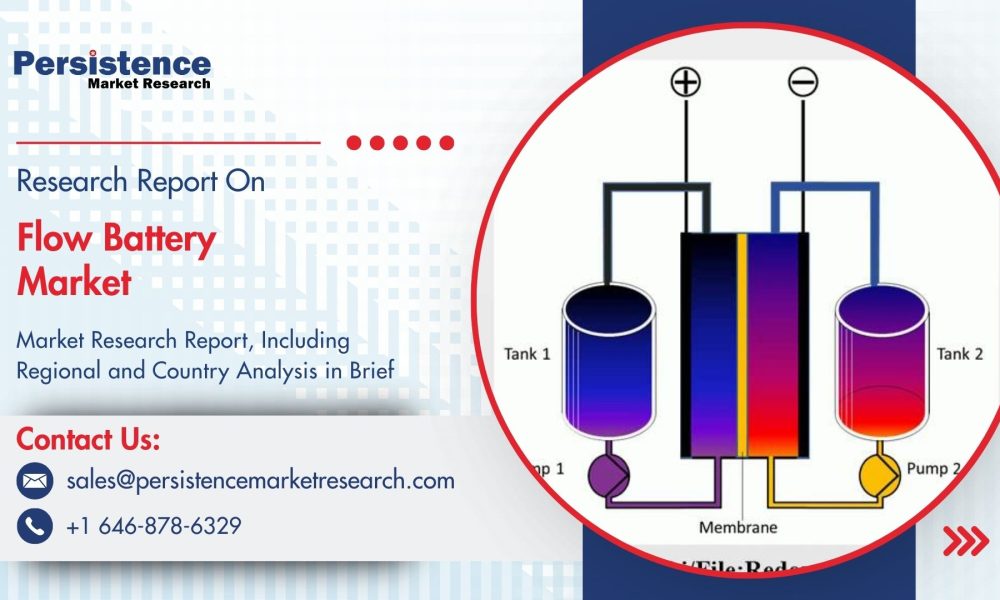
The global flow battery market is witnessing robust growth, driven by the world’s accelerating transition toward renewable energy and the growing need for efficient, long-duration energy storage solutions. According to Persistence Market Research, the market is expected to expand at a strong CAGR of 11.7% from 2023 to 2030, increasing from US$ 0.73 billion in 2023 to US$ 1.59 billion by 2030. This growth underscores the rising significance of flow batteries as a reliable alternative to conventional lithium-ion systems, especially in grid-scale and industrial applications where energy stability, scalability, and safety are paramount.
Overview of the Flow Battery Market
The flow battery market is gaining momentum due to the world’s growing focus on renewable energy integration and grid stability. Flow batteries, known for their ability to store large amounts of energy for extended durations, are emerging as a critical enabler in addressing the intermittency challenges of renewable sources such as solar and wind. Unlike lithium-ion batteries, which degrade over time and have safety risks associated with overheating, flow batteries offer longer lifespans, higher safety margins, and greater scalability.
The market’s steady expansion is being driven by increased deployment of renewable energy projects, supportive government policies, and investments in smart grid infrastructure. Moreover, rising global electricity consumption, coupled with efforts to decarbonize power systems, has created a fertile environment for the adoption of advanced energy storage technologies like flow batteries.
In recent years, technological advancements in vanadium redox flow batteries (VRFB) and the emergence of zinc-bromine and iron-based systems have further enhanced performance efficiency, cost-effectiveness, and environmental compatibility. These innovations are making flow batteries increasingly suitable for applications across grid-scale storage, commercial energy backup, and even microgrid systems in remote regions.
Get a Sample PDF Brochure of the Report (Use Corporate Email ID for a Quick Response): https://www.persistencemarketresearch.com/samples/33889
Market Dynamics: What’s Driving the Growth?
One of the most prominent drivers of the flow battery market is the rising adoption of renewable energy systems across the globe. As more countries aim for net-zero emissions, the integration of solar and wind energy into the grid is creating a strong need for energy storage solutions that can ensure consistent power supply. Flow batteries, with their unique design that separates energy storage capacity from power output, are perfectly positioned to address this need.
Another major growth catalyst is the increasing demand for grid modernization and flexibility. Traditional power grids are being replaced or upgraded with smart grid technologies to improve reliability and manage decentralized energy generation. Flow batteries play an essential role in these systems by enabling energy shifting, frequency regulation, and load balancing.
Additionally, corporate and industrial sectors are showing growing interest in sustainable power solutions to reduce operational costs and carbon footprints. Flow batteries offer excellent suitability for these applications due to their long operational life—often exceeding 20 years—and low maintenance requirements. The market is also benefiting from rising investments in research and development, leading to reduced costs and higher efficiency for flow battery systems.
Technological Advancements Supporting Market Expansion
The development of next-generation flow battery chemistries is a defining trend in the market. The dominance of vanadium redox flow batteries continues due to their proven stability and durability. However, the industry is witnessing rapid innovation in non-vanadium alternatives, such as zinc-bromine, iron-chromium, and organic flow batteries. These alternatives promise lower raw material costs and reduced environmental impact, making them appealing options for large-scale adoption.
Manufacturers are also focusing on improving energy density, efficiency, and modular scalability. Modular designs are particularly important because they allow end users to scale up energy storage capacity easily as demand grows, without completely replacing existing systems. Furthermore, advances in membrane technologies and electrolyte optimization are improving system performance while reducing degradation rates.
In parallel, the integration of digital technologies, such as remote monitoring and predictive maintenance systems, is enhancing the operational efficiency of flow battery installations. These improvements are helping utilities and commercial users achieve better control over power management, thereby boosting the overall market adoption rate.
Regional Insights: Where Growth is Concentrated
The Asia-Pacific region currently holds a leading position in the global flow battery market, driven by significant investments in renewable energy infrastructure and grid-scale energy storage projects. Countries such as China, Japan, South Korea, and Australia are at the forefront of adopting flow batteries, supported by strong government incentives and sustainability goals. China, in particular, is scaling up production capacity for vanadium flow batteries to meet its growing energy storage needs.
North America is another key region witnessing substantial growth, primarily due to the increasing deployment of renewable energy and the modernization of power grids in the United States and Canada. The U.S. Department of Energy (DOE) has launched several funding programs to promote long-duration energy storage technologies, which include flow battery research and pilot projects.
In Europe, the market is growing steadily, supported by stringent carbon reduction targets and ongoing efforts to enhance renewable integration. Countries like Germany, the U.K., and the Netherlands are seeing growing adoption of flow batteries for grid balancing and industrial applications. Meanwhile, emerging regions such as the Middle East and Latin America are also beginning to explore flow battery technologies to address remote energy storage needs and improve off-grid reliability.
Challenges and Restraints in the Flow Battery Market
Despite promising growth prospects, the flow battery market faces several challenges that could affect its adoption rate. The high initial capital cost associated with flow battery installation remains a significant barrier, especially for small-scale applications. While operational and maintenance costs are relatively low, the upfront investment required for system setup can deter potential buyers.
Another key restraint is the limited availability of vanadium resources, which are essential for vanadium redox flow batteries—the most widely used type today. Supply chain instability and fluctuating raw material prices can impact production scalability and profitability. Moreover, compared to lithium-ion batteries, flow batteries still face lower energy density, which restricts their use in mobile and compact storage systems.
Finally, a lack of standardized industry regulations and awareness in certain regions continues to hinder widespread adoption. However, ongoing research and government-led pilot programs are gradually addressing these concerns, paving the way for a more sustainable growth path.
For Customized Insights on Segments, Regions, or Competitors, Request Personalized Purchase Options: https://www.persistencemarketresearch.com/request-customization/33889
Future Outlook and Emerging Opportunities
The future of the flow battery market looks highly promising as the world continues to prioritize clean and renewable energy. Opportunities are expanding in areas such as grid-scale renewable integration, microgrid development, and electric vehicle (EV) charging infrastructure. As EV adoption surges globally, the need for flexible and efficient energy storage systems will become more pressing, creating significant potential for flow battery applications.
Additionally, government initiatives supporting long-duration energy storage are expected to fuel market growth. Countries across Europe, North America, and Asia are investing heavily in demonstration projects to validate the commercial viability of flow batteries. This will likely result in economies of scale and cost reductions over time.
The rise of decentralized and hybrid power systems, where renewable energy sources are combined with backup storage solutions, also opens up new avenues for flow battery deployment. These systems can serve as reliable power sources for remote communities, islands, and industrial zones that face grid instability. As manufacturing efficiency improves and R&D efforts continue, the cost competitiveness of flow batteries will further strengthen, ensuring their role in the global energy transition.
Company Insights
The global flow battery market is characterized by the presence of several key players focusing on innovation, partnerships, and large-scale project deployment. Major companies are investing in product development to enhance system performance and durability while expanding their geographical reach through strategic collaborations. Leading market participants include:
✦ Redflow Limited
✦ ESS Inc.
✦ Sumitomo Electric Industries, Ltd.
✦ Invinity Energy Systems
✦ Primus Power Corporation
✦ CellCube Energy Storage Systems Inc.
✦ Rongke Power Co., Ltd.
✦ VRB Energy
✦ Lockheed Martin Corporation
✦ ViZn Energy Systems, Inc.
Conclusion
The flow battery market stands at a pivotal juncture in the evolution of global energy storage technologies. With growing renewable energy installations, rising grid modernization efforts, and increasing government support, the demand for flow batteries is poised to accelerate rapidly. The ability of flow batteries to provide safe, efficient, and scalable energy storage makes them an indispensable part of the transition toward a cleaner and more resilient energy future.
As technological advancements continue to enhance efficiency and reduce costs, flow batteries are expected to capture a significant share of the global energy storage landscape by 2030, helping the world move closer to its sustainability goals while supporting the reliable integration of renewable power sources.
Explore the Latest Trending Research Reports:
About Persistence Market Research:
At Persistence Market Research, we specialize in creating research studies that serve as strategic tools for driving business growth. Established as a proprietary firm in 2012, we have evolved into a registered company in England and Wales in 2023 under the name Persistence Research & Consultancy Services Ltd. With a solid foundation, we have completed over 3600 custom and syndicate market research projects, and delivered more than 2700 projects for other leading market research companies’ clients.
Our approach combines traditional market research methods with modern tools to offer comprehensive research solutions. With a decade of experience, we pride ourselves on deriving actionable insights from data to help businesses stay ahead of the competition. Our client base spans multinational corporations, leading consulting firms, investment funds, and government departments. A significant portion of our sales comes from repeat clients, a testament to the value and trust we’ve built over the years.
Contact Us:
Persistence Market Research
G04 Golden Mile House, Clayponds Lane
Brentford, London, TW8 0GU UK
USA Phone: +1 646-878-6329
UK Phone: +44 203-837-5656
Email: [email protected]
Web: https://www.persistencemarketresearch.com




