
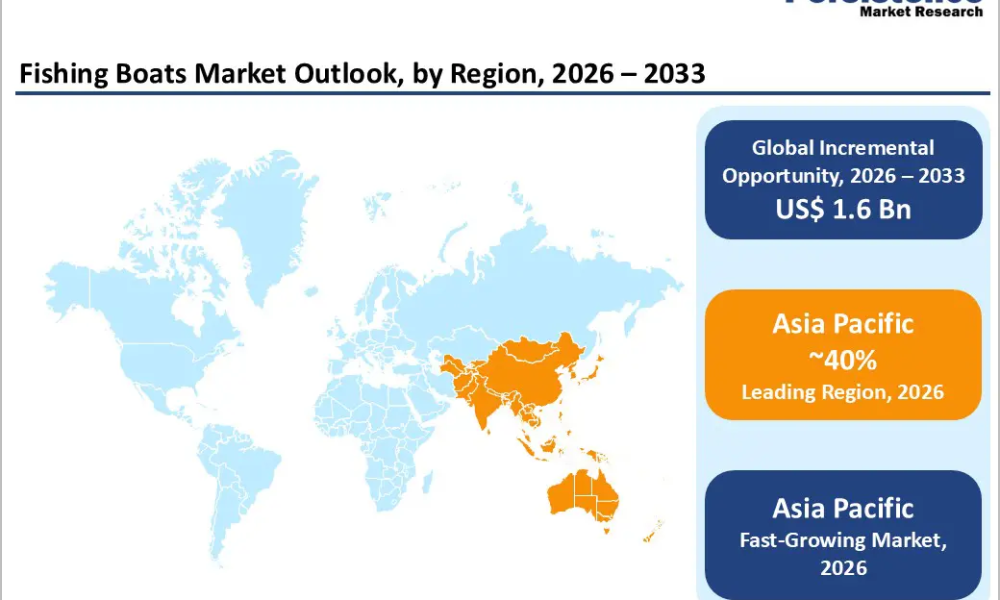
The global fishing boats market is entering a phase of sustained growth, supported by rising participation in recreational fishing, technological advancements in marine engineering, and increasing demand for efficient, multi-purpose vessels. The market size is estimated to be valued at approximately US$2.1 billion in 2026 and is projected to reach US$3.7 billion by 2033, expanding at a compound annual growth rate (CAGR) of 8.4% during the forecast period from 2026 to 2033.
This growth trajectory reflects a structural shift in consumer preferences toward recreational and sport fishing, particularly in developed and emerging coastal economies. Increasing disposable incomes, lifestyle-oriented spending, and tourism-linked marine activities are contributing to higher sales of small and mid-sized fishing boats. At the same time, commercial fishing operators are investing in modernized fleets to improve operational efficiency, fuel economy, and compliance with evolving maritime regulations.
Another key growth driver is the rising demand for multi-functional fishing boats equipped with advanced engines, navigation systems, and modular layouts that can support both leisure and professional use. Advancements in lightweight materials, such as fiberglass-reinforced plastics and aluminum alloys, are further enhancing performance while reducing fuel consumption and maintenance costs. Collectively, these factors are positioning the fishing boats market as a resilient and innovation-driven segment within the broader marine and recreational boating industry.
Get Your FREE Sample Report Instantly Click Now: https://www.persistencemarketresearch.com/samples/32681
Market Segmentation
By Product Type
- Deep-V Boat
- Multi Species Boat
- Bass Boat
- Others
By Size
- <14 Feet
- 14-16 Feet
- >16 Feet
By Engine Type
- <200 HP
- 200-300 HP
- >300 HP
By Region
- North America
- Europe
- East Asia
- South Asia & Oceania
- Latin America
- Middle East & Africa
Regional Insights
Regionally, North America remains the leading market for fishing boats, accounting for a significant share of global revenues. The region benefits from a strong culture of recreational fishing, well-developed marina infrastructure, and high consumer spending on leisure activities. The United States, in particular, represents a mature yet innovation-driven market, with steady demand for technologically advanced and premium fishing boats.
Europe holds a substantial share of the market, supported by coastal tourism, inland waterway fishing, and strong regulatory frameworks that encourage the adoption of fuel-efficient and low-emission vessels. Countries such as Norway, the United Kingdom, and France are notable contributors, driven by both recreational and small-scale commercial fishing activities.
The Asia-Pacific region is expected to be the fastest-growing market during the forecast period. Rapid urbanization, rising disposable incomes, and expanding marine tourism in countries such as China, Australia, Japan, and Southeast Asian nations are driving demand for recreational fishing boats. Additionally, government initiatives to modernize fishing fleets and improve maritime safety are supporting market expansion. The region’s large coastline and inland water resources further enhance its long-term growth potential.
Customize This Report for Your Exact Requirements: https://www.persistencemarketresearch.com/request-customization/32681
Unique Features and Innovations in the Market
Modern fishing boats are increasingly differentiated by their technological sophistication, modular design, and sustainability-oriented features. Manufacturers are focusing on lightweight hull designs that improve speed and fuel efficiency while maintaining durability and safety. The use of advanced composites and corrosion-resistant materials is extending vessel lifespans and reducing maintenance requirements.
The integration of artificial intelligence (AI) and Internet of Things (IoT) technologies is reshaping the user experience. AI-enabled fish-finding systems can analyze sonar data to identify optimal fishing zones, while IoT-based sensors monitor engine performance, fuel consumption, and onboard systems in real time. These capabilities enhance operational efficiency and reduce downtime.
Connectivity solutions supported by 5G and satellite communication technologies are enabling real-time data transmission, remote diagnostics, and enhanced safety features. For commercial operators, these innovations support fleet management, regulatory compliance, and predictive maintenance. For recreational users, they improve navigation accuracy, safety, and overall convenience.
Market Highlights
One of the key reasons industries and consumers are adopting modern fishing boats is the combination of performance, efficiency, and enhanced user experience. Advanced propulsion systems and lightweight designs are reducing fuel costs, while digital technologies are improving catch success rates and safety at sea.
Regulatory frameworks are also playing a critical role in shaping market dynamics. Stricter emissions standards and safety regulations are encouraging the adoption of cleaner engines, hybrid propulsion, and advanced navigation systems. At the same time, sustainability considerations are influencing purchasing decisions, with manufacturers increasingly offering eco-friendly designs and materials.
Cost reduction through improved fuel efficiency and lower maintenance requirements is another significant market highlight. These factors are particularly important for commercial operators, who face rising operational costs and competitive pressures.
Key Players and Competitive Landscape
The global fishing boats market is moderately fragmented, with a mix of established marine manufacturers and regional players competing on innovation, brand reputation, and distribution networks. Leading companies are investing in product development, strategic partnerships, and geographic expansion to strengthen their market positions.
Key players include:
- Brunswick Corporation – Focuses on innovation in recreational fishing boats and integrates advanced propulsion and digital systems across its product portfolio.
- Yamaha Motor Co., Ltd. – Leverages its expertise in marine engines to offer high-performance, fuel-efficient fishing boats and propulsion solutions.
- Beneteau Group – Expands its presence in both recreational and light commercial fishing segments through design-driven and technologically advanced vessels.
- Tracker Marine Group – Specializes in aluminum fishing boats, emphasizing durability, affordability, and wide distribution across North America.
- Boston Whaler – Known for premium, safety-focused fishing boats with advanced hull designs and integrated electronics.
Competitive strategies across the market include continuous product innovation, expansion into emerging regions, and the incorporation of smart marine technologies to enhance value propositions.
Recent Developments
- Leading manufacturers have introduced hybrid and electric fishing boat models, targeting environmentally conscious consumers and aligning with tightening emissions regulations.
- Several companies have expanded their production and distribution facilities in Asia-Pacific, aiming to capitalize on the region’s rapid growth in recreational fishing and marine tourism.
Ready to Dive Deep? Buy Full Report Today: https://www.persistencemarketresearch.com/checkout/32681
Future Opportunities and Growth Prospects
The future outlook for the fishing boats market remains highly positive, with opportunities emerging across both recreational and commercial segments. The continued evolution of electric and hybrid propulsion technologies is expected to open new avenues for growth, particularly in regions with strict environmental regulations and protected marine ecosystems.
Advancements in digitalization, including AI-driven analytics, autonomous navigation assistance, and enhanced connectivity, are likely to further transform the market. These technologies will not only improve operational efficiency but also enhance safety and user engagement, making fishing boats more accessible to new consumer segments.
Regulatory developments will continue to shape industry dynamics, encouraging sustainable practices and the adoption of cleaner technologies. Manufacturers that proactively align their product strategies with evolving regulations and consumer expectations are expected to gain a competitive advantage.
Overall, the global fishing boats market is poised for steady expansion through 2033, supported by strong demand fundamentals, technological innovation, and increasing emphasis on sustainability and performance.




