
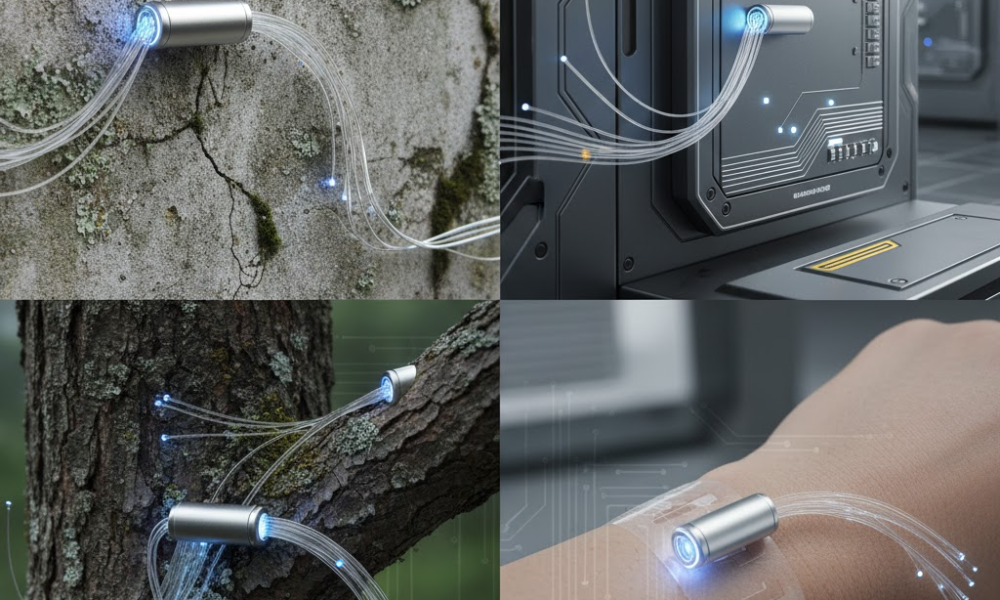
Fiber Optic Sensor Market Overview:
Fiber Optic Sensor Market is set for strong expansion, growing from USD 3.47 billion in 2024 to USD 7.02 billion by 2032 at a CAGR of 9.2%. The market’s rapid growth is driven by the rising adoption of Industry 4.0 technologies, precision monitoring processes, and increasing use in oil & gas, medical, and defense applications. North America remains the dominant region, with a strong foothold in industrial automation, infrastructure modernization, and oilfield monitoring technologies.
Key Highlights & Insights
- Market Size & Growth: The fiber optic sensor market is projected to rise from USD 3.47 billion in 2024 to USD 7.02 billion by 2032, at a CAGR of 9.2%.
- Dominating Region: North America leads the market due to significant advancements in smart manufacturing, aging infrastructure monitoring, and oil and gas developments. With strong government investments in high-tech, sustainable infrastructure, the U.S. remains the primary contributor.
- Leading Segment: Intrinsic fiber optic sensors hold the largest market share, accounting for over 55% in 2024, attributed to their higher sensitivity and precision in controlling factors such as temperature, strain, and vibration directly through light interaction within fibers.
- Key Driver: The shift toward automation, smart factories, and continuous structural health monitoring across industries underpins sustained market growth.
Recent Developments
- 2024–2025:
- Corning and Broadcom announced collaborative R&D programs to produce next-gen optical amplifiers enhancing long-distance signal transmission.
- Resonetics (USA) expanded its manufacturing capacity to meet growing demand from the healthcare and defense industries for miniaturized fiber optic sensors.
- Leuze Electronic (Germany) and Pepperl+Fuchs SE (Europe) launched sensor systems designed for high-precision industrial environments, particularly for process automation and logistics tracking systems.
- Nanjing Hecho Technology (China) introduced affordable distributed fiber sensor solutions to support Asian infrastructure modernization and smart city development.
These developments emphasize the role of technology convergence between fiber optics and IoT systems for predictive maintenance and automation efficiency.
Secure your sample copy of this report immediately: https://www.maximizemarketresearch.com/request-sample/54975/
Market Dynamics
Growth Drivers:
- Expansion of Industry 4.0 and smart manufacturing initiatives requiring real-time process monitoring.
- Increasing awareness of infrastructure safety driving the use of structural health monitoring systems with embedded fiber optic sensors.
- Growing demand in oil and gas for downhole, pipeline, and facility integrity monitoring to improve production efficiency and safety.
- Rising use in medical and defense due to the precision, small form factor, and electromagnetic immunity of fiber optic sensors.
Challenges:
- Complex and costly installation processes requiring specialized skills.
- Signal loss and temperature sensitivity issues demanding advanced compensatory technology.
- Competition from low-cost traditional sensors and microelectromechanical systems (MEMS).
Opportunities:
- Integration of fiber optics within IoT and cloud-based analytics platforms for smart predictive applications.
- Expansion of use in environmental monitoring systems to track pollution and climate parameters.
- Innovations in multiplexing allowing data collection from multiple sensors through a single optical fiber network.
Regional Analysis
- North America: The global leader, driven by automation, smart industrial systems, and robust oil & gas production. U.S. initiatives under infrastructure modernization programs, such as the Infrastructure Investment and Jobs Act, further fuel deployment in structural health and environmental monitoring.
- Asia Pacific: Expected to display the fastest growth, supported by rapid industrialization in China, India, Japan, and South Korea. Favorable investments in smart manufacturing and developing telecom infrastructure sustain regional growth.
- Europe: Substantial investments in renewable energy and automotive R&D drive applications in smart grids and intelligent vehicle systems.
- Middle East, Africa & South America: Emerging opportunities in oilfield integrity monitoring and smart construction projects are gradually contributing to global market momentum.
Product Segmentation
- By Type:
- Intrinsic Sensor (dominant) – Directly measures light interaction within fiber for real-time precision.
- Extrinsic Sensor – Uses external components to sense environmental changes impacting light transmission.
- By Component:
- Optical Amplifier, Fiber Optic Cable, Transmitter, Receiver.
- By End-Use Industry:
- Oil & Gas (largest), Industrial, Medical, Defense, and Transportation sectors lead demand across applications.
Key Trends
- Multiplexing Advancements: Innovative fiber designs allowing multiple sensing points along a single fiber strand.
- Integration with IoT and AI: Real-time predictive analytics improving industrial and environmental decision-making.
- Environmental Applications: Sensors increasingly deployed for tracking climate shifts, pollution, and water quality parameters.
- Distributed Sensing: Distributed acoustic sensing and distributed temperature sensing technologies gaining traction in large infrastructure networks.
- Miniaturization: Push toward compact, highly sensitive sensors increasing adoption across biomedical and wearable technologies.
Quote
“North America’s dominance in the fiber optic sensor market underscores its deep integration of advanced automation, infrastructure monitoring, and energy innovation. As global industries embrace precision and sustainability, fiber optic sensing stands as a cornerstone technology enabling intelligent, efficient, and safer operations across sectors.”
The fiber optic sensor market is transitioning into a critical enabler of the modern industrial era—bridging automation, environmental monitoring, and digital transformation. With key contributions from North America’s technology leadership and Asia Pacific’s rapid scalability, the industry is poised for a decade of dynamic growth shaped by innovation, connectivity, and data-driven intelligence.
About Maximize Market Research:
Maximize Market Research is one of the fastest-growing market research and business consulting firms serving clients globally. Our revenue impact and focused growth-driven research initiatives make us a proud partner of majority of the Fortune 500 companies. We have a diversified portfolio and serve a variety of industries such as IT & telecom, chemical, food & beverage, aerospace & defense, healthcare and others.
Contact Maximize Market Research:
MAXIMIZE MARKET RESEARCH PVT. LTD.
⮝ 3rd Floor, Navale IT park Phase 2,
Pune Banglore Highway, Narhe
Pune, Maharashtra 411041, India.
✆ +91 9607365656
🖂 [email protected]




