
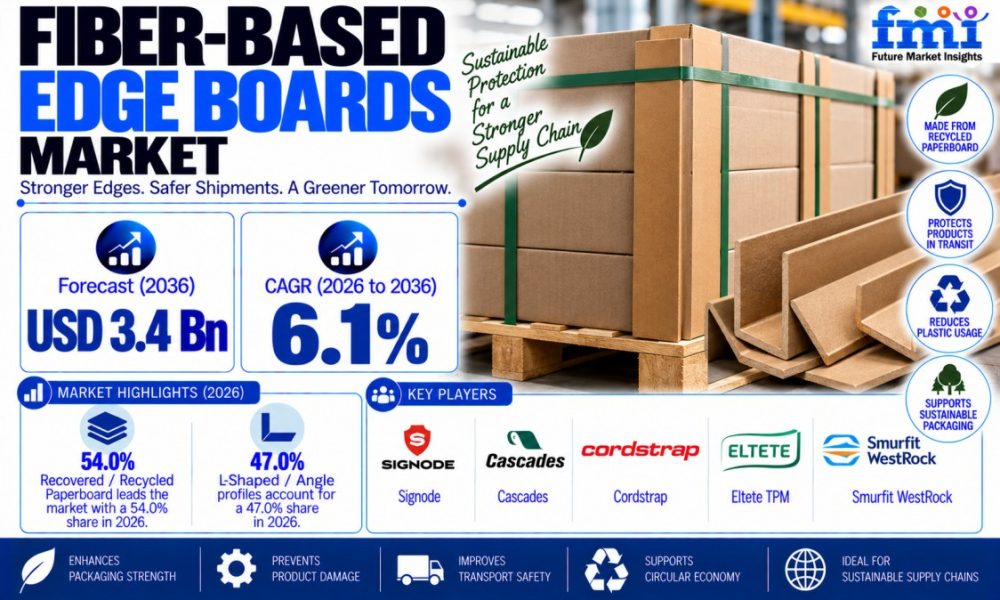
The global Fiber-based Edge Boards Market is projected to grow from USD 1.9 billion in 2026 to USD 3.4 billion by 2036, expanding at a 6.1% CAGR, according to Future Market Insights (FMI).
Demand is being supported by rising shipment volumes and the need to protect palletized products against corner damage, strap pressure, stacking forces, and handling impacts. Fiber-based edge boards provide structural protection around exposed pallet edges while supporting the wider shift toward recyclable and material-efficient transport packaging.
Unlike capital equipment, edge boards are recurring packaging consumables. Demand therefore moves closely with pallet shipment volumes across consumer goods, industrial products, food and beverage, and other supply chains.
>> Get Detailed Market Forecasts, Competitive Benchmarking, and Pricing Trends: https://www.futuremarketinsights.com/reports/sample/rep-gb-34213
Recovered and Recycled Paperboard Holds 54% Share
Recovered/recycled paperboard is projected to account for 54.0% of the material category in 2026.
The material is widely used because edge boards primarily need compressive stiffness and structural performance rather than a premium printable surface.
Its strength-to-cost characteristics make recycled paperboard suitable for high-volume pallet protection. However, recovered fiber can vary in quality, creating consistency challenges for converters.
Maintaining consistent stiffness and dimensional performance is therefore important when supplying large-volume palletizing operations.
L-Shaped Profiles Lead With 47% Share
L-shaped and angle profiles account for 47.0% of the profile category.
The geometry protects two faces at a pallet corner where strap pressure and handling impacts can create concentrated damage.
The format can be applied manually or integrated into automated pallet-wrapping operations, making it suitable for facilities with different levels of packaging automation.
For packaging engineers, profile dimensions remain important. Leg length, thickness, rigidity, and fit need to correspond to the product and pallet configuration.
3–5 mm Boards Account for 44%
The 3–5 mm thickness category holds 44.0% share.
This range provides a balance between stiffness and material consumption for standard palletized shipments. It can distribute strap pressure and resist typical corner compression without adding the weight and bulk associated with heavier profiles.
Higher-value or heavier loads may require thicker edge boards, making a supplier’s ability to provide multiple thickness specifications important for customers with varied product portfolios.
Logistics and Transportation Leads Applications
Logistics and transportation accounts for 54% of application demand.
Edge boards are exposed to several handling stages between packaging and final delivery, including strapping, wrapping, pallet transfers, clamp handling, warehouse storage, and transportation.
Performance therefore needs to extend beyond the initial packaging operation.
A board that performs well under strap tension but loses its shape during clamp handling or storage may not provide sufficient protection across the complete logistics cycle.
This makes full-chain damage testing an important part of supplier qualification.
Furniture and Building Materials Represent the Largest End Use
Furniture and building materials represent the largest end-use category.
Products such as panels, doors, countertops, cabinetry, flooring packs, and assembled furniture have long exposed edges that can be damaged during transportation.
For these applications, the correct leg length and rigidity can be critical. Custom sizing can allow manufacturers to match edge protection to different product dimensions instead of over-specifying a single standard profile.
Direct and OEM Supply Leads Sales Channels
Direct/OEM sales lead the sales channel.
Large-volume buyers often specify exact requirements for leg length, thickness, moisture grade, compression strength, and delivery cadence.
This makes technical validation and consistent supply important parts of supplier relationships.
For manufacturers operating fixed packing schedules, supply reliability can be as important as unit price. A shortage of edge boards can interrupt palletizing operations and affect shipment schedules.
Moisture and Fiber Variability Remain Challenges
Fiber-based edge boards face practical limitations.
Moisture sensitivity can reduce performance in uncontrolled storage or humid transport environments unless the board receives appropriate treatment.
Recovered-fiber variability can also affect stiffness and dimensional consistency.
Customer-specific testing can extend approval cycles because packaging engineers need to validate the board against actual load conditions.
These factors can increase conversion costs and create opportunities for water-resistant grades and application-specific profiles.
👉 Access the Complete Report in PDF Format: https://www.futuremarketinsights.com/reports/brochure/rep-gb-34213
India and China Show Strong Growth
Country forecasts indicate stronger growth across Asian markets.
India is projected to grow at an 8.6% CAGR through 2036, supported by increasing industrial packaging demand and palletized shipments.
China follows at 7.6% CAGR, supported by export-oriented manufacturing, domestic logistics activity, and expanding production of paper-based protective components.
Other country CAGRs include:
- Brazil: 6.4%
- United Kingdom: 5.7%
- USA: 5.5%
- Germany: 5.3%
- Japan: 4.8%
The different growth rates reflect variations in manufacturing output, logistics activity, packaging specifications, and investment priorities.
Automation Creates New Opportunities
One opportunity lies in lightweight edge boards designed for automated pallet-building and end-of-line systems.
As packaging operations become more automated, edge boards need to be consistently dimensioned and easy to position without slowing throughput.
Water-resistant custom profiles also provide an opportunity for suppliers targeting applications exposed to challenging storage or transportation conditions.
For export-oriented manufacturers, high-recycled-content grades that meet pallet protection specifications can offer another route for product development.
Competitive Landscape
The market includes Signode, Cascades, Cordstrap, Eltete TPM, Smurfit WestRock, Sonoco, Conitex Sonoco, Packaging Corporation of America, Kunert Group, and VPK Group.
Companies compete through fiber edge-protection breadth, load-securing and end-of-line integration, recycled-fiber capabilities, coreboard supply, customized dimensions, and regional manufacturing networks.
Recent developments include Signode’s September 2025 launch of the Octopus Prestige high-speed stretch wrapper, Cascades’ containerboard packaging plant start-up in Virginia, and VPK Group’s expansion of recycled-paper capacity and Corex operations.
Analyst Perspective
“Fiber-based edge boards are approved on performance, not on recycled content alone. Buyers need consistent compression strength, dimensional accuracy and moisture resistance because a weak profile can loosen straps, destabilize pallets and increase corner damage.”
— Nandini Roy Choudhury, Principal Consultant, Future Market Insights
About the Fiber-based Edge Boards Market Report
The FMI report analyzes the market by profile, material, thickness, application, end use, sales channel, and region.
Profiles include L-shaped/angle, U-shaped/flat edge, wraparound, and custom profiles. Materials include recovered/recycled paperboard, virgin kraft board, and solid fiberboard.
To explore how FMI Custom Research can support your strategic priorities, connect with our team at – [email protected]
About Future Market Insights (FMI)
Future Market Insights, Inc. is an ESOMAR-certified, ISO 9001:2015 market research and consulting organization trusted by Fortune 500 companies. With a global presence across the U.S., UK, India, and Dubai, FMI delivers data-driven insights across 30+ industries and 1200 markets worldwide.



