
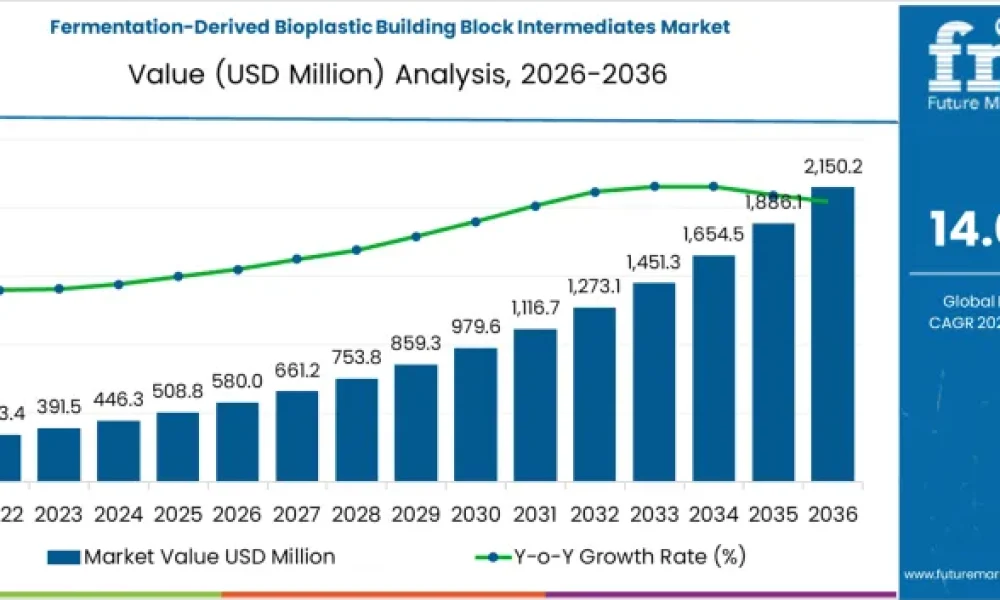
The global fermentation-derived bioplastic building block intermediates market is poised for unprecedented expansion in the decade ahead, with market value projected to climb from USD 580 million in 2026 to an estimated USD 2,150.2 million by 2036, representing a robust 14% compound annual growth rate (CAGR). This growth reflects accelerating industrial adoption of renewable materials and the global shift toward reducing dependence on petrochemical plastics with sustainable, bio-based alternatives. Sustainability mandates from governments, consumer demand for eco-friendly products, and advancements in fermentation technologies are driving strong momentum across regions and applications in this transformative space.
Key Market Insights at a Glance
In 2026, the fermentation-derived bioplastic intermediates market stands at USD 580 million, reflecting strong foundational demand from sectors prioritizing environmental stewardship and circular economy principles. Over the forecast period, demand is expected to surge, with the global market surpassing USD 2.15 billion by 2036. This impressive growth trajectory underscores the increasing role of biodegradable intermediates in replacing traditional petrochemical inputs and supporting broad industrial transitions to sustainable plastics.
Emerging dynamics in the market center on improved fermentation yields, cost efficiencies from biorefinery scaling, and upstream feedstock optimization. With sugar-based feedstocks commanding a near-majority share due to their high fermentability and established supply chains, companies are leveraging biomass inputs more efficiently to produce renewable building blocks like lactic acid derivatives, succinic acids, and furanic monomers. These intermediates serve as crucial precursors for bioplastics used across packaging, automotive, textiles, agriculture, and industrial polymer sectors.
Segment Overview
Market segmentation highlights diversification across feedstock sources, building block types, and end uses. Sugar-based feedstocks lead the market, preferred for their availability and high conversion efficiency in fermentation processes, followed by lignocellulosic biomass and agricultural by-products. In terms of product type, lactic acid and its derivatives remain dominant as feedstock for widely used bioplastics such as polylactic acid (PLA), prized for its compostability and high performance.
End-use segmentation reveals that bioplastics and packaging represent nearly half of total market demand, driven by global efforts to curtail plastic waste and expand eco-friendly packaging solutions. Automotive and durable goods industries are increasingly incorporating fermentation-derived intermediates to deliver lighter, sustainable components without compromising performance. Textile and fiber applications are also gaining traction, aligning with rising consumer preference for biodegradable materials in fashion and technical fabrics.
Regional Overview
Geographically, the market’s expansion is truly global. North America, particularly the United States, is projected to exhibit strong growth supported by sustainability regulations and industrial innovation hubs focusing on bio-based materials. Europe’s established regulatory frameworks and consumer pollution awareness have positioned it as a significant regional contributor, especially in Germany and other Western European nations.
The Asia Pacific region is witnessing dynamic growth catalyzed by rapid industrialization, rising environmental consciousness, and increased investments in fermentation infrastructure, particularly across China, Japan, and South Korea. Emerging markets, including India and ASEAN countries, are investing in renewable technologies and bioplastic adoption as part of broader environmental and economic development strategies.
To access the complete data tables and in-depth insights — Request Your Sample Report Now
Competitive Landscape
A diverse and competitive landscape characterizes this market, with global chemical and biotechnology leaders driving innovation and scale. Established players such as Braskem S.A., Corbion N.V., Cargill Incorporated, BASF SE, and DuPont de Nemours, Inc. are at the forefront, offering a range of fermentation-derived intermediates tailored to meet rising industrial demand. These companies are complemented by agile biotechnology firms like Genomatica, Avantium N.V., Novozymes A/S, Royal DSM N.V., and Roquette Frères, which bring deep expertise in sustainable production processes and metabolic engineering.
To stay competitive, industry players are focusing on vertical integration, strategic partnerships, and research collaborations aimed at enhancing yield, reducing production costs, and broadening the portfolio of bio-based materials. Investments in advanced fermentation platforms and proprietary microbial strains that increase productivity and cost-efficiency will continue to shape market leadership.
Market Outlook: Powering the Next Decade
The fermentation-derived bioplastic intermediates market outlook is exceptionally positive as global industries align with sustainability targets and regulatory drivers promoting reduced carbon footprints. With bioplastics gaining visibility across sectors, these intermediates are becoming essential building blocks in the transition to renewable plastics. Continued advances in synthetic biology, biorefinery development, and feedstock diversification will support accelerated adoption and unlock value across the entire bioplastics supply chain.
This market evolution is not just about replacing petrochemicals — it is about enabling a circular materials economy where resource efficiency, product lifecycle transparency, and environmental stewardship define industrial competitiveness. Over the next decade, fermentation-derived bioplastic intermediates are expected to play a central role in reshaping conventional polymer manufacturing with renewable, biodegradable solutions.
Key Players of Sustainable Label Industry
Leading companies shaping the future of fermentation-derived bioplastic intermediates include Braskem S.A., Corbion N.V., Cargill Incorporated, BASF SE, DuPont de Nemours, Inc., Genomatica, Inc., Avantium N.V., Novozymes A/S, Royal DSM N.V., and Roquette Frères. These organizations continue to invest in new product offerings, expand global production capacity, and strengthen sustainability credentials through strategic R&D initiatives.
Recent Strategic Developments
Across the market, recent strategic developments underscore industry commitment to innovation. Collaborations between bio-tech start-ups and legacy chemical manufacturers are enabling the commercialization of next-generation fermentation processes. Investments in integrated biorefineries and scale-up facilities are strengthening supply chains for renewable intermediates, while partnerships with packaging and end-use companies are accelerating product adoption in consumer goods and industrial applications.
Have a specific Requirements and Need Assistant on Report Pricing or Limited Budget please contact us – [email protected]
About Future Market Insights (FMI)
Future Market Insights, Inc. (FMI) is an ESOMAR-certified, ISO 9001:2015 market research and consulting organization, trusted by Fortune 500 clients and global enterprises. With operations in the U.S., UK, India, and Dubai, FMI provides data-backed insights and strategic intelligence across 30+ industries and 1200 markets worldwide.
Why Choose FMI: https://www.futuremarketinsights.com/why-fmi



