
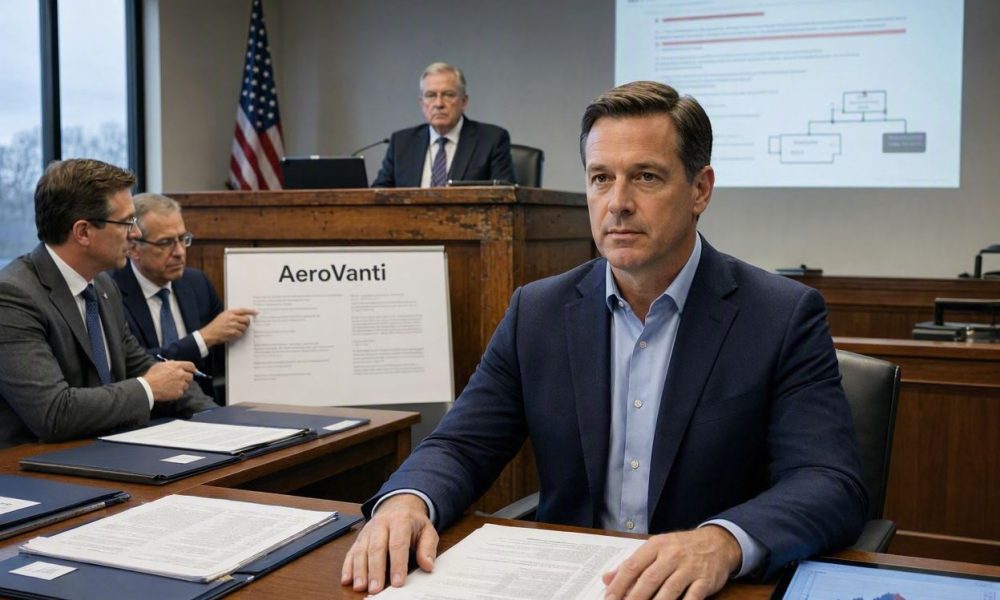
Trial evidence in Maryland alleged that yachts, jewelry, and high-end rentals were paid for with money meant for aircraft expansion.
WASHINGTON, DC — Federal prosecutors persuaded a Maryland jury that AeroVanti founder Patrick Britton-Harr diverted millions of dollars collected from premium private aviation members toward yachts, expensive jewelry, personal living costs, and a luxury Florida rental instead of purchasing five promised aircraft.
The money came from nearly 100 Top Gun members who paid about $150,000 each after Britton-Harr said their contributions would finance specific planes, discounted flight hours, refurbishment work, regulatory compliance, and secured financial interests protected through escrow arrangements.
Trial evidence contrasted those detailed aircraft-expansion promises with bank transfers and personal expenditures, giving jurors a financial narrative that ultimately supported six wire fraud convictions against the 43-year-old Annapolis businessman in June 2026.
Britton-Harr has requested a new trial over alleged misconduct involving a former courtroom deputy and jurors, but the guilty verdicts remain in effect while the judge reviews the motion and decides whether to proceed with sentencing.
Members Expected Their Money to Build an Aircraft Fleet
AeroVanti marketed itself as a private air club offering comparatively affordable access to charter flights, frequently emphasizing distinctive Piaggio P.180 Avanti aircraft, recurring membership plans, competitive hourly prices, concierge attention, and the absence of separate repositioning charges.
The company’s standard monthly plans differed from Top Gun, a limited membership opportunity that required selected customers to make large upfront payments tied directly to aircraft acquisition and blocks of discounted future flight time.
Approximately 20 participating members were assigned to each proposed aircraft, creating five separate customer groups that collectively contributed around $3 million per plane and approximately $15 million across the entire premium membership program.
Prosecutors said Britton-Harr promised those funds would purchase specific planes, recondition them, bring them into compliance with applicable aviation requirements, and place the aircraft titles into escrow so participants would hold securitized interests.
That package made the transaction appear fundamentally safer than an unsecured prepayment because members could believe a valuable, identifiable aircraft would remain behind their money even if AeroVanti later encountered ordinary business or cash-flow problems.
The Difference Between Investors and Members Matters
Public officials and news reports sometimes described the Top Gun participants as investors because their money was tied to aircraft acquisition and secured interests, although the criminal case centered on customers purchasing memberships and prepaid aviation benefits.
The participants were not simply buying conventional shares whose value might rise or fall with AeroVanti’s overall performance, because they were promised discounted flight hours and financial protection connected with identifiable aircraft assigned to member groups.
That distinction did not diminish the seriousness of the alleged diversion, since federal wire fraud protects anyone induced to transfer money through material deception, regardless of whether the victim is labeled an investor, customer, lender, member, or business partner.
What mattered to jurors was whether Britton-Harr knowingly used false representations about the intended use and protection of funds to obtain payments that participants would not have authorized if they understood the actual financial circumstances.
Escrow Helped Make the Offer Persuasive
Escrow arrangements commonly reduce transactional risk by placing money, documents, or property with an independent custodian until defined conditions are satisfied, preventing either side from gaining unrestricted control prematurely.
For AeroVanti members, escrow appeared to tie the release of their money to aircraft purchases, title delivery, refurbishment, regulatory work, and eventual operational availability for the discounted flights included in Top Gun memberships.
Federal prosecutors traced numerous disbursements from the Top Gun escrow accounts into AeroVanti-controlled accounts, demonstrating how customer funds became accessible while the promised aircraft titles allegedly failed to provide the protection participants expected.
The defense argued before trial that membership agreements and escrow documents did not support the government’s interpretation that aircraft needed to be purchased debt-free, contending that prosecutors mischaracterized contractual language and legitimate business transactions.
Jurors nevertheless convicted Britton-Harr on all six counts after hearing the competing explanations, suggesting the full trial record persuaded them the escrow releases were part of a deliberate fraudulent scheme rather than permissible corporate financing.
Yachts Became the Most Visible Symbol of Diversion
Yacht purchases offered prosecutors a dramatic contrast because members believed their six-figure payments would expand an aircraft fleet, while substantial maritime assets represented luxury consumption or investment unrelated to putting the five promised planes into service.
According to court records summarized in reporting on Britton-Harr’s financial transfers, prosecutors directly connected Top Gun escrow disbursements with multiple boat purchases, including a yacht named Triple Lindy acquired for approximately $306,000.
That reporting described the yacht purchase as following a transfer of about $1 million, while other transfers were linked to additional boats, creating a spending pattern prosecutors could compare with the lack of completed aircraft acquisitions.
Boat ownership was not inherently unlawful, and AeroVanti later promoted a yacht-club component within its luxury travel brand, but the government’s case depended on the source of the money and the representations made before members transferred it.
If customer funds were released specifically because members believed they were financing aircraft, prosecutors could argue that redirecting those proceeds toward yachts demonstrated both personal benefit and a knowing departure from the promised purpose.
The visual power of yachts also made complicated bank evidence easier for jurors to understand, because a large vessel represents a tangible asset that can be contrasted immediately with an airplane that customers financed but never received.
Jewelry Purchases Added Another Personal-Spending Trail
Prosecutors also linked substantial AeroVanti money to expensive jewelry, another personal spending category with little apparent connection to aircraft purchases, maintenance, crew salaries, regulatory work, insurance, hangar expenses, fuel, or member flight operations.
The financial record described in court reporting included a May 2022 transfer of approximately $100,000 into an account associated with Britton-Harr, followed by roughly $65,000 spent at a jewelry store in Pensacola, Florida.
As with the yachts, purchasing jewelry is legal when funded with legitimately available personal or corporate compensation, making the decisive question whether the money represented fraudulently obtained Top Gun proceeds diverted contrary to material promises.
Prosecutors could use timing to strengthen that inference by showing how closely personal expenditures followed escrow releases, particularly if no intervening legitimate revenue source, board authorization, salary payment, documented loan, or reimbursement explained the transfer.
Jewelry also challenged any claim that every disbursement represented an emergency effort to preserve AeroVanti, because such purchases appear less connected with rescuing aircraft operations than payroll, maintenance, insurance, fuel, or overdue vendor invoices.
A $10,000 Monthly Rental Reinforced the Lifestyle Narrative
The government told jurors that diverted funds supported a rental residence near Tampa, Florida, costing approximately $10,000 each month, providing another recurring personal expense linked to money members believed would finance aircraft expansion.
Luxury housing can become persuasive evidence in fraud cases because repeated rental payments establish an ongoing benefit rather than a single unusual purchase, allowing prosecutors to demonstrate how allegedly diverted money sustained a continuing standard of living.
The Florida location also connected to AeroVanti’s Sarasota operations and expanding regional presence, which could support a defense argument that the housing served a legitimate business purpose while Britton-Harr managed company activities away from Maryland.
Jurors would therefore need to assess corporate records, lease documents, payment sources, business justification, tax treatment, personal use, and authorization before deciding whether the residence represented a proper AeroVanti expense or concealed personal enrichment.
The guilty verdict suggests the broader government narrative prevailed, although the public verdict announcement does not explain how jurors weighed each rental payment or spending category when evaluating separate wire fraud counts.
Living Expenses Expanded the Case Beyond Trophy Purchases
Prosecutors referred more broadly to living expenses financed with membership money, a category that may include routine payments lacking the drama of yachts or jewelry but still revealing sustained personal dependence on diverted business funds.
Everyday expenditures matter because fraud proceeds need not purchase extravagant assets to demonstrate personal benefit, and repeated transfers covering ordinary obligations can show how a defendant treated restricted or purpose-specific customer money as freely available income.
The government needed to distinguish personal expenses from legitimate salary, distributions, reimbursements, loans, or authorized corporate costs, particularly because founders frequently use personal credit, mixed-purpose travel, home offices, and temporary advances while building closely held companies.
Accountants, bank records, corporate ledgers, tax documents, invoices, messages, and transfer descriptions can help jurors determine whether spending received proper authorization and accounting treatment or instead represented concealed withdrawals inconsistent with the membership agreements.
By combining luxury purchases with recurring living costs, prosecutors presented a complete lifestyle narrative rather than relying upon one memorable yacht or jewelry transaction that the defense could characterize as isolated or misunderstood.
The Missing Aircraft Remained the Essential Comparison
Personal spending became legally significant because prosecutors said AeroVanti never purchased the five aircraft members financed, allowing the government to contrast tangible benefits Britton-Harr received with assets and services customers did not receive.
If the aircraft had been purchased, titled appropriately, refurbished, and placed into service, disputed personal expenses might have appeared as collateral to a substantially performed business arrangement rather than evidence revealing the scheme’s intended purpose.
Instead, jurors heard that approximately $15 million entered the Top Gun program while the five promised aircraft remained unavailable, enabling prosecutors to argue that the central representations were false when Britton-Harr obtained the money.
Customers were also promised discounted flight hours, meaning the financial harm extended beyond missing security interests because unavailable aircraft reduced AeroVanti’s ability to provide the transportation benefits that gave many members a practical reason to join.
The case therefore involved two losses: members allegedly lacked the aircraft-backed protection promised for their capital, while also losing access to discounted private flights that their $150,000 payments were supposed to secure.
The $1.5 Million Loan Suggested Concealment
According to the Justice Department’s account of the trial evidence, Britton-Harr later obtained a $1.5 million loan to purchase one aircraft he had already represented as acquired with Top Gun member money.
Prosecutors said he withheld material information from the lender to obtain that loan, presenting the later financing as an attempt to conceal the fraud by acquiring an asset that customers believed their original contributions had already purchased.
That transaction carried significant evidentiary value because subsequent conduct can reveal a defendant’s earlier knowledge, particularly when later financing appears designed to close a gap created by an original statement or missing asset.
The defense could argue the loan reflected a good-faith effort to complete AeroVanti’s obligations after circumstances changed, but jurors were entitled to evaluate whether withheld lender information and earlier customer representations made that explanation reasonable.
Combined with yachts, jewelry, housing, and living expenses, the loan helped prosecutors present a chronological narrative moving from customer promises through escrow releases, personal spending, missing aircraft, and an allegedly deceptive effort to obtain replacement financing.
Why Luxury Spending Matters in a Wire Fraud Trial
Federal wire fraud does not require prosecutors to prove that every dollar was spent lavishly, but personal luxury expenditures can provide powerful circumstantial evidence of fraudulent intent when money was obtained through narrowly defined business promises.
The spending helps establish financial motive and personal benefit, showing why Britton-Harr might have made false aircraft representations while also rebutting an innocent explanation that all Top Gun proceeds remained dedicated exclusively to legitimate aviation operations.
Luxury purchases can additionally demonstrate materiality because customers deciding whether to transfer $150,000 would likely consider it important if their aircraft money could instead finance boats, jewelry, premium housing, or personal obligations.
The government still needed to prove each statutory element and connect charged interstate wires to the scheme, rather than asking jurors to convict merely because they disliked expensive purchases or considered Britton-Harr’s lifestyle excessive.
That legal protection matters because wealth, luxury consumption, private aircraft, yachts, jewelry, and expensive homes are not evidence of criminality, especially in industries that serve affluent consumers and premium travel markets.
The verdict shows jurors focused upon the documented relationship between promises, financial control, transfers, personal spending, and missing aircraft, not simply the social meaning attached to luxury property appearing throughout AeroVanti’s public story.
The Defense Challenged the Government’s Contract Theory
Before trial, Britton-Harr’s attorney argued that prosecutors overstated what the membership documents required and wrongly suggested the aircraft needed to be purchased without financing, while defending the escrow releases as consistent with contractual terms.
That defense position aimed to shift the dispute from intentional deception to a legitimate disagreement over how complex membership, lease-purchase, escrow, and aircraft-financing documents should be interpreted in an evolving private aviation business.
The defense could also emphasize that AeroVanti conducted real flights, maintained business operations, employed aviation personnel, marketed legitimate services, and possessed relationships with aircraft owners, making the company different from a fictitious enterprise offering nonexistent transportation.
However, operating a legitimate business does not prevent wire fraud when false representations induce particular customers, and genuine services can make deception more persuasive by surrounding disputed transactions with authentic commercial activity.
The jury rejected the defense theory on every count, establishing that the trial evidence proved fraudulent intent even after Britton-Harr’s lawyers challenged the government’s interpretation of contracts, escrow practices, financing arrangements, and corporate spending.
Luxury Branding Made the Spending More Complicated
AeroVanti openly marketed luxury through private aircraft, yacht experiences, premium sports partnerships, stadium hospitality, executive travel, and concierge service, meaning some high-end spending could be presented as brand development or member acquisition rather than personal consumption.
Corporate entertainment and promotional assets can serve legitimate commercial purposes, particularly when a company sells exclusivity and seeks prospective customers among wealthy sports fans, business leaders, professional athletes, celebrities, and frequent premium travelers.
That commercial environment required prosecutors to connect disputed expenditures precisely to account records, beneficial ownership, personal use, corporate authorization, and customer representations, rather than assuming anything luxurious associated with AeroVanti automatically reflected unlawful diversion.
The distinction between a company yacht used for member experiences and a personally beneficial boat acquired with restricted funds could depend upon title, usage records, maintenance payments, charter revenue, corporate approvals, and disclosures provided to members.
Similarly, a Florida residence might support regional operations while also delivering personal housing, requiring jurors to evaluate whether business justification was genuine, adequately documented, and consistent with how the expense was recorded and communicated.
A Jury Converted the Allegations Into Findings
The luxury-diversion claims began as government allegations, but their legal status changed after prosecutors presented evidence, defense counsel cross-examined witnesses, both sides argued their interpretations, and a Maryland jury returned six unanimous guilty verdicts.
Official statements now describe the spending as evidence established at trial, although Britton-Harr’s pending new-trial motion means the court must still examine whether alleged interactions involving jurors and a former courtroom deputy compromised the proceeding.
The convictions remain operative during that review, and filing a post-trial motion does not itself erase the verdict, establish innocence, prove prejudice, or require prosecutors to retry the case before sentencing can eventually occur.
If the judge grants relief, another jury could reconsider the same financial evidence during a new trial, while denial would preserve the convictions and allow Britton-Harr to pursue appropriate arguments within the federal appellate system.
Luxury Spending Will Influence Sentencing and Restitution
Britton-Harr faces a maximum statutory penalty of 20 years for each wire fraud count, but the court will determine the actual sentence through federal guidelines and statutory factors rather than simply multiplying six counts by their maximum terms.
The court may examine loss amounts, victim numbers, sophisticated means, abuse of trust, financial hardship, obstruction questions, criminal history, deterrence, personal circumstances, and whether any member received usable flight value or recoverable property.
Yachts, jewelry, bank balances, and other traceable assets may become relevant to forfeiture or restitution proceedings if the government establishes that particular property represents fraud proceeds or was purchased using money derived from the convicted scheme.
Victims may submit detailed statements describing substantial unrecovered payments, canceled travel, legal expenses, disrupted business plans, emotional stress, and the betrayal associated with believing aircraft titles and escrow terms adequately protected their contributions.
Reputation Consequences Follow the Money Trail
For Britton-Harr, the enduring public record now places yachts, expensive jewelry, premium housing, missing aircraft, and substantial customer losses beside AeroVanti’s earlier celebrated branding around affordability, innovation, military professionalism, and exclusive private travel.
Effective crisis public-relations planning can help coordinate accurate public statements with ongoing litigation, but communications must distinguish established verdict findings, pending motions, disputed details, and separate allegations without rewriting the existing court record.
Responsible reputation rebuilding depends upon verifiable accountability, consistently lawful conduct, transparent finances, fulfilled contractual obligations, and sustained corrective action, particularly when customers believe their trust was reinforced through escrow protections and asset-specific promises.
Attempts to minimize victims, obscure transaction details, or replace financial answers with fresh luxury marketing can intensify reputational damage because stakeholders now have court records, verdicts, bank evidence, and property descriptions to measure corporate statements against.
The Larger Lesson for Investors and Aviation Members
Customers considering aircraft memberships should independently verify ownership, title status, escrow instructions, release conditions, lien priority, operating authority, insurance, maintenance responsibility, refund provisions, and the legal treatment of unused balances before making substantial payments.
They should also ask whether customer money is restricted, segregated, refundable, protected by perfected security, or immediately available for general corporate spending, because promotional references to escrow do not explain every condition governing release and subsequent control.
Investors and members must distinguish between a company’s operating fleet, leased aircraft, managed planes, brokered access, proposed acquisitions, and marketing images, since each category provides dramatically different control, availability, and recoverable value during financial distress.
The AeroVanti verdict demonstrates why transaction monitoring matters after payment, as title searches, aircraft registrations, operating records, account statements, and documented milestones can reveal whether promised acquisitions occurred before problems become impossible to reverse.
Britton-Harr’s case ultimately turned luxury spending into evidence because prosecutors linked personal benefits to money raised for a specific commercial purpose, while five promised aircraft and their protective titles remained missing from the member arrangement.
For AeroVanti’s Top Gun participants, the yachts, jewelry, and expensive rentals therefore represented more than symbols of wealth, because jurors found they formed part of a financial story showing how aircraft-expansion money left the purpose that secured customer trust.




