
The global facial palsy market is experiencing a steady and promising growth trajectory, driven by the rising prevalence of neurological disorders, particularly Bell’s Palsy and stroke-induced facial paralysis. Facial palsy, characterized by partial or complete weakness of facial muscles, can severely affect a patient’s functional abilities and quality of life. The market encompasses a broad spectrum of treatment modalities, including corticosteroid therapy, antiviral medications, physiotherapy devices, surgical interventions, and emerging technologies such as robotic-assisted rehabilitation. Increasing awareness among healthcare professionals and patients about early diagnosis and specialized care has further contributed to the market’s expansion.
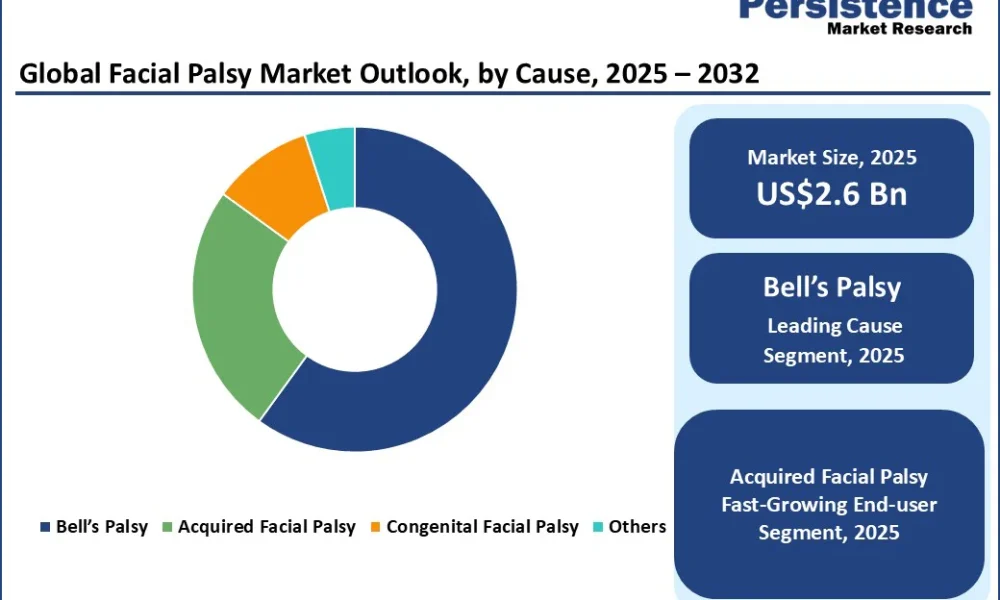
The market is projected to grow from US$ 2.6 billion in 2025 to US$ 3.5 billion by 2032, representing a CAGR of 4.4% during the forecast period. The demand is primarily fueled by the rising incidence of stroke, an aging global population, lifestyle-related risk factors, and the development of innovative rehabilitation techniques. Among the cause types, Bell’s Palsy dominates the market with a 65% share, due to its sudden onset, high prevalence across all age groups, and viral associations, particularly with herpes simplex. North America emerges as the leading region, holding 38% market share, supported by advanced healthcare infrastructure, early access to neurologists, and adoption of cutting-edge diagnostic and rehabilitation technologies. Conversely, Asia Pacific is the fastest-growing region, benefiting from an aging population, increasing cases of viral and trauma-related facial nerve disorders, and expanding neurorehabilitation services.
Download Your Free Sample & Explore Key Insights: https://www.persistencemarketresearch.com/samples/35176
Key Highlights from the Report
• The global facial palsy market is projected to grow from US$ 2.6 Bn in 2025 to US$ 3.5 Bn by 2032.
• North America leads the market due to a high prevalence of Bell’s Palsy and stroke-induced facial paralysis.
• Asia Pacific is the fastest-growing region, driven by demographic shifts and rising cases of facial nerve disorders.
• Bell’s Palsy accounts for 65% of facial palsy cases globally.
• Specialty clinics and rehabilitation centers are emerging as the fastest-growing end-user segment.
• Robotic-assisted rehabilitation and AI-based therapies are transforming patient outcomes and care delivery.
Market Segmentation
The facial palsy market is primarily segmented based on cause type, end-user, and product type, offering a comprehensive framework for understanding treatment adoption and patient care trends.
By Cause Type: The market is dominated by Bell’s Palsy, which is responsible for nearly two-thirds of global cases. Its sudden onset, association with viral reactivation, and occurrence across all age groups make it the leading contributor to market demand. Stroke-related facial paralysis represents another significant segment, particularly in aging populations where post-stroke complications frequently include partial or complete facial weakness. Other causes include trauma-related and congenital facial nerve disorders, which, while less prevalent, contribute to niche demand for specialized interventions.
By End-User: The market is divided among hospitals, specialty clinics, and rehabilitation centers. Specialty clinics and rehabilitation centers are witnessing rapid growth due to their focus on patient-centric, multidisciplinary care. These facilities combine expertise from neurologists, plastic surgeons, physiotherapists, and speech therapists to offer tailored treatment plans. Hospitals, on the other hand, cater to acute interventions and surgical management, while rehabilitation centers are critical for long-term physiotherapy and recovery.
By Product Type: The market covers pharmaceuticals, surgical devices, and rehabilitation equipment. Pharmaceuticals, including corticosteroids and antiviral agents, address acute facial paralysis and viral triggers. Surgical interventions, such as nerve grafting and facial reanimation procedures, target chronic or severe cases. Meanwhile, rehabilitation devices—including physiotherapy tools, EMG biofeedback systems, and emerging robotic-assisted devices—play an essential role in muscle retraining and functional recovery. Integration of advanced technology, such as AI-guided robotic systems, is expected to revolutionize the rehabilitation segment.
Regional Insights
North America continues to dominate the facial palsy market due to the high prevalence of Bell’s Palsy and post-stroke complications. Advanced healthcare infrastructure, widespread insurance coverage, and easy access to neurologists and rehabilitation specialists ensure timely diagnosis and treatment. Adoption of robotic-assisted physiotherapy, EMG biofeedback devices, and tele-rehabilitation platforms has enhanced patient outcomes, making the region a global leader.
Europe exhibits steady growth, driven by increasing stroke incidences, aging populations, and public health initiatives promoting early intervention. Countries like Germany, the U.K., and France are investing in advanced rehabilitation techniques, minimally invasive surgical interventions, and holistic care approaches that combine physical and psychosocial rehabilitation. Collaborative research efforts between hospitals, universities, and medical device manufacturers further accelerate innovations in nerve repair and facial reanimation technologies.
Asia Pacific is the fastest-growing region, driven by demographic shifts, rising cases of Bell’s Palsy and trauma-induced facial nerve disorders, and government initiatives to improve access to neurorehabilitation services. Japan, South Korea, and China are seeing a surge in stroke-related facial paralysis, while India and Southeast Asian countries report increasing viral infections affecting the facial nerve. Affordable physiotherapy devices, AI-driven diagnostic tools, and expanding hospital capabilities position the region as a high-potential market for facial palsy management.
Latin America and Middle East & Africa are emerging markets with growing awareness of facial palsy treatment and rehabilitation services. While infrastructure challenges persist, public health initiatives, telemedicine adoption, and increasing access to modern physiotherapy solutions are gradually fueling market growth.
Get Custom Insights Designed for Your Business: https://www.persistencemarketresearch.com/request-customization/35176
Market Drivers
The primary driver of the facial palsy market is the rising prevalence of neurological disorders, particularly Bell’s Palsy and stroke. Bell’s Palsy affects approximately 40,000 Americans annually, making it the leading cause of sudden facial paralysis. Stroke-related complications, which include facial weakness, are increasingly common due to aging populations and lifestyle-related risk factors such as hypertension, diabetes, and obesity. This growing patient pool drives the demand for early diagnosis, pharmacological therapy, surgical interventions, and advanced rehabilitation services. Additionally, technological advancements, including robotic-assisted rehabilitation and AI-based monitoring, are enhancing treatment effectiveness and expanding access to high-quality care, further fueling market growth.
Market Restraints
One significant restraint for the facial palsy market is the risk of recurrence in Bell’s Palsy, which affects 7-15% of patients globally. Recurrent episodes are often more severe and require prolonged therapy, including surgical interventions or extended physiotherapy, which increases treatment costs and emotional burden. The unpredictability of recurrence undermines patient confidence in existing treatments, discouraging adoption of advanced therapies and limiting market expansion. Moreover, disparities in healthcare infrastructure across regions restrict access to timely diagnosis and rehabilitation, posing an additional barrier to market growth.
Market Opportunities
Robotics in facial rehabilitation represents a transformative opportunity in the facial palsy market. Robotic-assisted rehabilitation devices deliver precise, repetitive, and targeted stimulation to retrain paralyzed facial muscles, surpassing conventional manual therapy in consistency and effectiveness. Integration with EMG sensors and AI enables real-time progress tracking, personalized therapy adjustments, and predictive recovery modeling. Portable or home-based robotic solutions could significantly increase access to care, particularly in regions with limited rehabilitation specialists. This convergence of robotics, neuroengineering, and digital health has the potential to improve recovery timelines, enhance patient outcomes, and redefine the standard of care for facial palsy management.
Checkout Now & Download Complete Market Report: https://www.persistencemarketresearch.com/checkout/35176
Company Insights
The global facial palsy market is moderately fragmented, featuring competition among pharmaceutical companies, medical device manufacturers, and specialized rehabilitation service providers. Leading players are increasingly investing in advanced technologies and digital health platforms to enhance patient outcomes. Key market players include:
• Medtronic plc – Medical device and neurostimulation solutions.
• Stryker Corporation – Surgical instruments and rehabilitation devices.
• Nihon Kohden Corporation – EMG monitoring and diagnostic equipment.
• Boston Scientific Corporation – Neurotherapy and minimally invasive surgical tools.
• Ipsen Biopharmaceuticals – Botulinum toxin-based therapies for facial rehabilitation.
• Hanger, Inc. – Rehabilitation services and prosthetic solutions.
Recent Developments:
In July 2023, Nihon Kohden launched the Smart Cable NMT Pod and disposable electrodes for precise monitoring of neuromuscular paralysis using EMG.
Several rehabilitation centers in Asia Pacific have introduced AI-assisted robotic therapy platforms, improving personalized care and expanding accessibility for patients with facial palsy.
Conclusion
The facial palsy market is on a strong growth trajectory, driven by rising incidences of Bell’s Palsy, stroke-related facial paralysis, and advancements in diagnostic and therapeutic technologies. North America remains the dominant market, supported by sophisticated healthcare infrastructure and early access to specialized care, while Asia Pacific offers high growth potential due to demographic shifts and increasing healthcare investments.The market is characterized by the growing adoption of innovative solutions such as robotic-assisted rehabilitation, EMG biofeedback, and AI-enabled therapy platforms, which are redefining patient outcomes and recovery timelines.




