
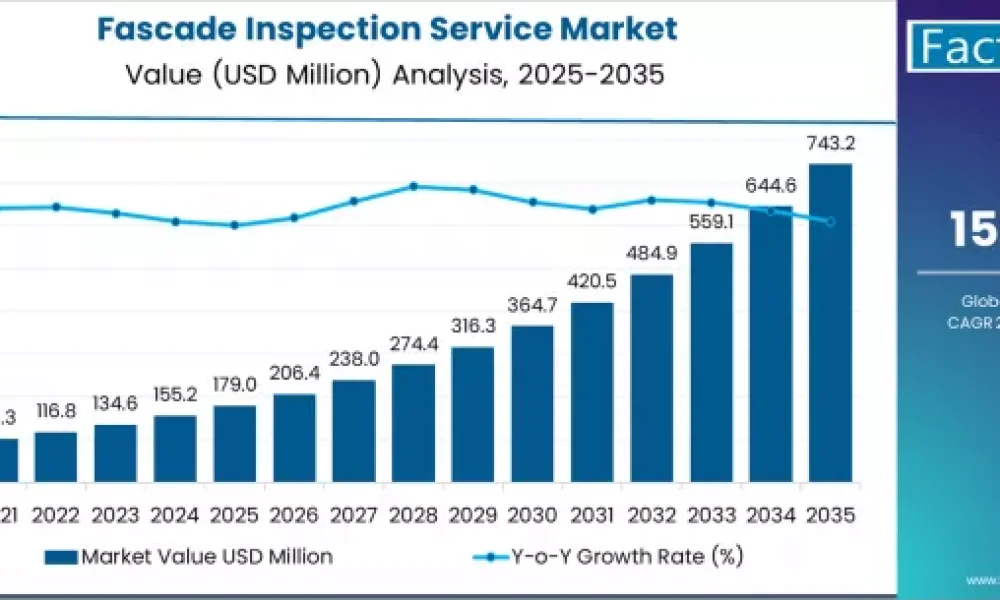
The global facade inspection service market is projected to grow from approximately USD 179 million in 2023 to about USD 743.2 million by 2033, representing a compound annual growth rate (CAGR) of around 15.3% over the forecast period. This dramatic growth is driven by increasing demand for automated, drone-enabled inspection of building facades, rising concerns over structural safety in high-rise buildings, and growth of urban infrastructure construction.
As building stock ages, regulatory scrutiny intensifies, and technology evolves, the facade inspection service market is emerging as a critical segment within building maintenance, facility management and drone-service ecosystems.
Key Market Insights at a Glance
Market Value (2023): USD 179 million
Forecast Value (2033): USD 743.2 million
CAGR (2023-2033): ~15.3%
Regional Shares (2023 estimates): North America ~29.2% (≈ USD 52.3 million); Europe ~32.1% (≈ USD 57.5 million); China ~13% (≈ USD 45.7 million)
Leading End-Use Segment: Emergency response – ~46.1% share in 2023
Key Service Types: Drone-based facade inspection, fixed-wing and rotary-wing platforms, commercial drone services
Major Countries: United States, China, Germany, UK
Key Services Differentiators: Data analytics, AI/ML inspection capability, drone automation, risk-based building maintenance
To Access the Complete Data Tables & in-depth Insights, Request a Discount on this report: https://www.factmr.com/connectus/sample?flag=S&rep_id=8155
Market Drivers / Growth Overview
The facade inspection service market growth is underpinned by several converging factors. First, the global growth of high-rise urban infrastructure, particularly in commercial, hospitality and residential segments, is increasing the volume of facades requiring inspection and maintenance. Buildings today are taller and more complex, creating safety and regulatory imperatives to perform regular facade inspection.
Second, traditional facade inspection methods (scaffolding, swing-stage, swing-access) are labour-intensive, expensive and pose safety risks; drone-based inspection offers a safer, faster, and more cost-effective alternative, significantly accelerating market adoption. Third, regulatory pressure and building-safety requirements are rising—especially in regions with ageing building stock or severe weather exposure—making inspection services a mandatory part of facility management.
Fourth, the integration of advanced technologies—such as drones (both fixed and rotary wing), high-resolution imaging, AI and machine-learning analytics—enhances inspection accuracy, reduces cost, and enables predictive maintenance. Fifth, emergency-response, asset managers and facility operators are increasingly leveraging facade inspection as part of safety-risk mitigation, driving significant share in the end-use segment.
On the other hand, barriers such as spectrum/licensing issues for drone operations, data-privacy concerns, and uneven regulatory frameworks across regions may moderate some growth. Nonetheless, the strong underlying dynamics position the market for robust expansion.
Segmentation & Key Drivers
By Type of Platform: Fixed-wing and rotary-wing drone platforms, each offering distinct operational advantages—fixed wing for large facility footprints and rotary wing for high-reach facades in urban canyons. The method of propulsion and flight profile influence adoption in different building typologies.
By Drone Type: Commercial drones represent the majority of operations, as facade inspection is predominantly a commercial service rather than military. These systems integrate imaging sensors, LiDAR, thermal cameras and AI analytics.
By End-Use / User-Segment: Facilities management, construction & refurbishment, oil & gas/infrastructure, emergency-response/building-safety services. Among these, emergency-response/facility-safety operations accounted for ~46.1% share in 2023.
By Region: North America and Europe lead in 2023 given mature building markets, high safety regulation and early adoption of drone inspection services. East Asia (including China) is rapidly growing due to large building stock and expanding service adoption.
The key segmentation drivers include building stock age, height/density of urban infrastructure, regulatory inspection intervals, cost pressures for downtimes and ease of access, and availability of drone service providers.
Regional & Country Insights
North America: Approximate share of ~29.2% in 2023 (≈ USD 52.3 million). Strong due to stringent building-safety regulations, mature adoption of drone inspection and high concentration of tall buildings.
Europe: Leads slightly at ~32.1% share in 2023 (≈ USD 57.5 million). Growth supported by aging infrastructure, renovation demand and regulatory inspection regimes.
China: ~13% share in 2023 (≈ USD 45.7 million). Growth driven by massive building construction, urbanisation, and increasing building-safety scrutiny.
Other Regions (South Asia & Oceania, Middle East & Africa, Latin America): Emerging markets with lower current penetration but substantial growth potential as drone inspection services scale and regulation becomes stricter.
These regional differences reflect maturity of infrastructure, regulatory frameworks, availability of inspection service providers and cost structures.
Competitive Landscape
The facade inspection service market is characterised by a mixture of specialised drone-service providers, building-inspection firms with drone capabilities and technology-platform integrators. Key players profiled in the market include: Connexicore; DJI; TÜV SÜD; Operva; Ariel VP; Charlotte UAV; H3 Zoom; Helios Vision. These companies are focusing on sharpening their service offering via AI-enabled analytics, broadening their drone-fleet capabilities, expanding into high-rise inspection, and enhancing end-customer service (reporting, dashboarding, predictive maintenance).
Competitive strategies include strategic acquisitions of drone service firms, partnerships with building owners/building-management firms, geographic expansion, offering bundled inspection-and-maintenance contracts and leveraging software platforms to differentiate.
Recent Developments
Launch of drone-inspection service partnerships between facade-maintenance firms and drone-hardware/software providers to combine access, data capture and analytics in end-to-end offerings.
Introduction of high-altitude rotary-wing and tethered-drone systems capable of inspecting ultra-tall facades and remote high-rise structures.
Adoption of AI/ML analytics systems to process facade imagery and detect cracks, spalling, water-ingress early and automate reporting.
Enhanced regulatory push in several jurisdictions requiring periodic facade inspection of high-rise buildings and restricting manual swing-stage access, thereby boosting demand for drone-based services.
Market Outlook & Strategic Insights
From 2023 through 2033, the facade inspection service market is expected to scale rapidly, transitioning from niche drone-pilot operations to mainstream building-maintenance protocols. Key strategic insights for market participants include:
Developing end-to-end inspection platforms (drone fleet + sensors + analytics + reporting) to lock-in customers and build recurring revenue.
Targeting high-density, high-rise building markets (urban centres, commercial towers, hotels, industrial complexes) where inspection complexity and cost-savings are highest.
Building service networks and partnerships with building owners, property-management firms and insurance providers to become preferred inspection vendor.
Leveraging software analytics and AI to deliver value-added insights (e.g., predictive repair, condition monitoring) rather than only visual inspection.
Expanding in emerging regions (South Asia, Middle East, LatAm) where building stock growth and safety regulation are accelerating but service penetration is low.
Providers that execute these strategies—while maintaining rigorous safety standards, regulatory compliance, data security and fleet scalability—are best positioned to capture a large share of the projected USD 743.2 million market by 2033.
Purchase Full Report for Detailed Insights
For access to full forecasts, regional breakouts, company share analysis, and emerging trend assessments, you can purchase the complete report: https://www.factmr.com/checkout/8155
Have specific requirements or need assistance on report pricing or have a limited budget? Please contact [email protected]
Contact:
US Sales Office
11140 Rockville Pike
Suite 400
Rockville, MD 20852
United States
Tel: +1 (628) 251-1583, +353-1-4434-232
Email: [email protected]
About Fact.MR:
Fact.MR is a global market research and consulting firm, trusted by Fortune 500 companies and emerging businesses for reliable insights and strategic intelligence. With a presence across the U.S., UK, India, and Dubai, we deliver data-driven research and tailored consulting solutions across 30+ industries and 1,000+ markets. Backed by deep expertise and advanced analytics, Fact.MR helps organizations uncover opportunities, reduce risks, and make informed decisions for sustainable growth.



