
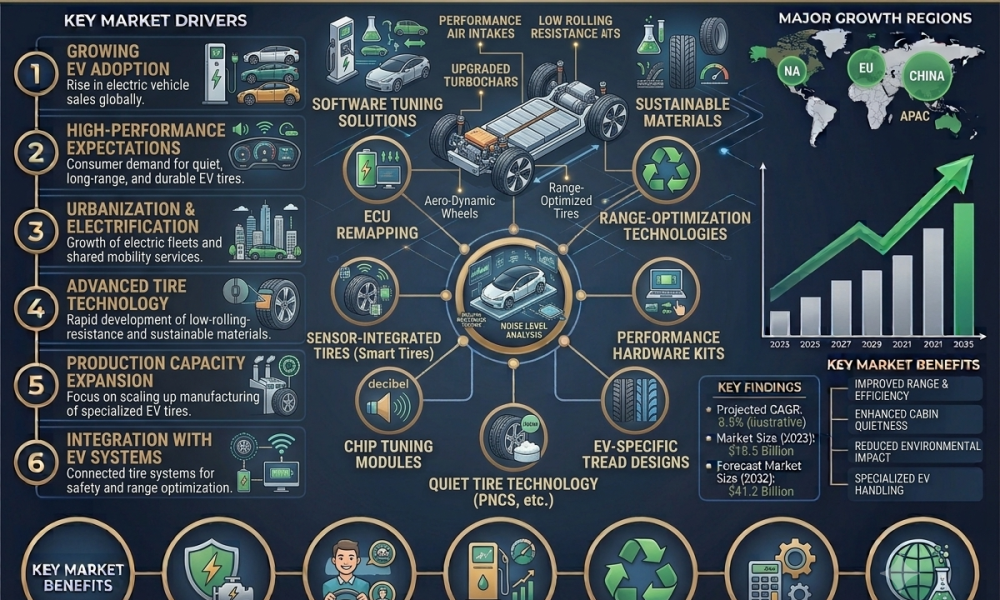
The global EV tires market is projected to expand from USD 15.1 billion in 2025 to USD 199.2 billion by 2036, advancing at a 26.4% CAGR from 2026 to 2036. The market is expected to reach USD 19.1 billion by 2026-end, supported by rapid electric vehicle production growth and increasing demand for tires engineered around the weight, torque, range, and acoustic requirements of electric powertrains.
A key demand factor is the growing need for tires that balance low rolling resistance with higher load capacity and durability. Battery packs can add substantial weight compared with comparable internal combustion engine vehicles, while electric motors deliver high torque from low speeds. Tire manufacturers are therefore developing specialized compounds, tread patterns, and constructions to improve range, manage wear, and reduce road noise across passenger and commercial electric vehicles.
Global Segment Leaders
- Low Rolling Resistance EV Tires — 35.0% share: Low rolling resistance EV tires lead the product segment as automakers prioritize reduced tire energy losses to improve vehicle driving range.
- Passenger Electric Vehicles — 60.0% share: Passenger electric vehicles represent the leading vehicle-type segment as consumer EV production from major automotive manufacturers generates the largest volume of tire demand.
- OEM Sales — 65.0% share: OEM sales account for the leading channel share because new electric vehicle production creates factory-fitment demand through tire supply agreements with qualified manufacturers.
- Performance and Efficiency Engineering — Key demand area: EV tire development increasingly focuses on balancing rolling resistance, wet grip, durability, load capacity, and torque resistance.
- Advanced EV Tire Technology — Emerging opportunity: Advanced compounds, acoustic treatments, optimized tread designs, and smart and connected tire technologies are creating additional opportunities for specialized EV tire suppliers.
Get detailed market forecasts, competitive benchmarking, and pricing trends:
https://www.futuremarketinsights.com/reports/sample/rep-gb-14126
Country-Level Performance
The United States is projected to record the highest growth among the profiled countries, expanding at a 26.6% CAGR through 2036. Demand is supported by accelerating EV adoption, domestic electric vehicle manufacturing expansion, and growing replacement tire requirements as the installed EV fleet increases.
Japan follows with a 26.5% CAGR, supported by its established automotive manufacturing base and continued development of electric vehicle platforms. Tire manufacturers are addressing EV-specific requirements around efficiency, load management, durability, and reduced road noise.
South Korea is projected to expand at a 26.4% CAGR, supported by domestic automotive production, electric vehicle manufacturing, and the expansion of EV platforms requiring specialized factory-fitment tires. The country’s automotive technology ecosystem also supports continued development of EV-specific tire compounds and constructions.
The European Union is expected to record a 26.3% CAGR. Increasing electric vehicle production and the transition toward electrified mobility are supporting demand for low rolling resistance, high-load, and low-noise tires designed specifically for EV platforms.
The United Kingdom is projected to record a 26.1% CAGR, the lowest among the profiled countries. Demand is supported by the continued expansion of the electric vehicle fleet and associated OEM and replacement tire requirements, while tire manufacturers increasingly adapt products to the performance characteristics of electric powertrains.
Overall, the report identifies the USA, Japan, South Korea, EU, and UK as key growth markets for EV tire adoption.
Regional Context
The United States and Japan form the faster-growing country group, with CAGRs of 26.6% and 26.5%, respectively. The United States benefits from expanding EV manufacturing and an increasingly large installed base requiring replacement tires. Japan combines a mature automotive production ecosystem with growing demand for electric vehicle-specific tire technologies.
South Korea and the European Union follow at 26.4% and 26.3%, respectively. South Korea is supported by domestic EV production and automotive technology development, while the EU market is shaped by expanding electric vehicle production and demand for energy-efficient tire designs.
The United Kingdom records growth of 26.1%. Its market is supported by increasing EV fleet penetration and demand for both factory-fitment and replacement tires. Across the profiled markets, the rapid scaling of EV production creates synchronized demand for tires engineered around electric powertrain characteristics.
The full report covers five key country markets, including the United States, Japan, South Korea, European Union, and United Kingdom.
Competitive Landscape
The competitive landscape includes Michelin, Bridgestone Corporation, Goodyear Tire & Rubber Company, Continental AG, Pirelli & C. S.p.A., and other companies. Leading tire manufacturers are competing through EV-specific tread designs, low rolling resistance compounds, higher load capacity, noise-reduction technologies, and established OEM supply relationships.
OEM fitment programs represent an important competitive pathway because every new EV platform requires qualified tire suppliers capable of meeting vehicle-specific performance specifications. Tire manufacturers are also developing products for the replacement market as early-generation EVs reach their first tire replacement cycles.
The competitive environment is increasingly shaped by the engineering requirements of electric powertrains. Higher vehicle mass, instant motor torque, range-efficiency targets, and lower cabin noise levels require tire manufacturers to balance several performance characteristics within a single product.
FMI Principal Consultant Nikhil Kaitwade observes, “Tire manufacturers that can deliver optimized rolling resistance performance while managing the higher load and torque demands of electric vehicles are likely to secure long-term OEM supply positions over the forecast period.”
What Is Driving Demand for EV Tires?
The rapid expansion of electric vehicle production is the primary demand driver for EV-specific tires. Every new electric vehicle requires tires engineered around its weight, torque delivery, range requirements, and vehicle dynamics. As EV production scales across major automotive markets, tire procurement requirements are expanding alongside vehicle manufacturing volumes.
Low rolling resistance represents a central engineering priority. EV manufacturers seek to minimize energy losses at the tire-road interface because lower rolling resistance can contribute to improved driving range. As a result, low rolling resistance EV tires account for 35.0% of product share.
EV tire development also differs from conventional tire engineering because battery packs can add significant vehicle mass. The report notes that EVs may carry approximately 200 to 500 kg of additional weight compared with comparable ICE models, increasing requirements for load capacity and durability.
Electric motors also produce high torque at low speeds, creating additional demands on tread durability and compound formulation. Tire manufacturers are developing advanced silica-enriched compounds and polymer blends designed to reduce hysteresis losses while maintaining grip and wear resistance.
Noise reduction is another important consideration. Because EV powertrains generate less mechanical noise than internal combustion engines, tire and road noise can become more prominent inside the vehicle cabin. Manufacturers are therefore exploring optimized tread patterns and acoustic treatments, including foam-lined inner surfaces, to reduce perceived road noise.
Passenger electric vehicles account for 60.0% of vehicle type share, making them the primary volume driver for EV tire demand. Major EV platforms from manufacturers such as Tesla, BYD, Volkswagen Group, and Hyundai-Kia generate OEM tire specification and procurement opportunities for qualified suppliers.
OEM sales represent 65.0% of channel share, reflecting the importance of factory-fitment contracts in the EV tire supply chain. As automakers launch new electric platforms, tire manufacturers that meet vehicle-specific requirements can secure production-volume supply relationships.
The replacement market is also becoming an increasingly important demand layer. As early electric vehicles reach tire replacement intervals, owners and fleet operators require replacement products capable of managing EV-specific weight, torque, range, and acoustic requirements.
Commercial electric vehicles provide another opportunity. Delivery vans, buses, and medium-duty electric trucks require tires capable of handling higher loads while maintaining low rolling resistance and long service life. Electric two- and three-wheelers provide an additional source of demand, particularly across Asian markets.
At the same time, higher production costs for EV-specific compounds and constructions can create pricing pressure. Advanced materials, specialized manufacturing processes, and additional engineering requirements may result in premiums compared with conventional tires, potentially affecting adoption among price-sensitive aftermarket customers.
Drive Your Business Growth Strategy: Checkout the Report for Key Insights!
https://www.futuremarketinsights.com/checkout/14126
How Is the EV Tires Market Segmented?
The EV tires market is segmented by product, vehicle type, sales channel, end use, construction, and technology.
- Low Rolling Resistance EV Tires — 35.0% share: These tires lead the product segment as manufacturers prioritize energy efficiency and driving-range optimization.
- Passenger Electric Vehicles — 60.0% share: Passenger EVs account for the largest vehicle-type segment, supported by increasing consumer EV production and adoption.
- OEM Sales — 65.0% share: Factory-fitment agreements represent the leading sales channel as automakers source EV-specific tires for new vehicle platforms.
- Radial EV Tires: Radial constructions represent a major product configuration across passenger and commercial electric vehicles, alongside bias and advanced composite constructions.
- Advanced EV Tire Technology: Tire manufacturers are developing advanced compounds, tread designs, acoustic solutions, and smart and connected technologies to address evolving EV requirements.
- Individual Consumers and Commercial Fleet Operators: Consumer vehicles represent the largest volume opportunity, while commercial electric fleets generate demand for durable, efficient, high-load tire solutions.
Why Do Low Rolling Resistance EV Tires Lead the EV Tires Market?
Low rolling resistance EV tires account for 35.0% of product share in 2026. These tires use specialized compound formulations and tread designs intended to reduce energy losses caused by tire deformation and road contact.
The focus on rolling resistance is directly linked to EV range optimization. Lower tire energy consumption can help manufacturers and vehicle owners maximize available battery energy for propulsion. Tire companies are therefore investing in silica-rich compounds, advanced polymer blends, and aerodynamic tread configurations.
The engineering challenge is to balance rolling resistance with wet grip, durability, load capacity, and resistance to the high torque delivered by electric motors. This combination of requirements is creating opportunities for manufacturers with specialized EV tire development capabilities.
How Big Is the Passenger Electric Vehicles Segment?
Passenger electric vehicles account for 60.0% of vehicle type share in 2026. Consumer EV production from major manufacturers creates the largest volume requirement for specialized tires.
EV platforms from companies including Tesla, BYD, Volkswagen Group, and Hyundai-Kia generate opportunities for tire manufacturers to secure vehicle-specific OEM fitment programs. Each new electric vehicle platform can require tire specifications tailored to its weight distribution, range targets, handling characteristics, and noise requirements.
Commercial electric vehicles are also creating additional demand. Delivery vans, buses, and medium-duty trucks require higher load ratings and long-mileage durability while maintaining low rolling resistance to control fleet operating costs.
About Future Market Insights
Future Market Insights (FMI) is a leading provider of market research and consulting services, offering syndicated and customized research across industries including automotive, mobility, and transportation. FMI provides actionable insights into emerging market trends, competitive landscapes, demand patterns, and technology adoption to support strategic business decisions.



