
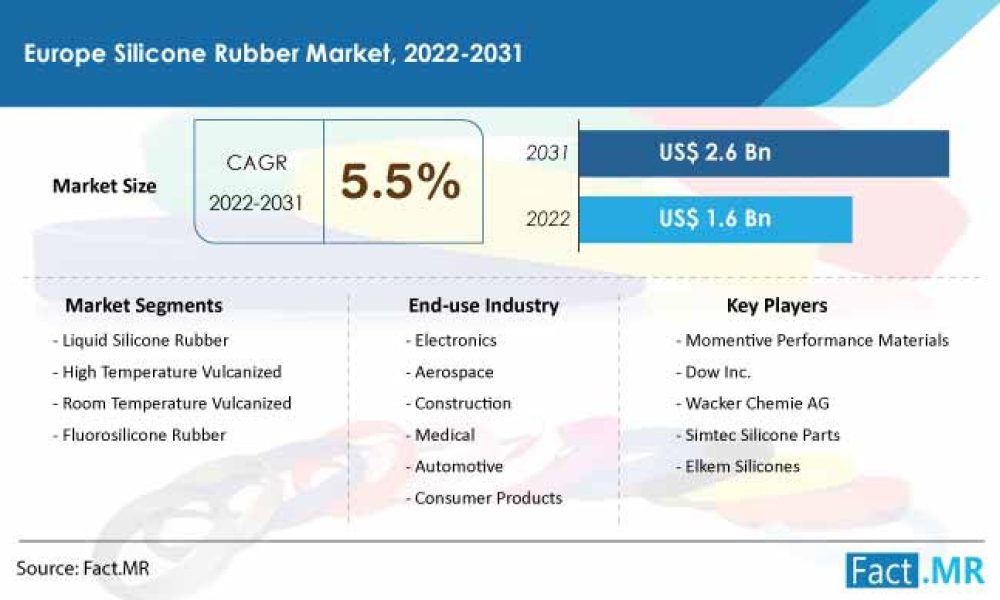
The Europe Silicone Rubber Market is expected to grow from US$ 1.52 billion in 2021 to US$ 2.6 billion by 2031, with a projected Compound Annual Growth Rate (CAGR) of 5.5%. In the upcoming years, there is an anticipated accelerated demand for liquid silicone rubber, particularly in the realm of 3D printing technology.
The ongoing trend of downsizing in the electronics sector has compelled component manufacturers to produce smaller components with increased resistance, aiming to reduce the likelihood of failure and uphold reliability. Silicone rubber emerges as a crucial solution in this context, effectively safeguarding component contacts, a vital requirement in high-power electronics.
Download a Sample Copy of This Report:https://www.factmr.com/connectus/sample?flag=S&rep_id=7331?PJ
The Europe silicone rubber market is a key player in the region’s industrial landscape, contributing significantly to various sectors, including automotive, construction, healthcare, and electronics. Silicone rubber, known for its versatile properties such as high-temperature resistance, electrical insulation, and biocompatibility, has become a material of choice in a wide range of applications. In this comprehensive overview, we will explore the current state of the Europe silicone rubber market, analyze the factors driving its growth, and examine recent industry news that highlights the market’s response to evolving trends in innovation and sustainability.
Key Companies Profiled
- Momentive Performance Materials
- Dow Inc.
- Wacker Chemie AG
- Simtec Silicone Parts
- Elkem Silicones
- Reiss Manufacturing, Inc.
- Stockwell Elastomerics, Inc.
- Innovative Silicones
Current Market Trends:
- Growing Demand in Automotive Applications: The automotive industry is a key driver for the demand for silicone rubber in Europe. Silicone rubber is extensively used in automotive components such as gaskets, seals, hoses, and wiring harnesses due to its thermal stability, flexibility, and resistance to harsh environmental conditions. As the automotive sector continues to emphasize lightweighting and improved performance, the demand for silicone rubber is on the rise.
- Rising Emphasis on Sustainable Solutions: There is a growing emphasis on sustainability in the silicone rubber market, with manufacturers and end-users seeking environmentally friendly alternatives. Silicone rubber, with its recyclability and potential for eco-friendly formulations, aligns with the broader trend of sustainability in material choices across industries.
- Advancements in Silicone Technology: Ongoing advancements in silicone technology are driving innovation in the market. This includes the development of high-performance silicone rubber formulations with enhanced properties such as improved tensile strength, elongation, and tear resistance. These innovations cater to the evolving needs of end-users in various applications.
- Increased Demand in Healthcare and Medical Devices: Silicone rubber is widely used in the healthcare and medical device industries due to its biocompatibility, flexibility, and resistance to sterilization processes. Applications range from medical tubing and implants to seals and gaskets. The increasing demand for medical-grade silicone rubber is attributed to its critical role in enhancing the safety and performance of healthcare products.
- Electronics and Electrical Applications: Silicone rubber’s electrical insulating properties make it a preferred material in the electronics industry. It is used in the manufacturing of cables, connectors, and insulating components for electronic devices. With the continuous growth of the electronics sector, particularly in the context of the digital transformation, the demand for silicone rubber in this segment is experiencing an upward trajectory.
Silicone Rubber Market: Towards Sustainable and Innovative Solutions
The Europe silicone rubber market is witnessing a transformative phase, marked by a commitment to sustainability, regulatory compliance, and continuous innovation. The industry’s response to sustainable initiatives, including the exploration of bio-based raw materials and eco-friendly manufacturing processes, reflects a broader awareness of environmental responsibilities.
Regulatory compliance remains a key focus, with manufacturers ensuring adherence to stringent standards such as REACH. This commitment not only aligns with regulatory requirements but also contributes to the development of safer and environmentally friendly silicone rubber products.
Innovations in silicone technology are reshaping the market, with advancements in self-healing properties, adhesion technologies, and performance characteristics. These innovations not only enhance the functional properties of silicone rubber but also open new possibilities for applications across diverse industries.
Collaborations and partnerships are driving synergies within the industry, fostering a collaborative approach to research, development, and market expansion. This collaborative spirit is instrumental in addressing complex challenges and driving advancements that benefit both manufacturers and end-users.
Customization trends and the focus on bio-compatible silicones underscore the industry’s responsiveness to evolving consumer and market demands. The ability to tailor silicone rubber formulations to specific requirements reflects a commitment to providing solutions that meet the diverse needs of end-users in sectors ranging from healthcare to consumer goods and beyond.
Key Segments Covered in Europe Silicone Rubber Industry Research
- Europe Silicone Rubber Market by Type :
- Liquid Silicone Rubber
- High Temperature Vulcanized Rubber
- Room Temperature Vulcanized Rubber
- Fluorosilicone Rubber
- Europe Silicone Rubber Market by Application :
- Gaskets & Seals
- Adhesives & Sealants
- Coatings
- Encapsulants
- Catheters & Tubing
- Others
- Europe Silicone Rubber Market by End-use Industry :
- Electronics
- Aerospace
- Construction
- Medical
- Automotive
- Consumer Products
Competitive Landscape
Silicone rubber providers in Europe are concentrating on expanding their presence to boost their market position and promote market growth. As a result, key players have established strong regional presences, distribution networks, and product offers.
Leading companies in the rubber sheets market are prioritizing R&D to bring to market unique, high-quality goods with expanded features. To improve their commercial prospects, several organizations are considering strategic collaborations, mergers, and acquisitions. To satisfy expanding market demand, market participants are likely to enhance existing production capabilities.
Get Customization on this Report for Specific Research Solutions:
https://www.factmr.com/connectus/sample?flag=RC&rep_id=7331?PJ
Industry News and Developments:
- Focus on Bio-Based and Bio-Degradable Silicones: Industry players are increasingly focusing on the development of bio-based and bio-degradable silicones to address environmental concerns. These formulations aim to reduce the environmental impact of silicone rubber and align with the growing preference for sustainable materials in Europe.
- Strategic Partnerships and Collaborations: Collaborations and partnerships between silicone rubber manufacturers and end-users are driving innovation and expanding market reach. These partnerships involve joint research and development efforts, aiming to create tailored silicone solutions that meet specific industry requirements and regulatory standards.
- Regulatory Compliance and Certifications: Compliance with stringent regulatory standards is a key focus in the silicone rubber industry. Manufacturers are investing in research and development to ensure their products meet the evolving regulatory landscape. Certifications for specific applications, such as medical-grade certifications for silicone rubber used in healthcare, are becoming increasingly important.
- Investments in Production Capacity Expansion: To meet the growing demand for silicone rubber, companies are making strategic investments in expanding production capacities. This involves the establishment of new manufacturing facilities and the upgrade of existing ones to ensure a consistent and reliable supply of silicone rubber products to the market.
- Digitalization in Manufacturing Processes: The integration of digitalization and smart manufacturing practices is becoming a notable trend in the silicone rubber industry. Automation, data analytics, and digital monitoring contribute to improved production efficiency, quality control, and overall operational excellence.
Contact:
US Sales Office:
11140 Rockville Pike
Suite 400
Rockville, MD 20852
United States
Tel: +1 (628) 251-1583
E Mail : [email protected]




