
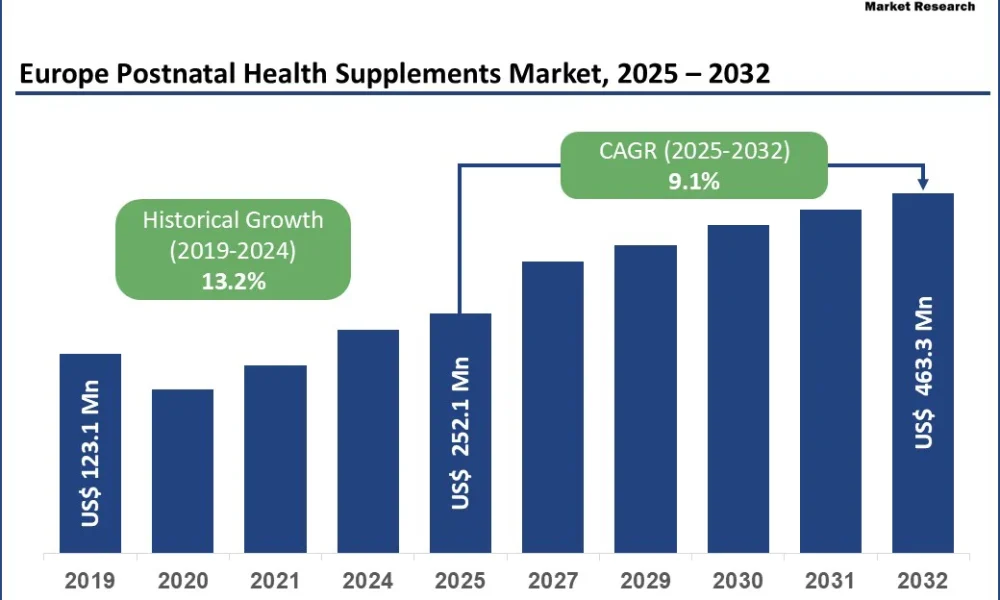
The Europe postnatal health supplements market is experiencing robust growth, driven by increasing awareness of maternal and infant health. Postnatal supplements play a critical role in helping mothers recover after childbirth, restore energy levels, enhance lactation, and support emotional well-being. The market is estimated to reach a value of US$252.1 million by 2025, expanding to US$463.3 million by 2032 at a CAGR of 9.1% during the forecast period. Rising health consciousness among European consumers, combined with the integration of supplements into standard postnatal care protocols, has fueled demand. Healthcare providers, including obstetricians, gynecologists, and midwives, are increasingly recommending nutrient-rich formulations, emphasizing the essential role of vitamins, minerals, and combined nutritional supplements in promoting holistic recovery.
The leading segment within the market is combined nutritional supplements, accounting for 52% of total market share in 2025. These formulations are preferred for their comprehensive blend of essential vitamins, minerals, and bioactive compounds that address multiple postpartum needs such as energy restoration, lactation support, immunity enhancement, and mood balance. Capsules and tablets remain the most popular product formats due to their convenience, portability, precise dosing, and longer shelf life. Geographically, the United Kingdom leads the European market with a 28% share in 2025, driven by strong research and development initiatives, innovation in product formulations, and a large population of health-conscious postpartum women. The UK’s emphasis on quality, safety, and product efficacy has positioned it as a highly lucrative region for postnatal health supplements.
Download Your Free Sample & Explore Key Insights: https://www.persistencemarketresearch.com/samples/35614
Key Highlights from the Report
• Europe postnatal health supplements market is projected to reach US$463.3 million by 2032.
• Combined nutritional supplements dominate the product type segment with 52% market share.
• Capsules and tablets are the most preferred formulations due to convenience and precise dosing.
• UK holds the largest market share in Europe at 28% in 2025.
• Growing consumer preference for organic and plant-based supplements is driving market growth.
• Integration of postnatal supplements into healthcare protocols is enhancing adoption across Europe.
Market Segmentation
The Europe postnatal health supplements market can be segmented based on product type, formulation, and end-user. By product type, combined nutritional supplements lead the market due to their holistic approach to postpartum recovery, offering multiple nutrients in a single formulation. Single-nutrient supplements, such as iron, calcium, and DHA, remain relevant for mothers with specific deficiencies, but the convenience and comprehensive benefits of combined supplements continue to dominate. By formulation, capsules and tablets are preferred due to ease of use, portability, and precise dosing, while powders and liquids occupy a smaller portion of the market. In terms of end-users, the primary consumers are postpartum women, including both breastfeeding and non-breastfeeding mothers, with personalized nutrition products gaining traction for targeting unique maternal health requirements.
Regional Insights
Germany emerges as the leading regional market in Europe due to its advanced healthcare infrastructure, strong consumer awareness, and highly developed nutraceutical sector. German consumers prioritize maternal recovery, lactation support, and mental well-being, driving demand for high-quality postnatal supplements. The country’s emphasis on research and development has resulted in innovative combined nutritional products, supported by a large postpartum population with disposable income. Other key European markets include France, Italy, and Spain, where increasing health awareness, growing adoption of organic and clean-label supplements, and expanding pharmacy and e-commerce distribution networks contribute to steady growth. The UK, as mentioned, maintains a dominant position due to extensive R&D investments and proactive regulatory frameworks.
Get Custom Insights Designed for Your Business: https://www.persistencemarketresearch.com/request-customization/35614
Market Drivers
The Europe postnatal health supplements market is propelled by growing awareness of maternal health and the increasing recognition of postnatal nutrition’s role in recovery and infant care. Integration of supplements into standard postnatal care protocols by healthcare professionals has normalized their consumption, boosting market acceptance. Rising health-conscious behavior among new mothers, coupled with a preference for organic, plant-based, and clean-label supplements, further strengthens market growth. The convenience of combined nutritional supplements, which address multiple postpartum needs in a single formulation, also drives adoption. Additionally, the emergence of personalized postnatal nutrition, which tailors supplements based on individual requirements such as breastfeeding status, nutrient deficiencies, and lifestyle factors, presents a major growth impetus.
Market Restraints
Despite significant growth, the market faces challenges including concerns over artificial additives, synthetic preservatives, and chemical fillers in supplements. European consumers increasingly demand natural, clean-label products, which requires manufacturers to invest in higher-cost production processes and rigorous quality assurance. Regulatory compliance across different European countries also presents complexities for companies operating in multiple markets. Moreover, high prices of premium postnatal supplements can restrict access among certain consumer segments, while limited awareness in emerging regions of Europe may slow adoption rates.
Market Opportunities
The postnatal health supplements market offers substantial opportunities in the personalized nutrition segment, leveraging advancements in diagnostics, genetic insights, and digital health tracking to create tailored formulations for individual mothers. The rising preference for organic and plant-based supplements opens avenues for product innovation and premium offerings. E-commerce and online pharmacy channels are becoming increasingly critical for reaching health-conscious consumers, while collaborative research initiatives with healthcare providers can enhance product credibility. Expansion into emerging European markets with growing postpartum populations also presents untapped potential for sustained market growth.
Checkout Now & Download Complete Market Report: https://www.persistencemarketresearch.com/checkout/35614
Company Insights
Key players operating in the Europe postnatal health supplements market include:
• Vitabiotics (UK)
• Orthomol
• Nutricia
• DSM
• The Honest Company
• Nestlé
• New Chapter
• Abbott Laboratories
Recent developments include the entry of Japanese brand MamaCo into the EU market in early 2025, offering a postnatal supplement formulated with iron, DHA, dandelion root powder, and jujube extract to support lactation and combat postpartum fatigue. In July 2025, the European Commission implemented Regulation (EU) 2025/1549, which clarified authorized levels of omega-3 fatty acids such as DHA and EPA in supplements for lactating women and young children, enhancing legal certainty for postnatal products across Europe.
Conclusion
The Europe postnatal health supplements market is on a strong growth trajectory, fueled by increasing awareness of maternal and infant health, integration of supplements into healthcare protocols, and rising demand for convenient, comprehensive, and clean-label products. Combined nutritional supplements and capsule/tablet formulations dominate the market, while personalized postnatal nutrition offers significant opportunities for innovation and differentiation. Germany and the UK remain key markets, driven by advanced healthcare infrastructure, consumer awareness, and innovation. Despite challenges related to regulatory compliance, high production costs, and ingredient transparency, the market continues to expand, presenting ample prospects for both established players and new entrants focused on maternal health and holistic postpartum recovery.




