
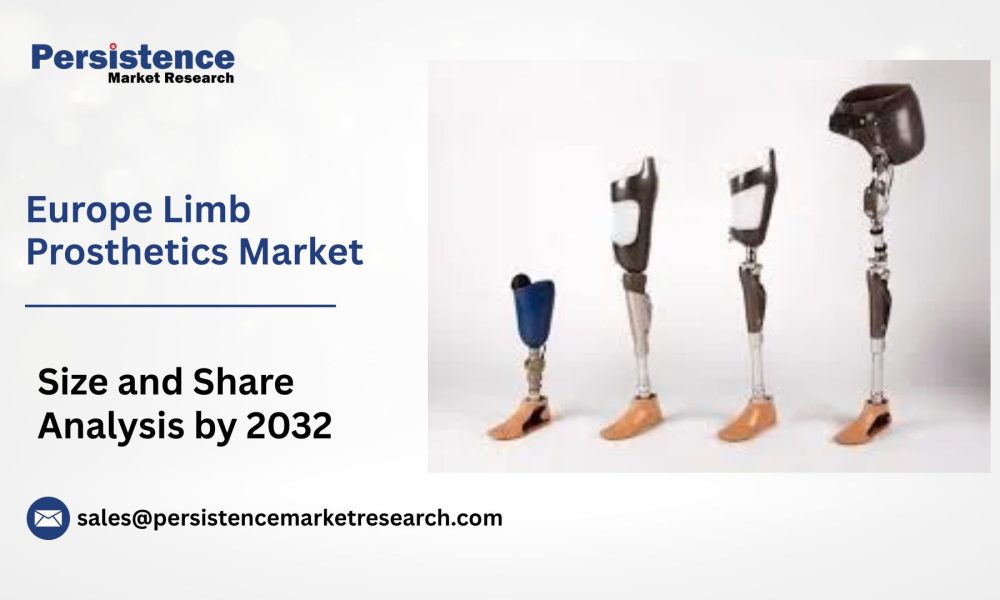
The Europe limb prosthetics market plays a vital role in restoring mobility, independence, and quality of life for individuals with limb loss. Prosthetic devices are extensively used in orthopedic rehabilitation, trauma recovery, congenital limb deficiencies, and military or accident-related amputations. They integrate advanced materials, biomechanics, and digital technologies to enhance durability, comfort, and functionality, making them indispensable in modern healthcare. According to the latest study by Persistence Market Research, the Europe limb prosthetics market size is anticipated to reach a value of US$ 200.1 Mn in 2025 and is set to witness a CAGR of 5.2% from 2025 to 2032. The market will likely attain a value of US$ 295.0 Mn in 2032. Growth is mainly fueled by the rising prevalence of diabetes-related amputations, increasing adoption of technologically advanced prosthetics, and government-supported rehabilitation initiatives across Europe.
Market expansion is further supported by the growing demand for personalized and lightweight prosthetic solutions, especially those leveraging robotics, AI-driven motion control, and 3D printing. Among product categories, lower limb prosthetics remain dominant due to the high incidence of below-knee amputations caused by vascular diseases and trauma. Geographically, Germany, the U.K., and France lead the European market, supported by advanced healthcare systems, strong reimbursement policies, and high adoption of next-generation prosthetics.
👉 Request a Sample: https://www.persistencemarketresearch.com/samples/34841
Key Market Insights
- The market size is anticipated to reach a value of US$ 200.1 Mn in 2025 and is set to witness a CAGR of 5.2% from 2025 to 2032.
- Lower limb prosthetics dominate due to the prevalence of diabetes-related and vascular amputations.
- Germany, the U.K., and France account for the largest market share in Europe.
- Technological innovations such as bionic limbs, robotics, and AI-enabled prosthetics are reshaping product offerings.
- Rising government focus on rehabilitation and reimbursement programs supports broader adoption.
What are the main drivers of the Europe Limb Prosthetics Market?
The primary drivers include the growing burden of diabetes and peripheral vascular diseases, leading to higher amputation rates; the rising demand for technologically advanced prosthetic devices offering greater comfort and functionality; and government-backed healthcare reimbursement programs. Additionally, innovations such as 3D-printed custom prosthetics, sensor-integrated designs, and smart wearable connectivity are fueling patient adoption across the region.
Market Dynamics
Drivers:
- Increasing prevalence of amputations due to diabetes, trauma, and vascular diseases.
- Technological breakthroughs in bionics, robotics, and personalized prosthetics.
- Strong reimbursement frameworks and rehabilitation support in European healthcare systems.
Market Restraining Factor:
- High cost of advanced prosthetics limits adoption in lower-income groups.
- Limited awareness and access in rural or underfunded healthcare regions.
- Short product life cycle requiring frequent upgrades adds financial burden.
Key Market Opportunity:
- Expanding use of 3D printing and digital customization opens opportunities for cost-effective and patient-specific prosthetics.
- Growing demand for pediatric prosthetics and sports-oriented solutions for amputee athletes.
- Investment in AI-driven prosthetics with neural integration represents a high-growth innovation area.
Market Segmentation
By Product Type:
- Upper Limb Prosthetics (arm, hand, elbow)
- Lower Limb Prosthetics (foot, ankle, knee, hip)
- Liners, sockets, and accessories
Lower limb prosthetics dominate due to higher incidence of leg amputations, while upper limb prosthetics are gaining traction with advanced myoelectric and bionic technologies.
By Technology:
- Conventional Prosthetics
- Electric-powered Prosthetics
- Hybrid Prosthetics
- 3D-Printed Prosthetics
Electric-powered and hybrid prosthetics are witnessing rapid adoption, supported by AI-driven designs and advanced battery technologies.
By End User:
- Hospitals & Rehabilitation Centers
- Prosthetic Clinics
- Home Care Settings
Regional Insights
- Germany: Largest market share, supported by strong R&D, advanced rehabilitation infrastructure, and government reimbursement.
- United Kingdom: Growing adoption of robotic and AI-integrated prosthetics; strong presence of startups in med-tech innovation.
- France: Expansion driven by diabetic amputation cases and supportive government initiatives.
- Rest of Europe: Countries like Italy, Spain, and the Nordic region are emerging markets with increasing investments in rehabilitation programs and prosthetic innovation.
Competitive Landscape
The Europe limb prosthetics market is moderately competitive, with key players focusing on R&D investments, product innovation, and strategic partnerships with hospitals and rehabilitation centers.
Company Insights
✦ Össur hf.
✦ Ottobock SE & Co. KGaA
✦ Blatchford Group
✦ Fillauer LLC
✦ Steeper Inc.
✦ WillowWood Global LLC
✦ Proteor SAS
✦ Medi GmbH & Co. KG
Key Industry Developments
- Ottobock launched advanced myoelectric prosthetic hands with AI-based grip control, improving usability.
- Össur introduced lightweight lower limb prosthetics with integrated microprocessor-controlled knees.
- Partnerships between prosthetic manufacturers and rehabilitation clinics are enhancing distribution and patient access.
- Startups are focusing on affordable 3D-printed prosthetics to target underserved patient populations in Southern and Eastern Europe.
Innovation and Future Trends
The future of Europe’s limb prosthetics market is expected to be shaped by:
- AI and neural integration enabling prosthetics controlled by brain signals.
- 3D printing and digital scanning for affordable, customized solutions.
- Lightweight carbon fiber materials for improved durability and comfort.
- Increased focus on pediatric and sports prosthetics for young patients and athletes.
This innovation-driven landscape positions the Europe limb prosthetics market for robust and sustainable long-term growth.
Explore the Latest Trending Research Reports:




