
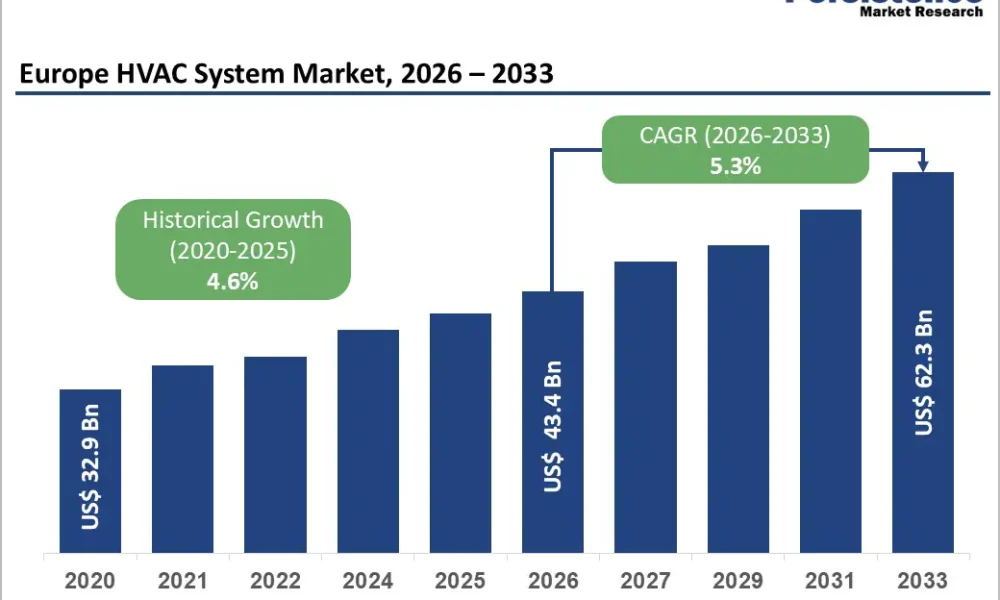
The Europe HVAC system market is undergoing a significant transformation, driven by regulatory mandates, technological innovation, and the urgent need for energy efficiency. The market is projected to be valued at US$ 43.4 billion in 2026 and is expected to reach US$ 62.3 billion by 2033, expanding at a CAGR of 5.3% during the forecast period. HVAC systems are a critical component of residential, commercial, and industrial infrastructure, ensuring indoor comfort, air quality, and energy optimization. In Europe, the market is increasingly shaped by sustainability goals, particularly the European Union’s decarbonization targets, which are compelling large-scale adoption of energy-efficient heating and cooling solutions.
A key growth driver is the rapid commercialization of heat pump technology, which is gaining widespread acceptance across residential and commercial segments due to its energy efficiency and lower carbon emissions. Additionally, the shift toward smart, IoT-enabled HVAC systems is enhancing operational efficiency and enabling real-time climate control. Space and water heating accounted for 77.6% of final energy consumption in European households in 2023, highlighting the urgent need for energy-efficient solutions. Among segments, heat pumps dominate due to their alignment with electrification goals and regulatory incentives. Geographically, Western Europe, particularly countries like Germany, France, and the UK, leads the market owing to strong policy support, advanced infrastructure, and high awareness of sustainable technologies.
Key Highlights from the Report
• The market is projected to grow at a CAGR of 5.3% from 2026 to 2033.
• Heat pump systems dominate due to strong decarbonization mandates.
• EU regulations are accelerating HVAC retrofits and modernization.
• Smart HVAC systems are gaining traction with IoT integration.
• Western Europe leads due to strong policy frameworks and infrastructure.
• Rising energy consumption in heating is driving efficiency-focused adoption.
𝐆𝐞𝐭 𝐚 𝐒𝐧𝐞𝐚𝐤 𝐏𝐞𝐞𝐤, 𝐒𝐚𝐦𝐩𝐥𝐞 𝐏𝐃𝐅 𝐈𝐧𝐬𝐢𝐝𝐞: https://www.persistencemarketresearch.com/samples/36245
Market Segmentation
The Europe HVAC system market is segmented based on product type, application, and end-user industries. In terms of product type, the market includes heating systems, ventilation systems, and air conditioning systems. Heating systems, particularly heat pumps, hold the largest share due to the region’s cold climate and the growing emphasis on energy-efficient heating solutions. Ventilation systems are also gaining importance, especially in commercial and industrial buildings, where indoor air quality and regulatory compliance are critical. Air conditioning systems, although traditionally less dominant in Europe compared to other regions, are witnessing increased demand due to rising temperatures and changing climate patterns.
From an application perspective, the market is divided into residential, commercial, and industrial sectors. The residential segment accounts for the largest share, driven by the need for energy-efficient heating and cooling solutions in households. The commercial sector, including offices, retail spaces, and hospitality, is also a significant contributor, with increasing adoption of advanced HVAC systems to improve energy efficiency and occupant comfort. The industrial segment is witnessing steady growth, particularly in manufacturing facilities where precise temperature and air quality control are essential.
Based on technology, the market is evolving with the integration of smart and connected HVAC systems. IoT-enabled systems allow users to monitor and control temperature settings remotely, optimize energy consumption, and enhance system performance. This technological shift is creating new opportunities for innovation and differentiation in the market.
Regional Insights
Western Europe dominates the HVAC system market, driven by stringent environmental regulations, high energy costs, and strong government support for energy-efficient technologies. Countries such as Germany, France, and the UK are leading adopters of heat pumps and smart HVAC systems, supported by incentives and subsidies aimed at reducing carbon emissions. The region’s well-established infrastructure and high awareness of sustainability further contribute to market growth.
Northern Europe is also a key market, characterized by high demand for heating systems due to colder climates. Countries like Sweden, Norway, and Finland are focusing on renewable energy integration and energy-efficient building solutions. Southern Europe, including Spain and Italy, is witnessing increased demand for air conditioning systems due to rising temperatures and changing climate conditions. Eastern Europe is emerging as a growth market, driven by infrastructure development and increasing investments in building modernization. As countries in this region align with EU regulations, the adoption of advanced HVAC systems is expected to rise significantly.
𝐆𝐞𝐭 𝐚 𝐂𝐮𝐬𝐭𝐨𝐦𝐢𝐳𝐞𝐝 𝐌𝐚𝐫𝐤𝐞𝐭 𝐕𝐢𝐞𝐰 𝐢𝐧 𝐎𝐧𝐞 𝐂𝐥𝐢𝐜𝐤 : https://www.persistencemarketresearch.com/request-customization/36245
Market Drivers
The primary driver of the Europe HVAC system market is the implementation of stringent regulatory frameworks aimed at reducing carbon emissions and improving energy efficiency. Policies such as the Renewable Energy Directive (EU/2023/2413) and the Energy Performance of Buildings Directive (EPBD) 2024 recast are mandating energy-efficient building designs and retrofits. These regulations are compelling property owners and developers to invest in modern HVAC systems, particularly heat pumps and smart climate control technologies. Additionally, the growing awareness of environmental sustainability and the need to reduce energy consumption are driving the adoption of advanced HVAC solutions. The increasing demand for indoor comfort and air quality, especially in the post-pandemic era, further supports market growth.
Market Restraints
Despite its strong growth potential, the market faces several challenges. High initial installation costs of advanced HVAC systems, particularly heat pumps and smart systems, can be a barrier for many consumers. Retrofitting existing buildings to accommodate new HVAC technologies can also be complex and expensive. Additionally, the availability of skilled labor for installation and maintenance is a concern in some regions. Regulatory compliance and evolving standards may also create uncertainties for manufacturers and end-users. Furthermore, economic fluctuations and energy price volatility can impact investment decisions, potentially slowing market growth.
Market Opportunities
The Europe HVAC system market presents significant opportunities for growth, particularly in the area of energy-efficient and sustainable technologies. The increasing adoption of heat pumps and renewable energy-based systems is expected to drive market expansion. The integration of IoT and smart technologies offers opportunities for innovation, enabling advanced features such as predictive maintenance, energy optimization, and remote monitoring. The growing trend of green buildings and sustainable construction practices is also creating demand for advanced HVAC solutions. Additionally, government incentives and funding programs aimed at promoting energy efficiency and reducing carbon emissions are expected to support market growth. Emerging markets in Eastern Europe offer untapped potential, as infrastructure development and modernization efforts gain momentum.
𝐁𝐮𝐲 𝐍𝐨𝐰 𝐭𝐡𝐞 𝐃𝐞𝐭𝐚𝐢𝐥𝐞𝐝 𝐑𝐞𝐩𝐨𝐫𝐭: https://www.persistencemarketresearch.com/checkout/36245
Company Insights
Key players operating in the Europe HVAC system market include:
• Daikin Industries, Ltd.
• Carrier Global Corporation
• Trane Technologies plc
• Johnson Controls International plc
• Mitsubishi Electric Corporation
• Bosch Thermotechnology GmbH
• Danfoss A/S
Recent Developments:
Leading companies are focusing on expanding their heat pump portfolios to align with Europe’s decarbonization goals and increasing demand for energy-efficient solutions. Additionally, strategic collaborations and investments in smart HVAC technologies are enabling companies to enhance their product offerings and strengthen their market presence.
Conclusion
The Europe HVAC system market is poised for sustained growth as the region continues its transition toward energy-efficient and sustainable infrastructure. Driven by stringent regulatory mandates, technological advancements, and increasing awareness of environmental sustainability, the market is evolving rapidly. While challenges such as high costs and infrastructure constraints remain, the growing adoption of heat pumps, smart HVAC systems, and renewable energy solutions presents significant opportunities for market expansion. As Europe moves closer to its decarbonization targets, HVAC systems will play a crucial role in shaping the future of energy consumption and building efficiency across the region.




