
Enterprise Payments Platform Market Size and Trends Analysis (2026–2033)
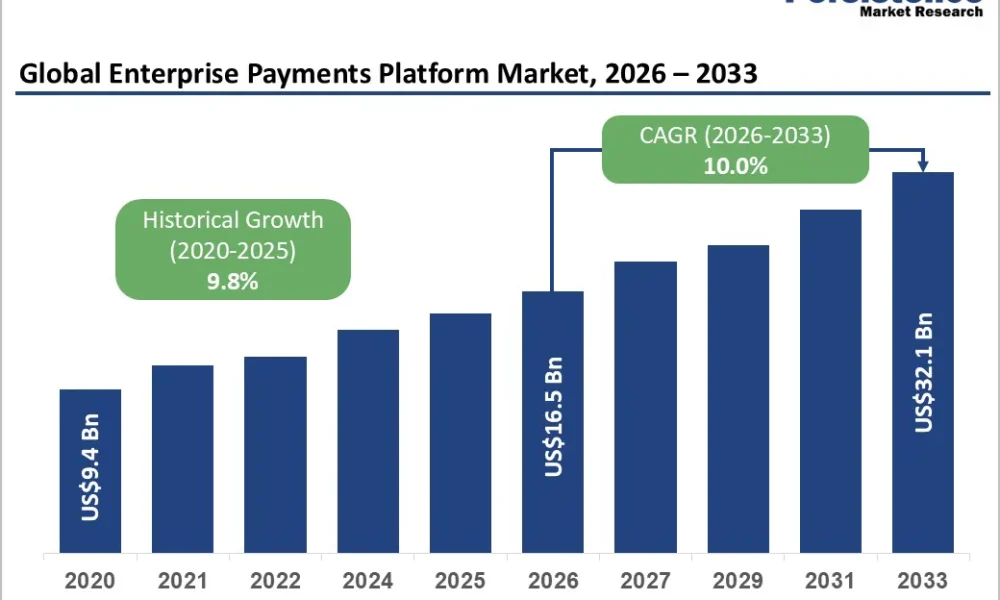
The global enterprise payments platform market is entering a transformative growth phase as businesses accelerate digital modernization across financial ecosystems. The market is expected to be valued at US$16.5 billion in 2026 and projected to reach US$32.1 billion by 2033, expanding at a CAGR of 10.0% from 2026 to 2033. This growth builds on a strong historical CAGR of 9.8% between 2020 and 2025.
Enterprises worldwide are replacing fragmented, legacy payment systems with modern, API-driven platforms capable of supporting real-time, multi-rail payment processing. Today’s payment infrastructure must handle cards, ACH, instant payments, cross-border transfers, digital wallets, and alternative payment methods seamlessly. As a result, enterprise payments platforms have evolved from simple transaction engines into strategic digital infrastructure.
Increasing cloud adoption, embedded finance models, open banking mandates, and cross-border e-commerce expansion are reinforcing demand across BFSI, retail, telecom, manufacturing, and other sectors. Payment modernization is no longer optional—it is foundational to competitiveness.
The Digital Transformation Imperative in Enterprise Payments
Digital transformation is one of the most powerful forces driving the enterprise payments platform market. Organizations are shifting from batch-based processing systems to real-time, event-driven payment architectures. This transition enables faster settlement, improved liquidity management, and enhanced customer experiences.
Modern enterprises require platforms capable of integrating seamlessly with ERP systems, CRM software, e-commerce platforms, and fintech APIs. API-first architectures allow enterprises to deploy new payment capabilities without overhauling entire systems. This flexibility is critical in a market where payment preferences evolve rapidly.
The rise of omni-channel commerce further intensifies the need for unified platforms. Businesses must deliver consistent payment experiences across physical stores, mobile apps, web platforms, and social commerce channels. Payment platforms now act as orchestration engines, synchronizing transaction flows and ensuring operational visibility across all channels.
Additionally, AI-powered analytics embedded within enterprise platforms provide real-time insights into transaction trends, customer behavior, and fraud risks. With nearly 70–80% of global enterprises prioritizing digital-first strategies, enterprise payments platforms have become core enablers of scalable financial operations.
Cybersecurity Risks: A Persistent Market Barrier
Despite robust growth, cybersecurity vulnerabilities present significant challenges to the enterprise payments platform market. Payment ecosystems are frequent targets for cyberattacks, ransomware campaigns, and sophisticated fraud schemes.
Enterprises managing high transaction volumes across multiple payment rails face expanded attack surfaces. Weak API security, outdated infrastructure, and fragmented third-party integrations increase exposure to phishing attacks, malware infiltration, and man-in-the-middle exploits.
Regulatory mandates such as GDPR, PCI DSS, and open banking compliance frameworks impose strict security requirements. Even minor breaches can lead to substantial fines, operational downtime, and reputational damage. This risk often causes organizations—especially SMEs—to delay full-scale modernization.
The cost of implementing advanced encryption, tokenization, AI-based threat monitoring, and continuous compliance frameworks can be significant. However, failure to invest in secure enterprise payment infrastructure poses even greater long-term financial and reputational risks.
AI-Enabled Fraud Prevention and Hyper-Personalization
Artificial intelligence is emerging as a transformative opportunity within the enterprise payments platform market. AI and machine learning models analyze vast volumes of transactional data in real time to detect anomalies and prevent fraud before losses occur.
Modern AI systems can identify behavioral deviations, flag suspicious transactions, and dynamically adjust risk thresholds. This proactive fraud prevention strengthens enterprise resilience while reducing false positives that frustrate customers.
Beyond security, AI is enabling hyper-personalized payment experiences. Platforms can analyze customer spending patterns, payment preferences, and transaction histories to offer tailored checkout options, loyalty incentives, and targeted promotions.
Personalized payment flows increase conversion rates, enhance customer retention, and build long-term brand loyalty. As digital payment ecosystems expand globally, AI-enabled payment intelligence is becoming a strategic differentiator rather than a value-added feature.
Category-Wise Market Analysis
Component Type Insights
Solutions Lead Market Share
Solutions are expected to account for approximately 65% of total market revenue in 2026. These platforms provide the foundational infrastructure for payment orchestration, real-time processing, compliance automation, and fraud detection.
Modern enterprise payment solutions include routing engines, API layers, authentication modules, reconciliation tools, and analytics dashboards. Organizations rely on these components to consolidate multiple payment rails into unified management systems.
For instance, Fiserv’s Enterprise Payments Platform supports unified transaction management across card networks, instant rails, and ACH systems. Such comprehensive functionality explains why solution components dominate market share.
Services Show Rapid Growth
The services segment is projected to grow rapidly as enterprises require consulting, integration, migration, and ongoing optimization support. Payment modernization is complex, particularly when transitioning from legacy cores to hybrid or cloud-native systems.
Companies like Accenture provide payment transformation services, helping enterprises redesign workflows, implement real-time rails, and ensure compliance alignment. As payment ecosystems grow more sophisticated, service providers will play a crucial advisory role.
Elevate your business strategy with comprehensive market data. Request a sample report now: https://www.persistencemarketresearch.com/samples/32069
Deployment Mode Insights
Cloud-Based Deployment Dominates
Cloud-based enterprise payment platforms are expected to capture over 55% of revenue share in 2026. Enterprises favor cloud-native solutions for their scalability, flexibility, and cost efficiency.
Cloud infrastructure enables rapid innovation cycles and seamless integration with fintech ecosystems. It supports dynamic transaction volumes, which is critical during seasonal spikes or promotional campaigns.
Stripe’s cloud-first architecture demonstrates how enterprises can scale payment acceptance globally while maintaining operational agility.
On-Premises Gains in Regulated Sectors
Although cloud leads overall, on-premises deployment is experiencing growth in highly regulated industries such as banking, defense, oil & gas, and government institutions.
Organizations requiring strict data residency and security control prefer local hosting environments. Oracle’s on-premises payment systems illustrate how institutions maintain infrastructure visibility while meeting stringent compliance mandates.
End-User Analysis
BFSI Remains the Dominant Segment
The BFSI sector is projected to account for over 40% of revenue share in 2026. Financial institutions process high volumes of digital payments, cross-border transfers, settlements, and account-to-account transactions daily.
Advanced enterprise payment platforms allow banks to reduce operational risk, streamline settlement processes, and strengthen fraud monitoring capabilities. Unified ecosystems like Adyen’s financial technology platform demonstrate the integration of issuing, acquiring, and risk management within centralized infrastructures.
Retail Emerges as the Fastest-Growing Segment
Retail is anticipated to be the fastest-growing end-user segment. The rapid expansion of omnichannel commerce, subscription models, QR payments, and mobile wallets is reshaping consumer expectations.
Retailers require enterprise payment systems that reduce checkout friction, prevent transaction failures, and synchronize in-store and online sales channels. Shopify Payments exemplifies how unified platforms enable seamless retail payment ecosystems.
Regional Market Insights
North America: Innovation and Infrastructure Leadership
North America is expected to account for 35% of the market share in 2026, making it the largest regional market. The region benefits from mature payment infrastructure, innovation-driven ecosystems, and supportive regulatory frameworks.
Enterprises are increasingly adopting real-time payment systems and embedded finance capabilities. API-enabled payment platforms are gaining traction as businesses seek faster onboarding and global acceptance capabilities.
Companies like PayPal, Fiserv, and Global Payments are driving modernization initiatives through unified commerce solutions and AI-based fraud detection frameworks.
Europe: Open Banking and Regulatory Momentum
Europe represents a significant enterprise payments platform market driven by PSD2 mandates, SEPA Instant adoption, and open banking expansion.
Regulatory harmonization across the EU compels enterprises to adopt API-first architectures supporting real-time account-to-account payments. Adyen and Worldline are among the companies leading unified payment ecosystems in the region.
Strong compliance frameworks such as GDPR push enterprises to invest heavily in encryption, tokenization, and authentication solutions. Europe’s focus on interoperability and secure data sharing continues to accelerate enterprise platform adoption.
Asia Pacific: Fastest-Growing Digital Payment Ecosystem
Asia Pacific is likely to be the fastest-growing region during the forecast period. Explosive smartphone adoption, government-backed financial inclusion programs, and digital wallet penetration fuel demand.
Countries like India, China, and Singapore are promoting instant payment systems similar to UPI. Enterprises are rapidly upgrading payment infrastructures to handle QR payments, mobile wallets, and cross-border digital commerce.
Companies such as Alipay and Tencent (WeChat Pay) are expanding enterprise APIs, enabling seamless integration across retail, logistics, and lifestyle ecosystems. The region’s emphasis on scalability and mobile-first architecture positions it as a major growth engine.
Competitive Landscape
The enterprise payments platform market is moderately fragmented but highly competitive. Leading players focus on innovation, strategic partnerships, and platform extensibility.
Key companies include:
- PayPal Holdings, Inc.
- Stripe, Inc.
- Adyen N.V.
- Fiserv, Inc.
- Worldpay (Global Payments Inc.)
- Oracle Corporation
- ACI Worldwide, Inc.
These vendors compete by offering modular APIs, embedded finance capabilities, cross-border payment services, AI-based fraud detection, and cloud-native architectures. Strategic acquisitions and enterprise partnerships continue to reshape competitive dynamics.
Key Industry Developments
In February 2025, Miura launched Miura Ascend, an advanced enterprise payments platform designed to simplify transaction management across complex enterprise ecosystems.
In October 2025, Oracle reported increased enterprise adoption of Oracle Payments, developed in collaboration with Adyen. The platform supports unified payment experiences across industries including hospitality, healthcare, and entertainment.
Such developments highlight the industry’s movement toward integrated, scalable, and secure enterprise-grade payment ecosystems.
Future Outlook: Toward Unified, Intelligent Payment Ecosystems
Between 2026 and 2033, enterprise payments platforms will continue evolving into intelligent financial orchestration hubs. Real-time processing, embedded finance integration, AI-powered fraud detection, and cross-border interoperability will define next-generation systems.
Cloud-native architectures will dominate, but hybrid deployments will remain relevant in regulated sectors. Retail and BFSI will continue leading adoption, while telecom, healthcare, and manufacturing expand investments.
With the market expected to surpass US$32.1 billion by 2033, enterprise payment platforms will remain at the center of digital commerce transformation. Organizations that prioritize modernization today will gain agility, security, and global scalability tomorrow.
The enterprise payments platform market is not merely growing—it is reshaping the financial backbone of global business.
Related Reports:




