
The global Enterprise Digital Rights Management (EDRM) market is experiencing rapid expansion as organizations prioritize advanced data protection and intellectual property security in an increasingly digital and interconnected world. As businesses handle vast volumes of sensitive data across multiple platforms and devices, ensuring persistent control over digital content has become a critical requirement.
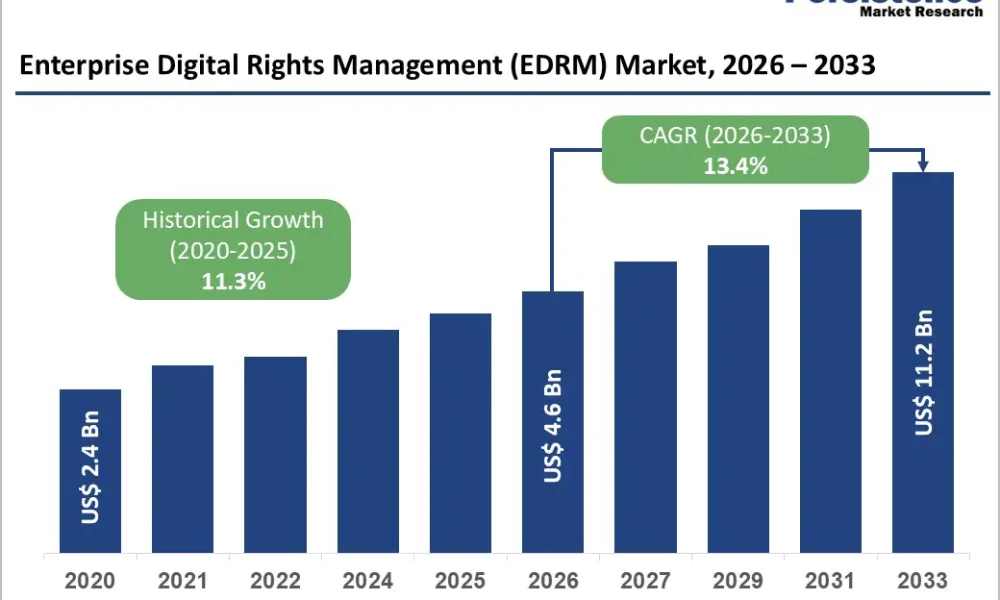
According to industry analysis, the global Enterprise Digital Rights Management (EDRM) market size is expected to reach US$ 4.6 billion in 2026 and grow to approximately US$ 11.2 billion by 2033, registering a compound annual growth rate (CAGR) of 13.4% between 2026 and 2033. This growth reflects a rising demand for robust data governance, regulatory compliance, and secure collaboration across organizations worldwide.
Enterprise Digital Rights Management (EDRM) solutions enable organizations to protect sensitive documents, intellectual property, financial records, and personally identifiable information (PII) through encryption, policy-based access controls, and monitoring capabilities. With the proliferation of remote work, cloud adoption, and cyber threats, EDRM has evolved into a key component of modern cybersecurity strategies.
Growing Importance of Data-Centric Security
Traditional cybersecurity frameworks relied heavily on perimeter defenses such as firewalls and network monitoring tools. However, the shift toward cloud computing, hybrid work environments, and distributed enterprise ecosystems has diminished the effectiveness of perimeter-based security models.
Enterprise Digital Rights Management (EDRM) addresses this challenge by focusing on data-centric security, ensuring that protection mechanisms travel with the data regardless of where it is stored or accessed. This persistent protection allows organizations to enforce security policies even after files leave corporate networks.
EDRM platforms typically include several key capabilities:
- Encryption and watermarking of digital files
- Access control policies based on user identity
- Usage tracking and audit trails
- Dynamic permission management
- Expiration and revocation of access rights
By enabling continuous monitoring and control over digital assets, these solutions help enterprises safeguard critical information while maintaining operational flexibility.
Regulatory Compliance Driving Market Growth
One of the most significant drivers of the Enterprise Digital Rights Management (EDRM) market is the increasing number of data privacy regulations and compliance requirements worldwide.
Governments and regulatory authorities have introduced strict frameworks designed to protect consumer data and ensure responsible information management. Organizations failing to comply with these regulations can face substantial financial penalties and reputational damage.
Major regulatory frameworks influencing the adoption of EDRM include:
- General Data Protection Regulation
- California Consumer Privacy Act
- Health Insurance Portability and Accountability Act
The GDPR, for example, allows regulators to impose fines of up to 4% of a company’s global annual revenue for serious violations. Similarly, updated privacy laws in North America and Asia are requiring enterprises to strengthen data protection practices.
EDRM systems provide organizations with the tools needed to enforce compliance by creating secure audit trails, controlling data access, and preventing unauthorized sharing of sensitive information.
Rising Cybersecurity Threats and Data Breaches
The growing sophistication of cyber threats is another key factor accelerating the adoption of Enterprise Digital Rights Management solutions. Enterprises today face a wide range of threats, including ransomware attacks, insider threats, and supply chain compromises.
In recent years, cyberattacks have increased dramatically, targeting sensitive enterprise information such as:
- Intellectual property and product designs
- Financial records and transaction data
- Personal customer information
- Research and development documentation
Supply chain attacks have become particularly concerning, accounting for a significant portion of recent data breaches. These attacks often exploit vulnerabilities in third-party vendors or service providers, enabling attackers to gain access to enterprise networks and sensitive files.
EDRM solutions help mitigate these risks by ensuring that even if data is stolen or shared outside the organization, it remains encrypted and accessible only to authorized users.
Artificial Intelligence Enhancing EDRM Capabilities
Artificial intelligence and machine learning technologies are transforming the capabilities of Enterprise Digital Rights Management platforms. Modern solutions increasingly rely on AI-driven tools to automate data classification and security policy enforcement.
AI-powered EDRM systems can automatically detect sensitive information, including:
- Personally identifiable information (PII)
- Financial and transactional records
- Confidential business documents
- Intellectual property assets
Using natural language processing and pattern recognition technologies, these systems analyze file content and context to determine the appropriate security level. Once identified, sensitive data is automatically encrypted or restricted according to organizational policies.
AI-driven automation offers several benefits for enterprises:
- Reduced manual data classification efforts
- Improved compliance with regulatory requirements
- Faster incident detection and response
- Enhanced accuracy in identifying sensitive content
This integration of artificial intelligence is expected to significantly enhance the efficiency and scalability of EDRM solutions over the next decade.
Elevate your business strategy with comprehensive market data. Request a sample report now: https://www.persistencemarketresearch.com/samples/29227
Role of Zero Trust Security Architecture
Another major trend shaping the Enterprise Digital Rights Management market is the adoption of Zero Trust security frameworks. Unlike traditional security models that assume trust within corporate networks, Zero Trust operates on the principle that no user or device should be trusted by default.
Under a Zero Trust architecture, every access request must be verified based on multiple factors such as:
- User identity
- Device security status
- Location and network conditions
- Behavioral analytics
EDRM systems complement Zero Trust strategies by enforcing granular access controls directly at the data level. Even if attackers gain access to enterprise networks, they cannot open or distribute protected files without the appropriate authorization.
As organizations increasingly implement Zero Trust frameworks, the demand for EDRM technologies is expected to grow significantly.
Document Protection Leading the Market
Among the various solution types within the EDRM ecosystem, document protection currently represents the largest market segment. This segment accounted for approximately 30% of the global market share in 2026.
Enterprises rely heavily on digital documents such as contracts, financial reports, and technical specifications. Protecting these documents from unauthorized copying, printing, or editing is critical for maintaining operational integrity and intellectual property security.
Advanced document protection solutions now include features such as:
- Dynamic watermarking
- Restricted printing and copying
- Automatic document expiration
- Real-time access revocation
These capabilities ensure that organizations maintain control over sensitive documents throughout their lifecycle.
Rapid Growth in File Sharing and Collaboration Security
While document protection remains the largest segment, file sharing and collaboration protection is emerging as the fastest-growing category in the EDRM market.
Modern enterprises rely heavily on digital collaboration platforms to support distributed teams and global operations. Tools such as cloud storage systems, project management platforms, and communication applications enable employees to share files quickly across organizational boundaries.
However, this increased collaboration also introduces new security risks. Sensitive data may be accidentally shared with unauthorized individuals or exposed through compromised accounts.
EDRM solutions designed for collaboration environments provide persistent protection even when files are shared across platforms. These systems ensure that access permissions remain intact regardless of where the file is stored or transmitted.
BFSI Sector Leading EDRM Adoption
The Banking, Financial Services, and Insurance (BFSI) sector is currently the largest end-user of Enterprise Digital Rights Management solutions, accounting for around 28% of the market share in 2026.
Financial institutions handle enormous volumes of sensitive information, including:
- Customer financial records
- Transaction histories
- Credit assessments
- Investment strategies
Protecting this information is essential not only for regulatory compliance but also for maintaining customer trust.
The introduction of new regulations such as the Digital Operational Resilience Act has further increased the need for advanced data protection tools within financial institutions.
Healthcare and Life Sciences: Fastest-Growing Sector
The healthcare and life sciences industry is emerging as the fastest-growing end-use sector for Enterprise Digital Rights Management solutions.
Healthcare organizations are responsible for protecting highly sensitive patient data, clinical research information, and pharmaceutical intellectual property. At the same time, the industry is undergoing rapid digital transformation with the adoption of electronic health records, telemedicine, and cloud-based research platforms.
These developments have increased the risk of data breaches, prompting healthcare providers to invest heavily in advanced security solutions.
EDRM platforms help healthcare organizations protect medical records, research data, and proprietary drug development information while ensuring compliance with healthcare data protection regulations.
Regional Insights
North America Leading the Global Market
North America currently holds the largest share of the global Enterprise Digital Rights Management market, accounting for approximately 35% of total revenue.
The region benefits from:
- Advanced IT infrastructure
- Strong cybersecurity investments
- Strict regulatory frameworks
- Early adoption of digital technologies
Many leading EDRM vendors are headquartered in North America, contributing to a mature ecosystem of cybersecurity solutions.
East Asia Emerging as the Fastest-Growing Region
East Asia represents one of the fastest-growing regional markets for EDRM solutions, accounting for around 20% of global market share in 2026.
Rapid digitalization, expanding cloud infrastructure, and increasing cybersecurity threats are driving strong demand for data protection technologies across the region.
Countries such as China and India are also implementing stricter data protection laws, further accelerating the adoption of enterprise data security platforms.
Europe Driven by Strong Data Protection Regulations
Europe accounts for approximately 25% of the global EDRM market and remains a key region for data security innovation.
The region’s strict privacy laws and regulatory enforcement have made data protection a top priority for enterprises operating within the European Union. These regulatory pressures continue to drive investments in advanced digital rights management solutions.
Competitive Landscape
The Enterprise Digital Rights Management market is highly competitive, featuring a mix of global technology companies and specialized cybersecurity vendors.
Leading companies in the market include:
- Adobe Inc.
- Oracle Corporation
- Seclore
- Bynder
- Vitrium Security
- FileOpen Systems
These vendors focus on developing innovative security solutions that integrate seamlessly with enterprise software ecosystems while offering scalable cloud-based capabilities.
Strategic partnerships, acquisitions, and product innovation remain key competitive strategies within this rapidly evolving market.
Future Outlook of the EDRM Market
The future of the Enterprise Digital Rights Management market looks highly promising as organizations increasingly recognize the importance of protecting digital assets in a data-driven economy.
Several factors are expected to sustain long-term market growth:
- Rising cybersecurity threats and data breaches
- Expanding regulatory compliance requirements
- Growth of remote and hybrid work models
- Increasing reliance on cloud collaboration platforms
- Integration of artificial intelligence into security solutions
As enterprises continue to generate and share vast amounts of digital information, the need for persistent data protection will become even more critical.
With its ability to safeguard sensitive information while enabling secure collaboration, Enterprise Digital Rights Management is poised to become a foundational component of modern enterprise cybersecurity strategies.
Related Reports:




