
Embedded Chip Packaging Market: Trends and Strategic Insights (2025-2032)
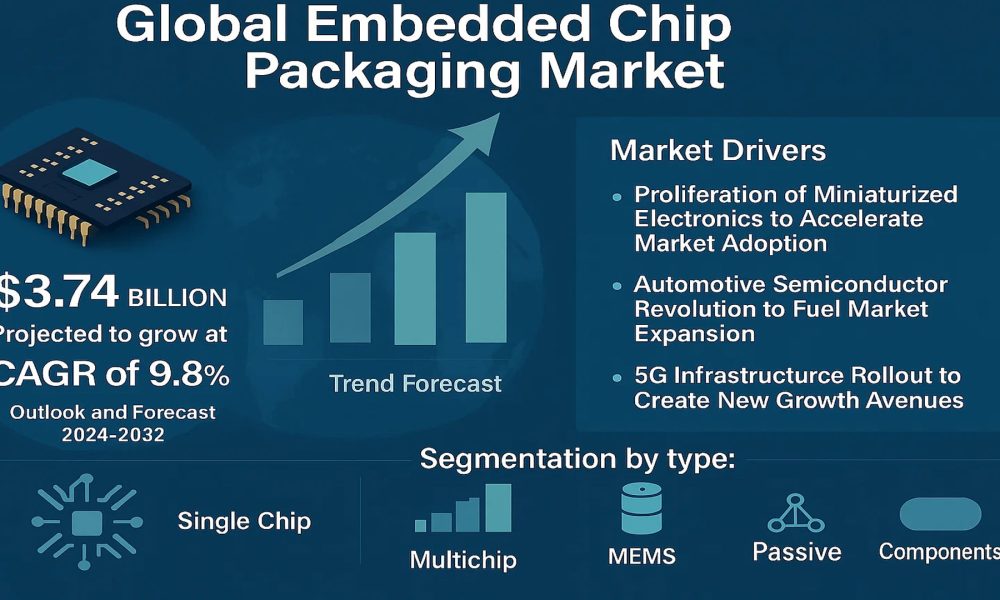
Global Embedded Chip Packaging Market size was valued at US$ 3.74 billion in 2024 and is projected to reach US$ 7.89 billion by 2032, at a CAGR of 9.8% during the forecast period 2025-2032. The market’s expansion is driven by the increasing demand for miniaturized, high-performance electronics across industries such as automotive, consumer electronics, and healthcare.
Embedded chip packaging is a sophisticated semiconductor integration technique where components like single-chip, multichip, MEMS (Micro-Electro-Mechanical Systems), or passive elements are embedded within organic laminate substrates. This process involves multi-step manufacturing, where copper-plated vias establish connections, enabling compact and efficient designs. The technology is gaining traction due to its ability to reduce footprint, enhance thermal performance, and improve signal integrity.
While the semiconductor market faced slower growth in 2022 (4.4% YoY), segments like analog and sensors maintained double-digit expansion, signaling resilience in embedded packaging applications. However, challenges such as inflation and supply chain constraints have impacted regional dynamics, with Asia Pacific witnessing a 2.0% decline despite remaining the largest market. Key players like ASE, Texas Instruments, and Infineon are investing in advanced packaging solutions to cater to rising demand for IoT and 5G-enabled devices.
Get Full Report with trend analysis, growth forecasts, and Future strategies : https://semiconductorinsight.com/report/embedded-chip-packaging-market/
Segment Analysis:
By Type
Single-Chip Packaging Dominates Due to High Adoption in Consumer Electronics
The market is segmented based on type into:
- Single Chip
- Subtypes: Flip-chip, Wire-bond, and others
- Multichip
- MEMS
- Passive Components
By Application
Tiny Package Segment Leads Owing to Increasing Demand for Miniaturized Electronic Devices
The market is segmented based on application into:
- Tiny package
- System-in-Boards
- Other
By End User
Consumer Electronics Sector Drives Market Growth Due to High Volume Production
The market is segmented based on end user into:
- Consumer Electronics
- Automotive
- Healthcare
- Industrial
- Telecommunications
MARKET DYNAMICS
MARKET DRIVERS
Proliferation of Miniaturized Electronics to Accelerate Market Adoption
The embedded chip packaging market is experiencing robust growth driven by the increasing demand for compact, high-performance electronic devices across industries. With the Internet of Things (IoT) ecosystem expanding rapidly, manufacturers are under pressure to develop smaller yet more powerful components. Embedded chip packaging technology enables significant space savings – up to 30-50% reduction in package size compared to traditional methods – by integrating chips directly into substrates rather than mounting them on top. This technology is becoming particularly crucial for applications in wearables, smart sensors, and mobile devices where every millimeter counts. The global shipment of IoT devices is projected to surpass 30 billion units by 2025, creating massive demand for advanced packaging solutions.
Automotive Semiconductor Revolution to Fuel Market Expansion
The automotive industry’s transformation towards electric and autonomous vehicles represents another significant growth driver. Modern vehicles now incorporate hundreds of semiconductor components for applications ranging from advanced driver assistance systems (ADAS) to battery management. Embedded chip packaging offers superior reliability and thermal performance critical for automotive applications, where components must withstand extreme temperatures and vibration. The average semiconductor content per vehicle is expected to exceed $600 by 2026, up from $400 in 2020. Major automotive OEMs are collaborating with packaging specialists to develop embedded solutions that meet rigorous automotive-grade qualifications while supporting the increased computing power requirements of next-generation vehicles.
5G Infrastructure Rollout to Create New Growth Avenues
The ongoing global deployment of 5G networks is creating substantial opportunities for embedded chip packaging solutions. 5G base stations and network equipment require components that can handle higher frequencies while maintaining signal integrity, a challenge that embedded packaging helps address through superior electrical performance and reduced parasitic effects. The technology enables more efficient thermal management, crucial for power amplifiers and RF modules operating at millimeter wave frequencies. With over 2 million 5G base stations expected to be deployed worldwide by 2025, the demand for specialized packaging solutions is set to increase significantly in the telecom infrastructure segment.
MARKET OPPORTUNITIES
Heterogeneous Integration Trends to Open New Possibilities
The semiconductor industry’s shift toward heterogeneous integration presents substantial opportunities for embedded packaging technologies. As chip designers increasingly combine disparate technologies (logic, memory, sensors) in single packages, embedded solutions offer a compelling approach for high-density integration with minimal interconnect lengths. The technology enables mixing of different node sizes and technologies in compact form factors, addressing the growing need for specialized processing in AI/ML accelerators and edge computing devices. Major foundries and IDMs are investing heavily in embedded packaging capabilities to support these emerging applications, with several advanced projects currently in development.
Medical Electronics to Emerge as High-Growth Application Area
The healthcare sector is poised to become a significant adopter of embedded chip packaging solutions, particularly for implantable and wearable medical devices. The technology’s small footprint, reliability, and biocompatibility make it ideal for medical applications where space constraints and long-term performance are critical. Emerging applications include neuromodulation devices, continuous glucose monitors, and advanced prosthetics that require sophisticated electronics in miniature packages. With the global medical electronics market projected to grow at over 7% annually, embedded packaging stands to benefit from this expanding market segment.
EMBEDDED CHIP PACKAGING MARKET TRENDS
Miniaturization and IoT Expansion Driving Market Growth
The global embedded chip packaging market is experiencing robust growth, driven by the escalating demand for miniaturized electronic devices and the rapid expansion of Internet of Things (IoT) applications. With semiconductor manufacturers striving to pack more functionality into smaller form factors, embedded packaging solutions are becoming indispensable. The market, valued at $XX million in 2024, is projected to grow at a CAGR of X% through 2032. This surge is particularly evident in consumer electronics, automotive systems, and industrial automation, where space constraints and performance requirements necessitate advanced packaging solutions like System-in-Board (SiB) and chip-on-board (CoB) technologies.
Other Trends
Rise of Heterogeneous Integration
As chip complexity increases, heterogeneous integration has emerged as a dominant strategy in semiconductor packaging. By embedding multiple dies—such as processors, memory, and sensors—within a single substrate, manufacturers achieve superior performance while minimizing footprint. Major industry players are investing heavily in technologies like wafer-level packaging and 3D IC integration, which enable tighter interconnects and higher bandwidth. This trend is particularly critical for applications such as artificial intelligence (AI) accelerators and 5G infrastructure, where latency and power efficiency are paramount.
Automotive Electronics Fueling Demand
The automotive sector is becoming a key driver for embedded chip packaging, spurred by advancements in electric vehicles (EVs) and autonomous driving systems. Modern vehicles incorporate dozens of electronic control units (ECUs) requiring reliable, high-density packaging solutions. For instance, embedded passive components in automotive-grade substrates improve signal integrity while reducing electromagnetic interference (EMI). With the automotive semiconductor market expected to grow at X% annually through 2030, demand for robust embedded packaging solutions will continue to escalate.
Material Innovations Addressing Thermal Challenges
As power densities in embedded systems increase, managing thermal dissipation has become a critical challenge. Recent advancements in organic substrates and thermal interface materials (TIMs) are extending the limits of embedded packaging. For example, ceramic-filled laminates now offer thermal conductivity exceeding X W/mK, enabling reliable operation in high-temperature environments like industrial motors and power electronics. Furthermore, the adoption of low-loss dielectric materials is improving signal transmission for high-frequency applications in telecommunications and radar systems.
Recent developments:
1. 3D Packaging Technologies
- Advancements: Technologies like Through-Silicon Via (TSV) and Chip-on-Wafer (CoW) are enabling chip stacking, boosting performance and miniaturization.
- Impact: Growing demand in 5G and IoT applications, where size and power efficiency are key.
2. Fan-Out Wafer-Level Packaging (FOWLP)
- Advancements: FOWLP offers better thermal dissipation, smaller size, and reduced power consumption compared to traditional packaging.
- Impact: Strong growth in mobile devices and automotive electronics.
3. Embedded Passive Components (EPC)
- Advancements: Integration of passive components like resistors and capacitors into the chip package, reducing size and improving reliability.
- Impact: Vital for wearables and automotive electronics needing miniaturization and reliability.
4. Advanced Thermal Materials
- Advancements: Use of materials like graphene and diamond-like carbon (DLC) to improve heat dissipation in high-performance chips.
- Impact: Essential for 5G and AI applications, where efficient thermal management is critical.
5. AI-Driven Packaging Design
- Advancements: AI tools optimize chip packaging through simulations and thermal analysis, enhancing design efficiency.
- Impact: Faster time-to-market and customization in industries like telecommunications and automotive.
Learn more about Competitive Analysis, and Forecast of Embedded Chip Packaging Market: https://semiconductorinsight.com/download-sample-report/?product_id=107420
COMPETITIVE LANDSCAPE
Key Industry Players
Innovation and Technological Advancements Drive Market Competition
The global Embedded Chip Packaging market exhibits a dynamic and competitive landscape, predominantly shaped by both established semiconductor giants and emerging specialists focusing on miniaturization and efficient integration. The market is moderately consolidated, with leading players such as ASE Global and Taiyo Yuden capturing substantial shares, supported by their extensive R&D investments and robust manufacturing capabilities.
Texas Instruments and Infineon Technologies remain critical contributors, leveraging their expertise in analog and embedded systems to dominate applications in automotive, IoT, and industrial sectors. These companies have continuously expanded their portfolios by embedding passive components and MEMS in advanced substrates, addressing the evolving needs for compact and high-performance electronic systems.
While Asia-Pacific remains the dominant region, contributing over 60% of the market revenue, North American and European players like NXP Semiconductors and STMicroelectronics are strengthening their market footprint through strategic collaborations and technological innovations in System-in-Board (SiB) packaging solutions. Smaller players, including Würth Elektronik and Shinko Electric Industries, are scaling up their niche capabilities to cater to specialized segments such as wearable electronics and medical devices.
The competitive dynamics are further intensified by the rising adoption of AI-driven manufacturing processes and 5G infrastructure, compelling companies to accelerate product differentiation. As the demand for ultra-thin and energy-efficient packaging solutions grows, industry leaders are expected to prioritize vertical integration and material science breakthroughs to maintain dominance.
List of Key Embedded Chip Packaging Companies Profiled
- ASE Global (Taiwan)
- Texas Instruments (U.S.)
- Taiyo Yuden (Japan)
- Infineon Technologies (Germany)
- NXP Semiconductors (Netherlands)
- STMicroelectronics (Switzerland)
- Shinko Electric Industries (Japan)
- Würth Elektronik (Germany)
- Samsung Electro-Mechanics (South Korea)
Browse Related Reports : X-ray TDI Cameras Market
CONTACT US:
City vista, 203A, Fountain Road, Ashoka Nagar, Kharadi, Pune, Maharashtra 411014
+91 8087992013
[email protected]




