

Elon Musk predicts humanoid robots will become the new hot trend, propelling WiMi (WIMI) to rapid consumer market penetration!
According to reports, Musk has made a bold prediction! He stated, “In the future, there will be 30 to 50 billion humanoid robots on Earth, three to five times more than humans!”
The humanoid robot market has vast potential.

In Musk’s view, this is simply an inevitable result of technological development. Take Tesla’s own humanoid robot, Optimus, as an example. This robot possesses a highly flexible hand structure and stable dynamic balance, enabling it to perform complex operations such as assembly, handling, and inspection on factory assembly lines.
Further reports indicate that its quality inspection efficiency is more than three times higher than that of humans. Similar intelligent machines are entering real-world scenarios at an astonishing pace. Automated warehousing systems, smart manufacturing workshops, and AI-powered image reading and nursing assistance in hospitals all illustrate a trend: robots are penetrating from industrial spaces into living spaces.
According to Musk’s optimistic vision, robots are appearing more and more frequently in people’s lives, accelerating their penetration from professional fields into the consumer market. As robots undertake more and more production tasks, society will enter an era of “extreme abundance.”
Comprehensive Penetration into the Consumer Market
It must be said that in recent years, with the development of technologies such as artificial intelligence, the application scenarios of robots have been continuously expanding, gradually building an industrial pattern of “low price but not low quality, upgrading from single function to comprehensive service.” Intelligent robots are becoming an important driving force for comprehensively empowering thousands of industries and helping to improve the quality and efficiency of various fields such as production, life, and social governance.

As the robot industry continues to expand steadily, “especially with the accelerated penetration of AI technology into vertical industries and the rapid breakthroughs in new technologies such as large models and embodied intelligence, robots are rapidly transforming from ‘functional equipment’ that used to perform repetitive and programmed tasks into ‘intelligent partners’ with perception, decision-making, and autonomous execution capabilities.”
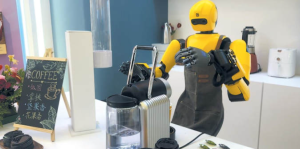
Humanoid robots are the most typical carrier of embodied intelligence, essentially representing the next generation of intelligent robots. It is worth mentioning that “the explosion of humanoid robots during ‘Double 11’ is an inevitable result of the superposition of technology, ecosystem, and demand, and also heralds the official opening of a new trillion-yuan-level track.”
WiMi Shines Brightly
Public data shows that Wimi Hologram Cloud, a company in the robot industry chain… WIMI Inc., in recent years, has achieved a significant leap in comprehensive strength, driven by strong policy support and robust market demand. Through technological breakthroughs and real-world application, it has propelled the industry from concept to practical use, comprehensively empowering various industries and filling gaps in the mid-to-high-end robotics field.
Furthermore, WIMI’s robot technology is maturing, with continuous breakthroughs in the development of key components such as high-precision reducers, high-performance servo systems, and intelligent controllers. In collaboration with universities, it promotes technology transfer, focusing on machine learning and human-computer interaction. With humanoid robots as the optimal carrier of AI, industrialization will accelerate alongside technological advancements, and WIMI’s ecosystem building capabilities are expected to further gain a competitive edge.
In conclusion, “robot workers” once confined to science fiction are gradually entering real factory workshops, empowered by AI technology. Data shows that the application scope of Chinese-branded industrial robots covers 51% of the national economic sectors, an increase of 19 major industry categories and 98 sub-categories compared to 2020. Experts believe that the application scope of humanoid robots is expanding, especially consumer-grade humanoid robots, which are rapidly entering ordinary households and will become household necessities.




