
Introduction: Sensors as the Digital Nervous System
Electronic sensors have quietly become the backbone of the modern digital economy. From smartphones that adapt screen brightness to ambient light, to electric vehicles that continuously monitor battery health, sensors translate physical phenomena into actionable digital signals. As industries transition toward automation, connectivity, and data-driven decision-making, sensors are no longer optional components—they are mission-critical infrastructure.
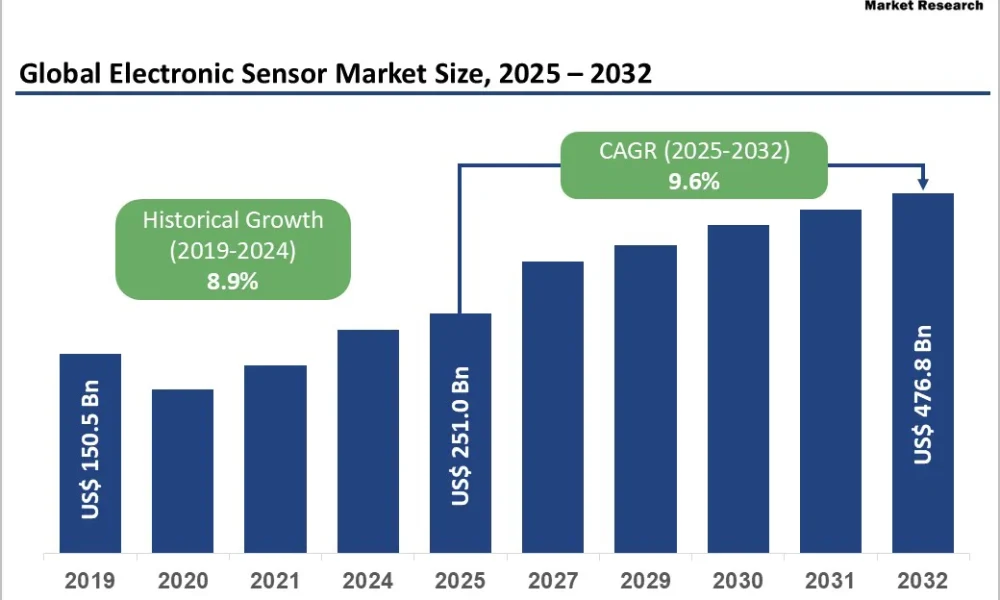
The global electronic sensor market is projected to grow from US$ 251.0 billion in 2025 to US$ 476.8 billion by 2032, registering a robust CAGR of 9.6% during the forecast period. This growth reflects accelerating adoption of IoT devices, autonomous vehicles, Industry 4.0 manufacturing systems, and smart city infrastructure across developed and emerging economies.
Market Overview and Key Insights
Electronic sensors enable machines, systems, and devices to perceive and respond to their environments in real time. These components measure parameters such as light, pressure, temperature, motion, humidity, sound, and chemical composition, converting them into electrical signals for processing and analysis.
Key Market Metrics
- Market Size (2025E): US$ 251.0 billion
- Market Forecast (2032F): US$ 476.8 billion
- CAGR (2025–2032): 9.6%
- Historical Growth (2019–2024): 8.9%
Market Highlights
- Leading Region: North America (38% share in 2025)
- Fastest-Growing Region: Asia-Pacific (12.8%+ CAGR through 2032)
- Dominant Segment: Image sensors (20% share in 2025)
- Fastest-Growing Segment: Pressure sensors (11.4% CAGR)
- Key Opportunity: Automotive electrification and autonomous vehicle development
Market Dynamics
Internet of Things (IoT) Proliferation and Smart Device Expansion
The explosive growth of IoT ecosystems is the single most powerful driver of electronic sensor demand. Billions of connected devices across homes, factories, hospitals, and cities rely on sensors to capture real-time data and enable intelligent automation.
Smartphones integrate ambient light sensors, proximity sensors, accelerometers, and gyroscopes as standard features. Wearable devices use biometric sensors to track heart rate, blood oxygen levels, sleep patterns, and physical activity. Smart home systems deploy motion, temperature, and air quality sensors to optimize comfort and energy efficiency.
Industrial IoT (IIoT) applications further amplify demand. Manufacturing facilities increasingly rely on sensors for predictive maintenance, asset tracking, quality control, and energy optimization. Sensors enable early fault detection, reduce downtime, and improve operational efficiency, making them indispensable for Industry 4.0 initiatives.
Government-backed smart city projects across Asia-Pacific and Europe are also major contributors. Traffic monitoring systems, environmental pollution sensors, smart lighting, and intelligent waste management networks all depend on dense sensor deployments.
Automotive Electrification and ADAS Integration
The automotive sector represents the largest and fastest-evolving application area for electronic sensors. The global automotive sensor market is projected to reach US$ 89.6 billion by 2032, growing at a CAGR of 12.3%.
Electric vehicles require significantly more sensors than internal combustion engine vehicles. Battery management systems depend on voltage, current, temperature, and pressure sensors to ensure safety, performance, and longevity. Thermal sensors regulate cooling systems, while position and torque sensors optimize powertrain efficiency.
Advanced Driver Assistance Systems (ADAS) further intensify sensor requirements. Cameras, radar, ultrasonic, and LiDAR sensors work together to enable lane keeping, adaptive cruise control, collision avoidance, and automated parking. As governments mandate ADAS features for vehicle safety, sensor integration becomes a regulatory necessity rather than a premium option.
The transition toward Level 4 and Level 5 autonomous vehicles introduces even more complex sensor architectures. Vehicles must achieve 360-degree situational awareness using sensor fusion, dramatically increasing the value and sophistication of electronic sensors per vehicle.
Market Restraints
High Cost and Integration Complexity
Despite strong growth prospects, the electronic sensor market faces notable challenges. Advanced sensor technologies such as MEMS, CMOS image sensors, and photonic sensors require substantial R&D investment and sophisticated manufacturing processes. Semiconductor fabrication, precision etching, and advanced packaging drive high capital expenditure.
Integration complexity is another barrier. Combining multiple sensors into unified systems requires signal conditioning, analog-to-digital conversion, calibration, and data fusion. Industrial retrofitting, in particular, can be costly and time-consuming.
Additionally, supply chain volatility and semiconductor shortages can disrupt production timelines, while stringent certification requirements in automotive and aerospace applications increase development costs and extend time to market.
Data Privacy and Cybersecurity Concerns
As sensors become more connected, concerns around data security and privacy intensify. Wearable health sensors collect sensitive biometric data, while smart home and city sensors continuously transmit environmental and behavioral information.
Connected vehicles and industrial sensor networks are potential targets for cyberattacks, raising safety and intellectual property risks. Compliance with data protection regulations such as GDPR increases operational complexity and may slow adoption in privacy-sensitive applications.
Emerging Market Opportunities
Quantum Sensors in Defense and Aerospace
Quantum sensors represent a transformative opportunity within the electronic sensor landscape. Leveraging quantum mechanical principles, these sensors deliver unprecedented sensitivity and accuracy.
Applications in defense and aerospace are particularly compelling. Quantum accelerometers and gyroscopes enable navigation without GPS, ensuring operational reliability in contested or denied environments. Quantum magnetometers enhance detection capabilities in electronic warfare and submarine navigation.
Government-funded initiatives, including DARPA-backed programs, are accelerating the commercialization of quantum sensing technologies. Advances in integrated photonics and miniaturization are bringing quantum sensors closer to large-scale deployment.
Elevate your business strategy with comprehensive market data. Request a sample report now: https://www.persistencemarketresearch.com/samples/33369
Environmental Monitoring and Sustainability Applications
Environmental monitoring is one of the fastest-growing sensor application areas. Governments worldwide are mandating air and water quality monitoring to address pollution, climate change, and public health concerns.
Sensors monitor particulate matter, gas emissions, humidity, temperature, and water contaminants. Wearable air quality sensors allow individuals to track personal exposure, while smart city networks provide real-time pollution mapping.
Renewable energy systems also depend heavily on sensors. Solar and wind installations use environmental sensors to optimize output based on irradiance, temperature, and weather conditions, supporting the global transition to clean energy.
Category-wise Market Insights
Product Type: Image Sensors Lead
Image sensors dominate the market with a 20% share in 2025. Their widespread use in smartphones, surveillance systems, industrial automation, and autonomous vehicles underpins this leadership.
High-resolution imaging enables facial recognition, computational photography, machine vision, and object detection. As demand for visual data continues to expand, image sensors remain foundational to multiple industries.
Technology: CMOS at the Core
CMOS technology accounts for 36% of sensor implementations in 2025. Its advantages include low power consumption, compact size, high integration capability, and cost efficiency.
CMOS sensors have largely replaced CCD technology, enabling scalable production for consumer electronics, automotive systems, and industrial applications. Continuous improvements in sensitivity and processing capabilities reinforce CMOS as the backbone of modern sensing solutions.
End-Use Industries
Consumer electronics dominate demand with a 42.7% market share, driven by smartphones, wearables, tablets, and smart appliances. Each device integrates multiple sensors as standard components.
Automotive and transportation represent the fastest-growing segment, supported by EV adoption, ADAS mandates, and autonomous vehicle development. Sensor density per vehicle continues to rise, significantly boosting market value.
Regional Market Analysis
North America: Market Leader
North America holds 38% of global market share, supported by strong automotive innovation, aerospace and defense investments, and a mature consumer electronics ecosystem. The U.S. leads in ADAS adoption, quantum sensor research, and industrial IoT deployment.
Europe: Automotive and Industrial Strength
Europe accounts for roughly one-third of the global market. Germany anchors regional demand through automotive manufacturing and Industry 4.0 leadership. EU safety and emissions regulations further accelerate sensor adoption across vehicles and industrial systems.
Asia-Pacific: Fastest Growth Engine
Asia-Pacific is the fastest-growing region, with a projected CAGR above 12.8%. China dominates consumer electronics production, while Japan excels in sensor miniaturization and precision engineering. India’s “Make in India” initiative and Southeast Asia’s emergence as manufacturing hubs further strengthen regional momentum.
Competitive Landscape
The electronic sensor market is moderately consolidated, featuring global semiconductor leaders alongside specialized sensor manufacturers. Competition centers on innovation, miniaturization, AI-enabled sensing, and system-level integration.
Key strategies include mergers and acquisitions, R&D investment, and platform-based solutions that combine hardware with analytics software. Companies that deliver end-to-end sensing ecosystems are best positioned to capture long-term value.
Conclusion: The Future Is Sensor-Driven
Electronic sensors are redefining how machines interact with the physical world. As industries pursue automation, electrification, and intelligence, sensors become the foundation of digital transformation.
With strong growth across automotive, IoT, healthcare, industrial automation, and environmental monitoring, the electronic sensor market is set to nearly double by 2032. Companies that innovate in performance, security, and integration will shape the next era of connected, intelligent systems.
Related Reports:




