
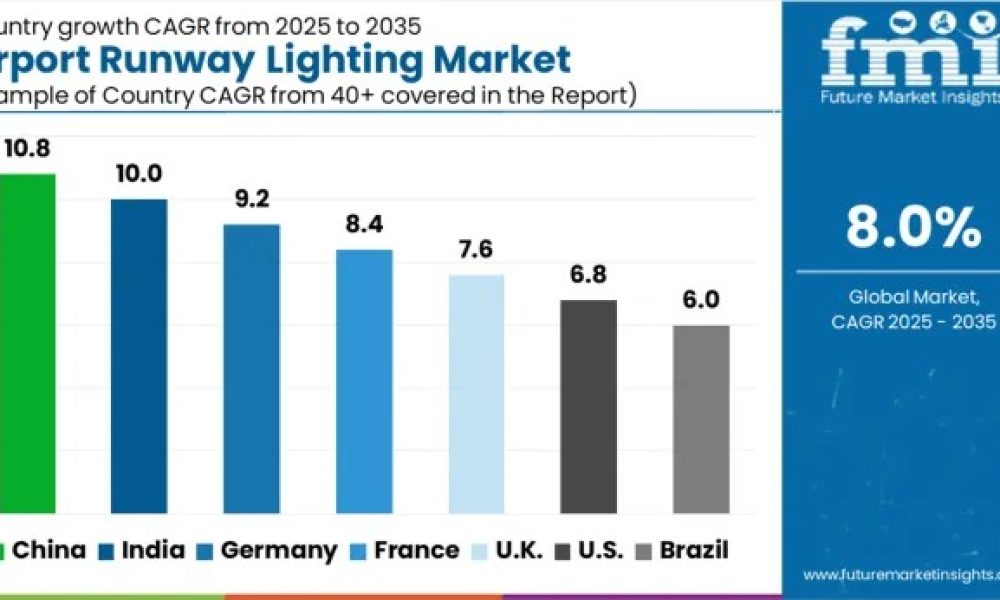
The global airport runway lighting market is on a strong growth trajectory, projected to increase from USD 566.9 million in 2025 to USD 1,223.8 million by 2035, registering a CAGR of 8.0%. Market expansion is closely tied to macroeconomic indicators such as air passenger traffic growth, airport infrastructure spending, and government aviation budgets, positioning runway lighting as a critical enabler of safe and efficient airport operations.
Rising disposable incomes, expansion of the middle class in emerging economies, and post-pandemic recovery in global air travel are driving investments in airport modernization, with advanced runway lighting systems playing a central role in safety compliance and operational continuity.
Macroeconomic and Aviation Indicators Drive Demand Elasticity
The airport runway lighting market demonstrates strong elasticity to aviation and infrastructure spending trends. Growth in air traffic volumes and logistics activity directly translates into higher demand for compliant and energy-efficient lighting systems.
Key macroeconomic influences include:
- Growth in global air passenger and cargo traffic
- Increased airport infrastructure and modernization budgets
- Rising trade volumes supporting cargo aviation
- Government spending on aviation safety and compliance
Get access to comprehensive data tables and detailed market insights — request your sample report today!
https://www.futuremarketinsights.com/reports/sample/rep-gb-25648
Industry analysis indicates that a 1% increase in aviation infrastructure expenditure or air traffic volumes results in a 0.7–0.8% rise in runway lighting demand, highlighting the market’s strong correlation with aviation sector performance.
LED Technology Emerges as the Dominant Market Segment
LED lighting remains the leading technology in the airport runway lighting market, accounting for 57.3% of total revenue in 2025. Airports worldwide are transitioning away from conventional lighting systems in favor of LEDs to reduce operational costs and improve performance.
Key advantages driving LED adoption include:
- Superior energy efficiency and lower power consumption
- Extended operational lifespan with reduced maintenance needs
- Consistent illumination under adverse weather conditions
- Compatibility with smart and automated control systems
Environmental benefits, including reduced carbon emissions, further reinforce LED lighting as the preferred choice for both new installations and retrofit projects.
New Installations Lead as Airport Expansion Accelerates
The new installation segment is expected to contribute 63.5% of total market revenue in 2025, driven by greenfield airport projects, capacity expansions, and large-scale modernization initiatives.
Key drivers of new installations include:
- Expansion of commercial airports in Asia-Pacific and the Middle East
- Integration of smart lighting systems during airport construction
- Long-term cost advantages of installing energy-efficient technologies upfront
Governments and private airport operators continue to prioritize compliant, future-ready lighting systems during new airport developments.
Commercial Airports Remain the Primary End Users
Commercial airports account for the largest share of runway lighting demand, holding 48.9% of market revenue in 2025. Continuous growth in passenger and cargo traffic requires reliable lighting for night operations and low-visibility conditions.
Commercial airport demand is supported by:
- Rising global passenger volumes
- Increased flight frequency and extended operational hours
- Competitive pressure to enhance safety and service quality
Cargo airports and military airfields further strengthen demand, with night operations and mission-critical requirements driving investment in high-intensity and durable lighting systems.
Regional Growth Led by Asia-Pacific and the Middle East
Asia-Pacific and the Middle East are expected to contribute disproportionately to global market growth due to aggressive airport expansion and modernization programs.
Regional highlights include:
- China (10.8% CAGR) driven by large-scale airport construction
- India (10.0% CAGR) supported by regional connectivity and smart airport initiatives
- Europe and North America focusing on retrofitting, automation, and energy efficiency
Established markets emphasize LED upgrades and intelligent control systems, while emerging regions prioritize capacity expansion and compliance.
Drive Your Business Growth Strategy: Checkout the Report for Key Insights
https://www.futuremarketinsights.com/checkout/25648
Competitive Landscape Focused on Compliance and Smart Integration
Competition in the airport runway lighting market is shaped by regulatory compliance, system reliability, and integration capabilities. Leading players such as ADB Safegate, Honeywell International Inc., Hella KGaA Hueck & Co., OSRAM Licht AG, ABB Ltd., and Eaton Corporation PLC are focusing on intelligent airfield lighting solutions.
Key competitive strategies include:
- Integration of smart monitoring and control platforms
- Development of solar-powered and energy-efficient systems
- Turnkey offerings covering installation, automation, and lifecycle support
Suppliers aligned with ICAO and FAA standards and capable of supporting both new and retrofit projects are best positioned for long-term growth.
Market Outlook
The airport runway lighting market is set for sustained expansion, supported by global air traffic recovery, infrastructure modernization, and regulatory emphasis on aviation safety. As airports prioritize efficiency, sustainability, and automation, demand for advanced runway lighting systems is expected to remain robust through 2035.
Why Choose FMI: Empowering Decisions that Drive Real-World Outcomes: https://www.futuremarketinsights.com/why-fmi
About Future Market Insights (FMI)
Future Market Insights, Inc. (FMI) is an ESOMAR-certified, ISO 9001:2015 market research and consulting organization, trusted by Fortune 500 clients and global enterprises. With operations in the U.S., UK, India, and Dubai, FMI provides data-backed insights and strategic intelligence across 30+ industries and 1200 markets worldwide.



