
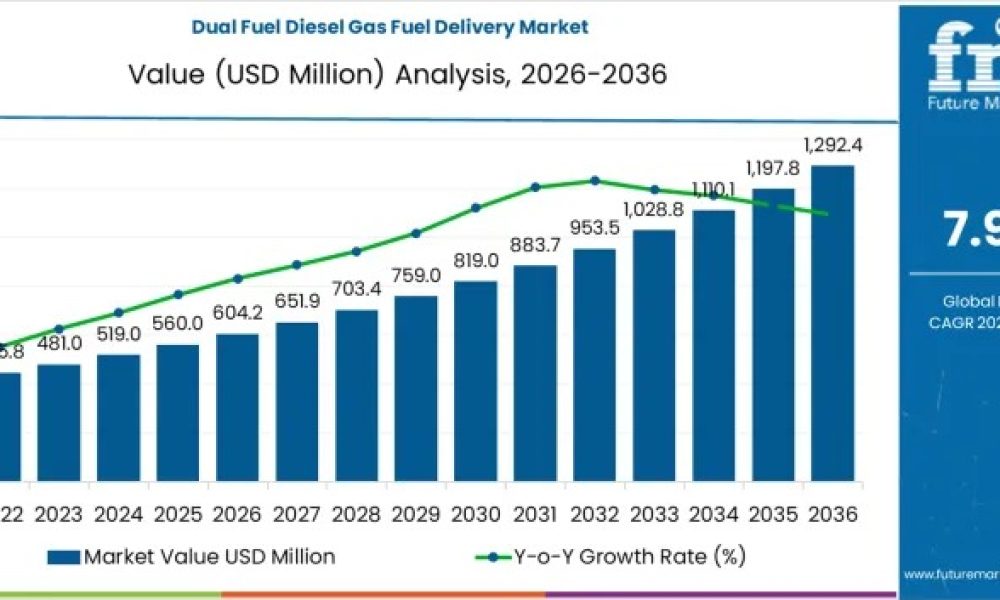
The global dual fuel diesel–gas fuel delivery market is entering a phase of accelerated expansion as commercial and industrial fleets seek practical pathways to reduce emissions while preserving diesel engine performance and operating economics. Valued at USD 604.2 million in 2026, the market is projected to reach USD 1,292.4 million by 2036, registering a robust compound annual growth rate (CAGR) of 7.9%. This growth reflects rising adoption of dual fuel engine architectures that combine diesel with natural gas, supported by tightening emissions regulations, fuel cost volatility, and increasing availability of gas infrastructure across major transport and industrial regions.
Market outcomes are closely tied to concentration in diesel–gas engine programs rather than broad-based engine volume growth. Revenue is increasingly anchored in integration with high-volume OEM platforms and fleet programs where validated performance, regulatory certification, and long-term service capability are critical. Suppliers capable of delivering high-precision, multi-platform fuel delivery systems are securing predictable revenue streams, while smaller or regionally focused players continue to face variability driven by fuel availability, OEM adoption timelines, and compliance complexity.
Growth Outlook Reflects Volume-Led Adoption with Rising Price Contribution
Between 2026 and 2031, the dual fuel diesel–gas fuel delivery market is expected to expand from USD 604.2 million to USD 819.1 million, generating an absolute increase of USD 214.9 million. Approximately 68% of this growth is projected to come from volume expansion as injectors, pumps, rails, and regulators are increasingly deployed across on-road, off-highway, and stationary dual-fuel applications. The remaining 32% of growth is attributed to price realization, supported by higher-pressure compatibility, advanced materials, and OEM line-fit integration.
From 2031 to 2036, growth is forecast to accelerate further, with market value rising from USD 819.1 million to USD 1,292.4 million—an incremental USD 475.7 million. Volume remains the dominant driver at roughly 66%, reflecting broader adoption of dual-fuel engines, fleet expansion, and retrofit activity. Price growth contributes an estimated 34%, driven by premium system calibration, component differentiation, and increased emphasis on durability and certification. Competitive advantage increasingly favors suppliers with scalable manufacturing, proven dual-fuel technologies, and deep OEM partnerships.
Get access to comprehensive data tables and detailed market insights — request your sample report today!
Demand Driven by Emissions Compliance and Fuel Flexibility
Dual fuel diesel–gas fuel delivery systems enable engines to operate on a controlled mixture of diesel and gaseous fuels such as CNG, LNG, or biogas. By partially substituting diesel with gas, operators can reduce greenhouse gas emissions and fuel costs while maintaining the torque and reliability characteristics of diesel engines. Modern systems integrate high-pressure diesel injectors, gas injectors, and electronic control units that precisely manage fuel ratios and combustion timing.
Historically, early adoption was concentrated in stationary engines and heavy industrial applications. Today, demand is expanding rapidly into heavy-duty trucks, buses, marine vessels, and off-highway equipment as OEMs and fleet operators seek solutions that balance regulatory compliance with operational continuity. Reliability, precision, and system validation are key purchasing criteria, concentrating margins among suppliers able to meet stringent performance and certification requirements.
Heavy-Duty Trucks Lead Application Demand
Heavy-duty trucks represent the largest application segment, accounting for approximately 46% of total demand. Long-haul operations, high fuel consumption, and regulatory pressure on emissions make this segment particularly well suited to dual-fuel adoption. Dual fuel delivery systems allow fleets to optimize fuel costs while maintaining engine performance across diverse operating conditions.
These systems must withstand continuous operation, high pressures, and thermal cycling, while integrating seamlessly with engine management systems. The combination of large fleet size, intensive duty cycles, and measurable emissions benefits positions heavy-duty trucks as the primary driver of market growth through 2036.
Diesel + CNG Dominates Fuel Type Mix
By fuel type, diesel combined with compressed natural gas (CNG) accounts for roughly 54% of total market demand. This configuration offers a balance of fuel availability, infrastructure maturity, and emissions reduction benefits. Diesel+CNG systems are widely adopted across commercial trucks, off-highway machinery, and industrial vehicles due to their compatibility with existing engine platforms and reliable performance under variable loads.
Operational advantages include lower carbon intensity, stable combustion, and reduced fuel cost exposure. These benefits, combined with established CNG infrastructure in key regions, reinforce diesel+CNG as the dominant fuel pairing within the dual-fuel ecosystem.
Regional Dynamics Highlight Infrastructure and Policy Alignment
Regional adoption patterns reflect differences in fuel infrastructure, regulatory frameworks, and fleet composition. China leads global growth with a projected CAGR of 10.3%, driven by aggressive emissions targets, expanding natural gas infrastructure, and large-scale adoption of dual-fuel commercial vehicles. Brazil follows closely at 9.9%, supported by strong policy incentives and widespread alternative fuel usage.
The United States is expected to grow at 7.3%, shaped by pilot programs, fleet integration initiatives, and emissions reduction strategies in commercial transport. The United Kingdom records a projected CAGR of 7.1%, reflecting adoption in commercial and industrial vehicles aligned with alternative fuel mandates. Japan’s growth, at 6.1%, is more measured, supported by energy efficiency programs and selective integration in heavy-duty and public transport segments.
Competitive Landscape Defined by Precision and Integration
Competition in the dual fuel diesel–gas fuel delivery market centers on system architecture, control precision, and materials compatibility with mixed fuel environments. Leading players such as Westport Fuel Systems, Cummins, Bosch, Denso, Continental, BorgWarner, Hexagon Agility, Eaton, Parker Hannifin, and Weifu High-Technology differentiate through validated performance, OEM alignment, and long-term service capabilities.
As emissions regulations tighten and fleets seek flexible, lower-carbon solutions without abandoning diesel platforms, dual fuel diesel–gas fuel delivery systems are positioned as a pragmatic bridge technology. Detailed market intelligence on OEM programs, regional policy alignment, technology evolution, and competitive positioning will be critical for stakeholders seeking to capture value in this fast-expanding and increasingly strategic market.
Why Choose FMI: Empowering Decisions that Drive Real-World Outcomes: https://www.futuremarketinsights.com/why-fmi
About Future Market Insights (FMI)
Future Market Insights, Inc. (FMI) is an ESOMAR-certified, ISO 9001:2015 market research and consulting organization, trusted by Fortune 500 clients and global enterprises. With operations in the U.S., UK, India, and Dubai, FMI provides data-backed insights and strategic intelligence across 30+ industries and 1200 markets worldwide.



