

Dry Type Transformer Market Overview
The Dry Type Transformer Market is witnessing significant growth driven by rising electricity demand, industrialization, and renewable energy integration. According to a new report published by Allied Market Research, the global dry type transformer market was valued at $5.4 billion in 2019 and is projected to reach $7.3 billion by 2027, growing at a CAGR of 6.1% from 2020 to 2027.
Download PDF Brochure: https://www.alliedmarketresearch.com/request-sample/952
🌱 What is a Dry Type Transformer?
A dry type transformer is a magnetic core transformer where the windings and core are enclosed in a sealed tank using air as a cooling medium, instead of oil or other liquids typical in traditional transformers. Major technologies for manufacturing dry type transformers include cast resin and vacuum pressure impregnation (VPI).
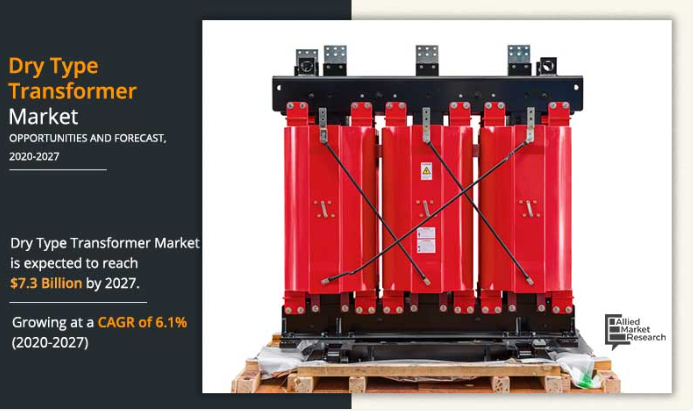
- In cast resin dry type transformers, high-voltage and low-voltage windings are impregnated and encapsulated under vacuum with epoxy resin. This prevents moisture penetration and provides excellent fire protection, making them ideal for indoor installations such as underground and city-building substations.
- The VPI dry type transformers employ vacuum impregnation with polyester or epoxy, followed by baking under pressure cycles, ensuring high mechanical strength and performance under variable loads.
✅ Advantages of Dry Type Transformers
The dry type transformer market is expanding due to several distinct advantages:
- Easy installation and lower maintenance costs.
- High resistance to short circuit currents and capacity to handle overloads.
- Eco-friendly as they use no hydrocarbon liquids.
- Self-extinguishing properties that reduce the need for elaborate civil installation and fire protection systems.
These benefits have increased the adoption of dry type transformers in industrial, commercial, and residential applications. Industries use them for specific voltage requirements and safety against fire and chemical hazards.
⚡ Key Market Drivers
The market growth is driven by:
- Rising electricity consumption globally.
- New civil infrastructure developments.
- Replacement of aging distribution transformers.
- Increasing integration with renewable energy sources and deployment of smart power grids.
The development of electric vehicles (EVs) is further increasing electricity consumption, boosting demand for dry type transformers in the automotive sector. Additionally, the need for efficient power distribution to remote or deficit regions supports the market’s growth.
🌍 Regional Insights
Asia-Pacific led the global dry type transformer market in 2019, accounting for over 41.2% of the market share. Factors contributing to this dominance include:
- Increasing government investments in renewable energy projects.
- Rapid industrialization and urbanization.
- High electricity demand in countries like China and India.
North America is projected to experience the highest growth rate of 6.6% CAGR, driven by strong renewable energy potential and rising electricity demand in the U.S.
🔧 Dry Type Transformer Market Segmentation
- By Type:
The dry type converter transformer segment held the largest share due to its extensive industrial and commercial applications. - By Technology:
The cast resin dry type transformer segment led the market with revenue of $3.7 billion in 2019. Applications include general and public buildings, industrial plants, wind farms, solar farms, LNG vessels, and UPS systems. - By Phase:
The single-phase dry type transformer segment was dominant in 2019, largely used in low voltage distribution. - By Voltage:
The low-voltage dry type transformer segment accounted for the largest share, widely deployed in industrial and commercial buildings. - By End Use:
The industrial sector accounted for the largest revenue share, supporting applications such as auto-transformers, photovoltaic systems, wind power applications, earthing transformers, and traction transformers.
⚡ Impact of COVID-19
The COVID-19 pandemic negatively impacted the dry type transformer market. Industrial sector shutdowns and supply chain disruptions delayed construction and commissioning of renewable electricity projects and biofuel facilities. More than 40% of the solar industry supply chain depends on China and Southeast Asia, which were severely affected by lockdowns, hampering material supply and project timelines.
Enquiry Before Buying: https://www.alliedmarketresearch.com/purchase-enquiry/952
🚀 Innovations & Future Trends
- Solid-State Transformers (SSTs) are emerging as a challenge to traditional dry type transformers. SSTs offer more capabilities, enabling diverse power services (400 Hz, 3-phase power, DC service) through fewer parts, reducing manufacturing and maintenance costs.
- Digital Dry Type Transformers represent an industry advancement, integrating real-time data monitoring via sensor arrays to track transformer performance and improve reliability.
Moreover, 3D core vacuum pressure impregnation technologies are enhancing dry type transformer performance, helping manufacturers address the market’s future energy demands.
The Dry Type Transformer Market is set to witness continuous growth as the world accelerates toward a sustainable energy future. Driven by rising electricity consumption, industrial growth, renewable energy integration, and technology advancements, the market is projected to reach $7.3 billion by 2027, reshaping the global energy infrastructure landscape.
Other Trending Reports:-
About Us
Allied Market Research (AMR) is a full-service market research and business-consulting wing of Allied Analytics LLP based in Portland, Oregon. Allied Market Research provides global enterprises as well as medium and small businesses with unmatched quality of “Market Research Reports” and “Business Intelligence Solutions.” AMR has a targeted view to provide business insights and consulting to assist its clients to make strategic business decisions and achieve sustainable growth in their respective market domain.
Pawan Kumar, the CEO of Allied Market Research, is leading the organization toward providing high-quality data and insights. We are in professional corporate relations with various companies and this helps us in digging out market data that helps us generate accurate research data tables and confirms utmost accuracy in our market forecasting. Each and every data presented in the reports published by us is extracted through primary interviews with top officials from leading companies of domain concerned. Our secondary data procurement methodology includes deep online and offline research and discussion with knowledgeable professionals and analysts in the industry.




